



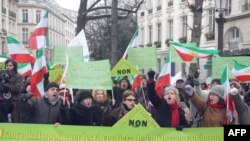
When Iranian foreign policy is mentioned, one image that immediately comes to mind is of the brash rantings of radical fundamentalist President Mahmud Ahmadinejad. But one of Tehran's major foreign-policy priorities that is rarely mentioned publicly is to perpetuate the blacklisting by the West of the principal Iranian opposition force.
European Union officials make no secret of the fact that it was at the request of the Iranian government that they branded the People's Mujahedin Organization of Iran (PMOI, aka Mujahedin-e Khalq Organization) a terrorist organization in 2002. "The Wall Street Journal" reported in October 2008 that Tehran has made securing the blacklisting of the PMOI as a terrorist organization a diplomatic priority.
In a report released in March 2008, the Foreign Affairs Committee of the British Parliament said that member of Parliament (MPs) who visited Iran in November 2007 were struck by the number of times that Iranian officials raised the issue of the PMOI. Those MPs formed the impression that the PMOI had almost become an "obsession." "It was on their program, they wanted us to talk about it, and they raised it in lots of contexts," the report said.
The question thus arises: what is it about the PMOI that Ahmadinejad's regime fears?
The PMOI is unquestionably the best-organized opposition movement to the ayatollahs' regime. Some 4,000 PMOI members, men and women of all ages, are currently based in Camp Ashraf in Iraq. Over the past three decades, Tehran has executed 120,000 of the group's members. A fatwa issued by then-Supreme Leader Ruhollah Khomeini in the summer of 1988 and later made public by his chief deputy led to the execution of over 30,000 political prisoners because of their membership of the PMOI.
Yet despite those reprisals, the group remains the greatest threat to the religious theocracy. In 2002, it was the first to expose Iran's clandestine nuclear weapons program and its uranium-enrichment and heavy-water reactor sites, leading to Tehran's international isolation and three rounds of UN Security Council sanctions.
Domestically, the group is working on university campuses to mobilize antigovernment protests. Iranian state media announced in November the arrest of 20 people in northern Tehran for systematically sending out SMS text messages on mobile phones in support of the group.
The PMOI has also exposed Iranian meddling abroad, thereby undermining Tehran's goal of expanding its influence over its neighbors. Most importantly, however, it is the principal member of the coalition capable of replacing the theocratic dictatorship with a democratic, pluralist republic and a secular government.
A 'Third Option' On Iran
The National Council of Resistance of Iran, the Paris-based parliament-in-exile of which the PMOI is a leading member, rejects both foreign military intervention and continuation of the West's appeasement policy toward the mullahs. Instead, it advocates a "third option," in the form of democratic change brought about by the Iranian people and the organized resistance. Over 70,000 Iranians gathered in Paris in June 2008 to express their support for this "third option."
 PMOI leader Maryam Rajavi has urged an end to the terror listing.Maryam Rajavi, president-elect of the Resistance coalition, has urged European governments and successive U.S. administrations to impose comprehensive sanctions on the regime and at the same time to abandon the one misguided element in the West's policy that has emboldened Tehran to step up repression and terrorism.
For years now, in various European parliaments, Rajavi has urged the European Union and United States to lift the ban on the PMOI. The group found itself on the EU's terrorist list in 2002, one year after the United Kingdom proscribed the group. European and U.S. officials have conceded that the ban was meant to curry favor with the mullahs who rule the world's fourth-largest oil-producing state.
In 2006, however, the European Court of First Instance (CFI) suddenly annulled on procedural grounds the inclusion of the PMOI on the EU blacklist. A year later, the British High Court looked in detail at all the open and closed evidence and ruled that it was "flawed" and "perverse" to label the PMOI as terrorist. That ruling was upheld in May 2008 by the Court of Appeal, headed by the lord chief justice, and the group was de-proscribed in Britain by both Houses of Parliament after a unanimous vote.
Though legally required to lift the ban after the court rulings, the EU Council of Ministers maintained it at France's request. President Nicolas Sarkozy's government even pressured the EU's 27 member states to defy a second European Court ruling in October 2008 annulling the group's terror label.
Then in December, the European Court of First Instance annulled for a third time the EU ban on the PMOI, handing down the fastest-ever verdict in its history, in less than 24 hours.
The CFI judges were quite simply convinced that the EU is acting illegally in banning the group. The court even rejected a request by the EU Council of Ministers and France to maintain the ban until after an eventual appeal. The EU will have to decide by the end of this month whether it will maintain the ban on the group in defiance of seven British and European high-court rulings. And it will be up to the administration of incoming U.S. President Barack Obama to reverse the ban in the United States in light of in-depth court investigations concluding that the group is not involved in terrorism.
If justice and the rule of law mean anything in today's world, the ban on the PMOI will soon be lifted, allowing this powerful opposition force to direct all its resources towards replacing the present regime with a democratic, secular government. It will also send a strong signal to the Iranian people that the international community is no longer prepared to offer support to a regime that oppresses them, and thereby fuel the momentum for change. It is in this context the regime so fears the de-listing of the PMOI.
Hamid Irani is a London-based researcher and expert on Iranian affairs. The views expressed in this commentary are the author's own, and do not necessarily reflect those of RFE/RL
European Union officials make no secret of the fact that it was at the request of the Iranian government that they branded the People's Mujahedin Organization of Iran (PMOI, aka Mujahedin-e Khalq Organization) a terrorist organization in 2002. "The Wall Street Journal" reported in October 2008 that Tehran has made securing the blacklisting of the PMOI as a terrorist organization a diplomatic priority.
In a report released in March 2008, the Foreign Affairs Committee of the British Parliament said that member of Parliament (MPs) who visited Iran in November 2007 were struck by the number of times that Iranian officials raised the issue of the PMOI. Those MPs formed the impression that the PMOI had almost become an "obsession." "It was on their program, they wanted us to talk about it, and they raised it in lots of contexts," the report said.
The question thus arises: what is it about the PMOI that Ahmadinejad's regime fears?
The PMOI is unquestionably the best-organized opposition movement to the ayatollahs' regime. Some 4,000 PMOI members, men and women of all ages, are currently based in Camp Ashraf in Iraq. Over the past three decades, Tehran has executed 120,000 of the group's members. A fatwa issued by then-Supreme Leader Ruhollah Khomeini in the summer of 1988 and later made public by his chief deputy led to the execution of over 30,000 political prisoners because of their membership of the PMOI.
Yet despite those reprisals, the group remains the greatest threat to the religious theocracy. In 2002, it was the first to expose Iran's clandestine nuclear weapons program and its uranium-enrichment and heavy-water reactor sites, leading to Tehran's international isolation and three rounds of UN Security Council sanctions.
Domestically, the group is working on university campuses to mobilize antigovernment protests. Iranian state media announced in November the arrest of 20 people in northern Tehran for systematically sending out SMS text messages on mobile phones in support of the group.
The PMOI has also exposed Iranian meddling abroad, thereby undermining Tehran's goal of expanding its influence over its neighbors. Most importantly, however, it is the principal member of the coalition capable of replacing the theocratic dictatorship with a democratic, pluralist republic and a secular government.
A 'Third Option' On Iran
The National Council of Resistance of Iran, the Paris-based parliament-in-exile of which the PMOI is a leading member, rejects both foreign military intervention and continuation of the West's appeasement policy toward the mullahs. Instead, it advocates a "third option," in the form of democratic change brought about by the Iranian people and the organized resistance. Over 70,000 Iranians gathered in Paris in June 2008 to express their support for this "third option."

For years now, in various European parliaments, Rajavi has urged the European Union and United States to lift the ban on the PMOI. The group found itself on the EU's terrorist list in 2002, one year after the United Kingdom proscribed the group. European and U.S. officials have conceded that the ban was meant to curry favor with the mullahs who rule the world's fourth-largest oil-producing state.
In 2006, however, the European Court of First Instance (CFI) suddenly annulled on procedural grounds the inclusion of the PMOI on the EU blacklist. A year later, the British High Court looked in detail at all the open and closed evidence and ruled that it was "flawed" and "perverse" to label the PMOI as terrorist. That ruling was upheld in May 2008 by the Court of Appeal, headed by the lord chief justice, and the group was de-proscribed in Britain by both Houses of Parliament after a unanimous vote.
Though legally required to lift the ban after the court rulings, the EU Council of Ministers maintained it at France's request. President Nicolas Sarkozy's government even pressured the EU's 27 member states to defy a second European Court ruling in October 2008 annulling the group's terror label.
Then in December, the European Court of First Instance annulled for a third time the EU ban on the PMOI, handing down the fastest-ever verdict in its history, in less than 24 hours.
The CFI judges were quite simply convinced that the EU is acting illegally in banning the group. The court even rejected a request by the EU Council of Ministers and France to maintain the ban until after an eventual appeal. The EU will have to decide by the end of this month whether it will maintain the ban on the group in defiance of seven British and European high-court rulings. And it will be up to the administration of incoming U.S. President Barack Obama to reverse the ban in the United States in light of in-depth court investigations concluding that the group is not involved in terrorism.
If justice and the rule of law mean anything in today's world, the ban on the PMOI will soon be lifted, allowing this powerful opposition force to direct all its resources towards replacing the present regime with a democratic, secular government. It will also send a strong signal to the Iranian people that the international community is no longer prepared to offer support to a regime that oppresses them, and thereby fuel the momentum for change. It is in this context the regime so fears the de-listing of the PMOI.
Hamid Irani is a London-based researcher and expert on Iranian affairs. The views expressed in this commentary are the author's own, and do not necessarily reflect those of RFE/RL