


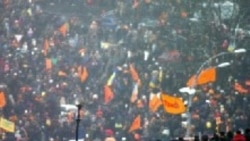
The peaceful rallies led by the OTPOR youth group that overthrew Milosevic in October 2000 had a huge impact in the region.
It showed democratic opposition groups in former Soviet states that it was possible to peacefully change their governments. And it showed Western governments and NGOs that with their financial and technical assistance, they could actually help these groups achieve their goals.
The Belgrade experience inspired the West and the opposition in Belarus, where it failed to win power in 2001, and then in Georgia's successful "Rose Revolution" in 2003.
But advice and funding is one thing -- a successful peaceful revolution is another. OTPOR activist Aleksandar Maric made several trips to Ukraine before the elections.
"If citizens in a respective country are not interested in change, in replacing the authorities in a peaceful, democratic, and lawful way, no one can 'import' revolution from abroad," Maric said.
Maric said that any successful effort requires the will and energy of the local population, who cannot be coerced or bribed into taking to the streets for weeks at a time.
Maric and other OTPOR staffers spent the past two years advising young Ukrainians with a desire for change on building a movement that could succeed at the ballot box. They did not put revolutionary ideas into their heads, he said, but offered organizational tips.
"We trained them in how to set up an organization, how to open local chapters, how to create a 'brand,' how to create a logo, symbols, and key messages," Maric said. "We trained them in how to identify the key weaknesses in society and what people's most pressing problems were -- what might be a motivating factor for people, and above all young people, to go to the ballot box and in this way shape their own destiny."
Indeed, OTPOR's tactics have been replicated not only in Kyiv, but were also visible in Minsk and Tbilisi. They include nonviolent mass protests with humor and irony, a distinct logo and clear demands.
Revolutionary Activism
KMARA, which played a key part in Georgia's uprising, has also run seminars for the Ukrainian opposition.
But an activist with the group, who asked not to be named for fear of retribution during the closing days of the Ukrainian election campaign, dismissed any talk that the Rose Revolution was all part of a Western plot.
In an interview from Tbilisi, he said KMARA received only limited advice from the Belgrade revolutionaries.
"[The OTPOR activists] came here two times," Georgian said. "We had summer camps for activists and they just told the story of how they did it and we made our own conclusions. Actually, there was a very comprehensive training planned later on but then the revolution happened and it never took place."
The KMARA activist insists that Georgia's revolution succeeded -- like its Ukrainian counterpart -- because it was homegrown and carried out by people determined to reclaim their government from corrupt elites.
"Actually, we had a great disillusionment in Western involvement after the elections in Azerbaijan," said one Georgian analyst. "Elections in Azerbaijan took place in October, if you remember, of 2003. And there also mass fraud took place and power was transferred from father to son and the country moved to feudalism. And Western reaction was completely shameful, I would say, with a really shameful report from the OSCE. And some observers from East European countries even staged protests in Warsaw, if you remember. So then it became clear for us that any outcome [in Georgia] would be acceptable for the West. Yes, relations would be cooler between [former Georgian President Eduard] Shevardnadze and the West but they would still shake hands. So we told ourselves either we do this or [nothing is going to change.]"
To be sure, Western governments, often working through NGOs, have for years funded democracy-building initiatives across Eastern Europe. Officially, the U.S. government spent $41 million organizing and funding the yearlong drive to oust Milosevic.
And this month, the U.S. administration revealed that it had spent $65 million over the past two years on such efforts in Ukraine. The money went to local groups involved in a range of activities -- from education and legal reform to electoral monitoring.
The U.S. State Department said the money was not distributed directly to parties, nor was it meant to favor any one side.
Funding Ideas
Patrick Merloe, the director of election programs for the U.S.-based National Democratic Institute (NDI), which receives U.S. funds, said that the "NDI has conducted programs in Ukraine since 1992. All of the institute's programs are aimed towards helping Ukrainians build a democratic political process. It is not aimed at achieving any specific electoral outcome." As an example, he said, "NDI has supported the work of Ukraine's largest domestic nonpartisan monitoring organization, the Committee of Voters of Ukraine, since 1994 and through this very moment. The institute also has offered technical assistance to all of the political parties and blocs in Ukraine, to help them to build political party structures, to reach out to citizens, develop legislative agendas, consider coalition-building and particularly in this recent period, to monitor and help improve the integrity of the election process."
But there's more to revolutions than just money, said American political scientist Gene Sharp. For example, there are ideas.
Sharp's 1993 book "From Dictatorship To Democracy: A Conceptual Framework For Liberation" is a how-to manual offering practical advice on how to organize a nonviolent movement, what to focus on, when to be stubborn, and when to negotiate with authorities.
Although originally conceived for the Burmese opposition, the book was distributed in Serbia by an American NGO during the last days of the Milosevic regime.
Sharp said the concepts underpinning his book -- about democracy and the rights of the individual -- have been around for a long time, emanating from 18th century French and English philosophers. Leaders ranging from Mahatma Gandhi to Martin Luther King Jr. have used those concepts, underpinned by nonviolent protest, to achieve revolutionary goals.
The main ingredient, he said, is not money but a change in mindset.
"It's a very fundamental conceptual shift, from thinking that the government is all-powerful, that it can do everything it wants to do, to realizing that in fact it depends of sources [of power] and is therefore vulnerable to the shrinking or the cutting off of those sources of power," Sharp said.
Conspiracy Theories
Unlike other groups, Sharp and the Albert Einstein Institution -- the think-tank he founded in 1993 -- receive no U.S. government money. He laughs at the conspiracy theorists in Moscow and Kyiv.
"They always have some plausible explanation as to why ordinary people, using their heads, could not possibly have accomplished this," Sharp said. "Back in the days of Gandhi's struggle in India, they could only do that supposedly because the English were all gentlemen. Which is utter nonsense. The English machine-gunned hundreds of people at a time on occasion in India. And in other situations there's been some 'explanation.' We've had no contact with the CIA. We have no U.S. government funding. We barely scrape by to continue in existence, we have so little money."
Critics in former Soviet countries, including Russian President Vladimir Putin, accuse the West of meddling in Ukraine's affairs.
But critics in the West accuse Russia of doing far more than that.
Taras Kuzio, a Ukraine specialist at George Washington University in Washington, said that the major effort to influence the Ukrainian elections was run out of Moscow -- not Washington or Belgrade.
"All of the funds given by the United States government through think tanks like Freedom House or USAID, or the National Democratic Institute and the International Republican Institute -- all of that is done transparently," Kuzio said. "Reports are published publicly and everything is noted as to exactly how the money is spent and who it's given to. With the case of the [Viktor] Yanukovych campaign, together with Russia's backing of it, there's no transparency at all, so all we can have ever are estimates. And the estimates, which I think are quite credible, by people like the Carnegie Endowment in Washington, are that the Yanukovych campaign spent -- in addition to what he legally declared to the Central Election Commission -- an additional $6 billion, half of which came from Russian companies such as Gazprom."
Russia's ambassador to Ukraine is former Gazprom Chairman Viktor Chernomyrdin. Putin twice visited Ukraine during the election campaign, speaking live to Ukrainian voters on state television on one occasion, praising Yanukovych's management abilities.
(RFE/RL correspondent Andrew Tully in Washington and Dragan Stavljanin of RFE/RL's South Slavic service contributed to this report)
It showed democratic opposition groups in former Soviet states that it was possible to peacefully change their governments. And it showed Western governments and NGOs that with their financial and technical assistance, they could actually help these groups achieve their goals.
The Belgrade experience inspired the West and the opposition in Belarus, where it failed to win power in 2001, and then in Georgia's successful "Rose Revolution" in 2003.
But advice and funding is one thing -- a successful peaceful revolution is another. OTPOR activist Aleksandar Maric made several trips to Ukraine before the elections.
"If citizens in a respective country are not interested in change, in replacing the authorities in a peaceful, democratic, and lawful way, no one can 'import' revolution from abroad," Maric said.
Maric said that any successful effort requires the will and energy of the local population, who cannot be coerced or bribed into taking to the streets for weeks at a time.
Maric and other OTPOR staffers spent the past two years advising young Ukrainians with a desire for change on building a movement that could succeed at the ballot box. They did not put revolutionary ideas into their heads, he said, but offered organizational tips.
"We trained them in how to set up an organization, how to open local chapters, how to create a 'brand,' how to create a logo, symbols, and key messages," Maric said. "We trained them in how to identify the key weaknesses in society and what people's most pressing problems were -- what might be a motivating factor for people, and above all young people, to go to the ballot box and in this way shape their own destiny."
Indeed, OTPOR's tactics have been replicated not only in Kyiv, but were also visible in Minsk and Tbilisi. They include nonviolent mass protests with humor and irony, a distinct logo and clear demands.
Revolutionary Activism
KMARA, which played a key part in Georgia's uprising, has also run seminars for the Ukrainian opposition.
But an activist with the group, who asked not to be named for fear of retribution during the closing days of the Ukrainian election campaign, dismissed any talk that the Rose Revolution was all part of a Western plot.
In an interview from Tbilisi, he said KMARA received only limited advice from the Belgrade revolutionaries.
"[The OTPOR activists] came here two times," Georgian said. "We had summer camps for activists and they just told the story of how they did it and we made our own conclusions. Actually, there was a very comprehensive training planned later on but then the revolution happened and it never took place."
"The main ingredient is not money but a change in mindset."
The KMARA activist insists that Georgia's revolution succeeded -- like its Ukrainian counterpart -- because it was homegrown and carried out by people determined to reclaim their government from corrupt elites.
"Actually, we had a great disillusionment in Western involvement after the elections in Azerbaijan," said one Georgian analyst. "Elections in Azerbaijan took place in October, if you remember, of 2003. And there also mass fraud took place and power was transferred from father to son and the country moved to feudalism. And Western reaction was completely shameful, I would say, with a really shameful report from the OSCE. And some observers from East European countries even staged protests in Warsaw, if you remember. So then it became clear for us that any outcome [in Georgia] would be acceptable for the West. Yes, relations would be cooler between [former Georgian President Eduard] Shevardnadze and the West but they would still shake hands. So we told ourselves either we do this or [nothing is going to change.]"
To be sure, Western governments, often working through NGOs, have for years funded democracy-building initiatives across Eastern Europe. Officially, the U.S. government spent $41 million organizing and funding the yearlong drive to oust Milosevic.
And this month, the U.S. administration revealed that it had spent $65 million over the past two years on such efforts in Ukraine. The money went to local groups involved in a range of activities -- from education and legal reform to electoral monitoring.
The U.S. State Department said the money was not distributed directly to parties, nor was it meant to favor any one side.
Funding Ideas
Patrick Merloe, the director of election programs for the U.S.-based National Democratic Institute (NDI), which receives U.S. funds, said that the "NDI has conducted programs in Ukraine since 1992. All of the institute's programs are aimed towards helping Ukrainians build a democratic political process. It is not aimed at achieving any specific electoral outcome." As an example, he said, "NDI has supported the work of Ukraine's largest domestic nonpartisan monitoring organization, the Committee of Voters of Ukraine, since 1994 and through this very moment. The institute also has offered technical assistance to all of the political parties and blocs in Ukraine, to help them to build political party structures, to reach out to citizens, develop legislative agendas, consider coalition-building and particularly in this recent period, to monitor and help improve the integrity of the election process."
But there's more to revolutions than just money, said American political scientist Gene Sharp. For example, there are ideas.
Sharp's 1993 book "From Dictatorship To Democracy: A Conceptual Framework For Liberation" is a how-to manual offering practical advice on how to organize a nonviolent movement, what to focus on, when to be stubborn, and when to negotiate with authorities.
Although originally conceived for the Burmese opposition, the book was distributed in Serbia by an American NGO during the last days of the Milosevic regime.
Sharp said the concepts underpinning his book -- about democracy and the rights of the individual -- have been around for a long time, emanating from 18th century French and English philosophers. Leaders ranging from Mahatma Gandhi to Martin Luther King Jr. have used those concepts, underpinned by nonviolent protest, to achieve revolutionary goals.
The main ingredient, he said, is not money but a change in mindset.
"It's a very fundamental conceptual shift, from thinking that the government is all-powerful, that it can do everything it wants to do, to realizing that in fact it depends of sources [of power] and is therefore vulnerable to the shrinking or the cutting off of those sources of power," Sharp said.
Conspiracy Theories
Unlike other groups, Sharp and the Albert Einstein Institution -- the think-tank he founded in 1993 -- receive no U.S. government money. He laughs at the conspiracy theorists in Moscow and Kyiv.
"They always have some plausible explanation as to why ordinary people, using their heads, could not possibly have accomplished this," Sharp said. "Back in the days of Gandhi's struggle in India, they could only do that supposedly because the English were all gentlemen. Which is utter nonsense. The English machine-gunned hundreds of people at a time on occasion in India. And in other situations there's been some 'explanation.' We've had no contact with the CIA. We have no U.S. government funding. We barely scrape by to continue in existence, we have so little money."
Critics in former Soviet countries, including Russian President Vladimir Putin, accuse the West of meddling in Ukraine's affairs.
But critics in the West accuse Russia of doing far more than that.
Taras Kuzio, a Ukraine specialist at George Washington University in Washington, said that the major effort to influence the Ukrainian elections was run out of Moscow -- not Washington or Belgrade.
"All of the funds given by the United States government through think tanks like Freedom House or USAID, or the National Democratic Institute and the International Republican Institute -- all of that is done transparently," Kuzio said. "Reports are published publicly and everything is noted as to exactly how the money is spent and who it's given to. With the case of the [Viktor] Yanukovych campaign, together with Russia's backing of it, there's no transparency at all, so all we can have ever are estimates. And the estimates, which I think are quite credible, by people like the Carnegie Endowment in Washington, are that the Yanukovych campaign spent -- in addition to what he legally declared to the Central Election Commission -- an additional $6 billion, half of which came from Russian companies such as Gazprom."
Russia's ambassador to Ukraine is former Gazprom Chairman Viktor Chernomyrdin. Putin twice visited Ukraine during the election campaign, speaking live to Ukrainian voters on state television on one occasion, praising Yanukovych's management abilities.
(RFE/RL correspondent Andrew Tully in Washington and Dragan Stavljanin of RFE/RL's South Slavic service contributed to this report)