



Iran
Iran: Government Report Acknowledges Torture In Prisons

Exiled Iranians in Germany demonstrating this month against execution and torture in Iran Iran's hard-line judiciary has acknowledged in an unprecedented report that human-rights abuses, including torture, have taken place in prisons. The report says prisoners were sometimes detained over a long period of time without trial. They were blindfolded, beaten, and held in solitary confinement. The head of Tehran's justice department, Hojatoleslam Abbasali Alizadeh, says steps have been taken and that "these failings have now disappeared."
The report says a legal order banning torture had been ignored. It says arrests were made without sufficient evidence. In some cases suspects were held in undeclared detention centers.
It highlights the case of a 13-year-old boy who was held for a week in a detention center for stealing a hen. It also highlights the case of a 73-old-year woman who was held in prison for four months because she had no money. The report says the judiciary discovered a man who had been in prison more than 15 years without ever having a verdict issued against him.
But now judiciary officials say real reforms have been achieved and the problems have been removed. Hojatoleslam Abbasali Alizadeh says Iran's prisons are now among the best in the world.
Some observers remain skeptical.
Hassan Zarezadeh is in charge of the Student Committee In Defense Of Political Prisoners In Iran. He says the hard-line judiciary is trying to portray itself in a better light.
"[The report] shows that the regime wants to demonstrate that there have been real reforms in the judiciary and that they are committed to human rights," Zarezadeh told RFE/RL. "But their comments about torture being eradicated can be challenged because why are [prisoners] still being held in solitary confinement for long periods while facing complicated interrogations? Isn't it torture? Last week Behrouz Javid Tehrani, a member of the Democratic Party of Iran who has been held in solitary confinement for the last three months, managed to tell his relatives during a visit that he was severely beaten in prison."
Zarezadeh, who has been arrested several times in recent years, says he has witnessed the ill treatment of prisoners. "It includes long solitary confinements, hanging suspects [from the ceiling], handcuffing behind the back, beating, hitting the head of suspects to the wall and also psychological torture," he said.
Mohammad Ali Dadkhah is the spokesperson of the Center of Human Rights Defendants, founded by Nobel Peace Prize Laureate Shirin Ebadi. He says he too believes prisoners' rights are still being violated.
"The bitter reality is that these incidents have existed in our prisons. For example, when I was detained in Evin prison, I was once stripped naked in the snow," Dadkhah said. "I think illegal actions are still widespread in the prisons. As I speak to you, [jailed investigative journalist] Akbar Ganji has not the right to meet his lawyer."
Iranian authorities have in the past denied the mistreatment of prisoners and the use of torture. But human rights organizations have repeatedly said that torture is prevalent in prisons.
Several political prisoners including student activists and journalists have said that they were forced into false confessions under duress. Many have say they have been denied access to relatives and lawyers.
Last year the head of Iran's judiciary, Ayatollah Mahmud Hashemi-Shahrudi, ordered a ban on torture for obtaining confessions. The move was considered a tacit acknowledgement that torture was used in the Islamic Republic.
The Iranian government has welcomed the judiciary report.
But Zarezadeh expresses doubt the report will have real consequences.
"If the Islamic Republic has been forced into a retreat under protests from inside the country and international pressure, it does not mean that torture does not exist, that solitary confinement [will] be eradicated, that all the political prisoners [will] be freed and that other prisoners [will] be treated humanely," Zarezadeh said.
The use of torture in some of Iran's prisons was highlighted by the case of Zahra Kazemi, an Iranian-Canadian photojournalist who died in 2003 after being detained in front of Tehran's notorious Evin prison. According to a government investigation she was struck on the head during interrogations.
See also:
Political Crisis Grows Over Death Of Canadian Photojournalist
Nobel Peace Laureate To Represent Family Of Slain Photojournalist
Iranian Dissident's Health Reportedly Worsening
Concern Grows Over Fate Of Jailed Iranian Journalist
More News
Iran Homing In On Africa With Trade Promises, Chaos
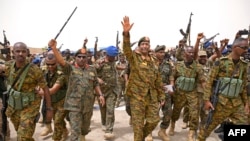
Iran is expanding its footprint in Africa, offering arms, partnerships, and chaos as it works to boost its influence on the continent.
It is part of a major strategic shift that has involved high-level Iranian diplomatic and trade delegations as well as weapons deliveries to Africa.
In return, experts say, Iran hopes to build partnerships that will help it bypass international sanctions while carving out new ground for its "axis of resistance" against its global and regional adversaries.
"Iran has been seeking to expand its political and economic reach further beyond its region," said Lukas Webber, senior consultant for Valens Global and co-founder of Militant Wire. And due to Western sanctions, Webber said, "Iran has extra incentive to pursue new trade opportunities with African countries."
Iranian officials have lauded the potential to gain access to Africa's agricultural and mineral wealth while finding new destinations for Iranian exports, including sophisticated weapons. President Ebrahim Raisi, underscoring the importance of the strategy, made a three-country tour to Africa in July -- the first by an Iranian president to the continent in more than a decade.

This week, Iran is touting the second Iran-Africa trade summit in just over a year, with representatives from more than 40 African countries expected for the April 26-29 event in Tehran.
An Iranian official responsible for the promotion of international business said this week that "the future of world trade will be determined in Africa." And unlike with other major powers that have sought to tap into Africa's "unexploited virgin resources," he said, African countries do not have "political angles" with Iran.
But Iran's engagement in Africa -- marked by efforts to export Tehran's version of political Islam, the establishment of proxies, and weapons supplies to both states and nonstate actors -- often coincides with instability and anti-Western sentiment, fitting in with Iran's broader aims.
"Iran is advancing its multipronged global 'resistance' strategy in Africa, whereby it seeks to secure partnerships that offset Western influence and isolation of Iran," said Liam Karr, an analyst with the American Enterprise Institute's Critical Threats Project.
In recent months, Iran has made its presence felt from the Horn of Africa to the Sahel, allowing it to put more pressure on regional adversaries and to attempt to derail Israel's offensive in the Gaza Strip.

With Iranian-backed Huthi rebels in Yemen wreaking havoc on international shipping in solidarity with the Palestinian cause, Tehran has solidified its position across the Bab al-Mandel Strait, a narrow passage to the Red Sea.
Iran's "expanded supply of weapons and ammunition to various regional markets" is evident in the Horn of Africa, Webber said, with Somalia serving as a hub. Iran has also provided the Ethiopian government with weapons to fight opposition armed groups.
With Tehran's strained relations with rival Saudi Arabia restored in early 2023, normalized ties with Horn countries have followed. In September, Iran reestablished relations with Djibouti, which cut ties with Iran seven years ago at Riyadh's urging.
Tehran has also worked to patch things up with Eritrea and Sudan, which fell out with Iran after joining a Saudi-led coalition against the Huthis.
Iranian weapons sales to Sudan's armed forces, which are fighting a civil war against rebels, have recently allowed the military to reverse losses and regain territory.
They have also provided Iran with an opening.
In March, Iran reportedly sought permission to establish a permanent naval base in Port Sudan, which serves as the military's de facto capital. The request was refused, and denied by Iran, but exposed Tehran's efforts to extend its presence along the western banks of the Red Sea.
"An Iranian naval base at Port Sudan would directly support Iranian out-of-area naval operations and attacks on international shipping," while allowing Tehran to counter regional rivals, Karr said.
From Sudan, Iran has carved out a sphere of influence that extends across the Sahel to the Atlantic, an area the West fears could become a refuge for Islamist militants.
Karr said Iran's efforts have been most successful in Nigeria, where Tehran has established a proxy group called the Islamic Movement of Nigeria that "functions like other [Iranian] proxies insofar as Lebanese Hizballah and the Iranian regime have provided financial, military, and political support."
Iran has also seized on the opportunity to reach out to a trio of anti-Western military juntas that have taken power in Burkina Faso, Mali, and Niger, which Karr said fits Tehran's broader efforts "to increase economic engagement to undermine Western sanctions."
There are also indications that Iran is seeking to capitalize on recent rifts between junta leaders and Western countries, whose forces are being pushed out.
"With the military withdrawals and declining French influence in West Africa, for instance, Iran has sought to increase its influence through security cooperation and infrastructure development projects," Webber said.
Iran has also said international security cooperation is needed in the fight against terrorism in Africa, suggesting it could help fill a role previously played by Western forces.
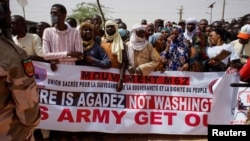
Since the Niger junta seized power in July, leading to the withdrawal of French and European forces from the region, its budding relationship with Iran has not gone unnoticed.
A U.S. delegation traveled to the country last month to express concerns about Niger's relations with Iran and its ally Russia, which is also expanding its influence in Africa.
Shortly after the visit, Niger terminated its counterterrorism alliance with Washington, reportedly after the U.S. officials accused the military junta of exploring a secret deal that would provide Iran access to its uranium reserves.
The ruling junta, which has called the U.S. military presence in Niger "illegal," rejected the allegations. Last week, the United States announced plans to withdraw 1,000 military personnel in what was seen as a victory for Iran's and Russia's aims in the region.
Sister Of Iranian Teen Killed In Anti-Government Protests Released From Prison
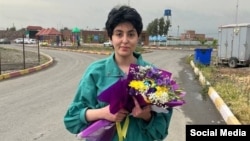
The sister of a 16-year-old killed in 2022 in anti-government protests has been freed from an Iranian jail. Aida Shakarami, sister of Nika Shakarami, was released on April 23 after about a week of detention for violating Iran’s hijab law. Shakarami was arrested by the morality police during the government's attempt to reimpose the compulsory head scarf. Nasrin Shakarami, the mother of Nika and Aida, said the judge in the case had insulted and threatened her daughter, including accusations of promoting corruption and prostitution. Pictures of Aida Shakarami on social media after her release showed her without a hijab. To read the original story by RFE/RL's Radio Farda, click here.
Iranian Cartoonist Arrested By Revolutionary Guards


Prominent Iranian cartoonist Atena Farghadani has been detained by the Revolutionary Guards (IRGC) after attempting to post her work on a wall near the presidential palace in Tehran, multiple sources in Iran have told Radio Free Europe/Radio Liberty (RFE/RL).
- By RFE/RL
U.S. Report Highlights Worsening Human Rights Abuses In Russia, Iran, Afghanistan
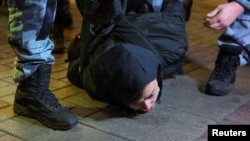
Russia has continued to show blatant disregard for human rights both in its unprovoked war against Ukraine and in the treatment of its own citizens over the past year, the U.S. State Department has said in its latest annual report on human rights around the globe, which also highlights the abuses committed by Iran's theocratic regime and the Taliban's mistreatment of Afghans -- especially its discrimination against women and girls.
Russian troops continued to commit numerous abuses and atrocities, some amounting to war crimes, the report says, highlighting the issuance by the International Criminal Court of arrest warrants for Russian President Vladimir Putin and his children's rights commissioner, Maria Lvova-Belova, for their role in the forced deportation of Ukrainian children to Russia.
"There were credible reports of summary execution, torture, rape, and attacks killing and injuring civilians and damaging or destroying civilian infrastructure by Russia's forces in Ukraine, as well as war crimes, including those involving forced deportation or transfer of civilians, and the forced placement in foster care or adoption of Ukrainian children," the report notes.
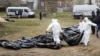
At home, Russian authorities continued to step up the pressure on dissent and independent expression, imprisoning political opponents and anti-war protesters, clamping down on the media, prosecuting numerous people for expressing their opinions online, and forcibly closing down nongovernmental organizations.
More moves were made to persecute opposition politicians such as the sentencing of Vladimir Kara-Murza to 25 years in prison on charges including treason and the slapping of an extra 19 years for "extremism" on the already imprisoned Aleksei Navalny, who subsequently died under suspicious circumstances in February in a penitentiary in Russia's Arctic region.
"Tragically, as we saw with Aleksei Navalny's unjust imprisonment in a Russian penal colony, incarceration can come with horrific conditions -- with abuse, even death," Secretary of State Antony Blinken said on April 22 while presenting the report.

The report also highlights a multitude of other human rights abuses committed by Russian authorities on Russia's territory and abroad, such as, but not limited to, arbitrary or unlawful killings, including extrajudicial killings; enforced disappearances; pervasive torture or cruel, inhuman, or degrading treatment by the government; harsh and life-threatening prison conditions; arbitrary arrest or detention; and serious problems with the independence of the judiciary.
Harsh Punishments Meted Out In Iran
Brutal human rights abuses continue to take place and even worsen in Iran, where women and members of marginalized communities bear the brunt of the regime's human rights violations and abuses, the report says, highlighting the harsh punishment meted out to prisoners, including executions, for bogus or unjust reasons.
"Women continued to face discrimination, including through enhanced means for enforcing the mandatory dress code, which led to acts of civil disobedience," the report says, adding that many people have reportedly disappeared during extended protests that were triggered by the death of 22-year-old Mahsa Amini in the custody of morality police in September 2022.
The number of executions was up by more than one-third last year compared to 2022, with 798 people being put to death, some of them political dissidents.

"The government often charged political dissidents with vague crimes, some of which carried the death penalty, such as 'antirevolutionary behavior,' 'corruption on earth,' 'siding with global arrogance,' 'waging war against God,' and 'crimes against Islam,'" the report notes.
The Iranian regime is also guilty of serious violations outside its borders, which include enabling abuses by terrorist groups throughout the region by the Syrian government, Iran-aligned militia groups in Iraq, and Yemeni Huthi militants, as well as the unlawful recruitment or use of child soldiers, the document said.
Systemic Mistreatment, Discrimination In Afghanistan
In Afghanistan, the Taliban has resorted to systemic mistreatment of and discrimination against Afghanistan’s women and girls since it returned to power in August 2021 following the hasty withdrawal of U.S.-led forces.
"In Afghanistan, the Taliban have limited work opportunities for women, shuttered institutions found educating girls, and increasing floggings for women and men accused of, quote, 'immoral behavior,' end quote," Blinken said.
The report says Taliban authorities have issued more than 50 pieces of legislation "that effectively erase women from public life."
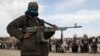
The Taliban authorities have shown continuous and widespread "disregard for the rule of law and official impunity for those responsible for human rights abuses," the document says, adding that both the Taliban and their current arch-foe, the Islamic State group, have been using child soldiers.
Referring to the ongoing war in Gaza that was triggered by an October 7 attack on Israel by Hamas, which has been designated a terrorist organization by the United States and the European Union, the report notes "serious abuses...by Hamas and Israel."
It says those abuses include unlawful or widespread civilian deaths and harm, enforced disappearances or abductions, torture, as well as "violence or threats against journalists."
Iranian Rapper's Death Sentence Changed To 5 Years In Prison

Iranian dissident rapper Saman Yasin, who was detained during nationwide protests in 2022, has been sentenced to five years in prison, according to a verdict obtained by RFE/RL’s Radio Farda.
In sentencing Yasin, Branch 15 of Tehran's Islamic Revolutionary Court said Yasin will serve the punishment at a prison in the city of Kerman, as dictated by a fatwa from the Islamic republic's leader that bars Yasin from associating with others. Yasin is from the northwestern Kurdish region of Iran, while Kerman is located near the southeastern part of the country.
Legal sources noted that Yasin, who was involved in the "Women, Life, Freedom" protests sparked by the death of a young woman in police custody for an alleged head-scarf violation, was initially sentenced to death, but that sentence was overturned by the Supreme Court.
Hossein Sartipi, Yasin’s lawyer, confirmed on social media platform X (formerly Twitter) that the sentence had been changed, remarking, "Saman Yasin was saved from execution."
Yasin has been in temporary detention for over 18 months. Sartipi said he plans to appeal the latest sentence.
The 25-year-old rapper recently made a plea from prison to the judiciary to "issue my death sentence" rather than continue holding him indefinitely without a trial after multiple court dates were set and then delayed.
Yasin described enduring a "mock execution" set up by prison officials before being moved to a prison in Karaj.
He has consistently maintained his innocence, releasing multiple audio recordings to publicize his claims. He has also reportedly launched at least one hunger strike in protest.
After the September 2022 death of Mahsa Amini in custody after she was detained for allegedly wearing her head scarf improperly, Iranians took to the streets across the country to protest a lack of rights, with women and schoolgirls making unprecedented shows of support in the biggest threat to the Islamic government since the 1979 revolution.
The judiciary, at the urging of lawmakers, has instituted harsh penalties, including the death sentence, for offenders.
Written by Ardeshir Tayebi based on an original story in Persian by RFE/RL's Radio Farda
In Sign Of Thawing Relations With Saudis, Iranian Pilgrims Leave For Mecca
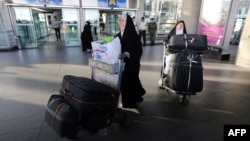
For the first time in nine years, a group of Iranian pilgrims has arrived in Saudi Arabia to perform the Umrah pilgrimage to Mecca, a sign of thawing relations between Tehran and Riyadh.
The arrival follows a restoration of full diplomatic ties in March 2023, which was mediated by China after a rift sparked by the 2016 execution of a Shi'ite cleric by Saudi Arabia and subsequent attacks on the Saudi Embassy in Tehran.
Diplomatic efforts, including a significant meeting in Beijing between Ali Shamkhani, the former secretary of the Supreme National Security Council of Iran, and a visit by Iranian President Ebrahim Raisi to Saudi Arabia, resulted in the lifting of restrictions on Iranian pilgrims. However, the resumption of flights from Iran to Saudi Arabia was delayed over technical issues, keeping pilgrims from making the trip until this year.
Muslims around the world pray toward the Kaaba, which is located in the Grand Mosque in Mecca, and pilgrims walk around it seven times.
Unlike the haj, which is compulsory and subject to strict annual quotas, the Umrah can be performed at any time of the year and is not deemed compulsory.
A ceremony held at Tehran’s main airport on April 22 -- coinciding with an announcement from Iran Air that it would operate two daily flights carrying up to 260 pilgrims between various cities in Iran and Saudia Arabia -- was attended by Saudi Ambassador to Iran Abdullah bin Saud al-Anzi, marking a significant step toward increased cooperation between the two Middle Eastern powers.
Written by Ardeshir Tayebi based on an original story in Persian by RFE/RL's Radio Farda
- By Reuters
EU Ministers Agree To Expand Iran Sanctions

EU foreign ministers agreed in principle on April 22 to expand sanctions on Iran following Tehran's missile and drone attack on Israel, the bloc's foreign policy chief, Josep Borrell, said. The European Union already has multiple sanctions programs against Iran, for the proliferation of weapons of mass destruction, human rights abuses and supplying drones to Russia. But several EU countries had called for widening the drone-related sanctions regime to cover missiles and transfers to proxy forces.
- By RFE/RL
Iran, Pakistan Hold First Talks Since Cross-Border Strikes
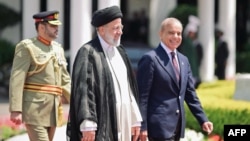
Iranian President Ebrahim Raisi held talks with Pakistani Prime Minister Shehbaz Sharif on April 22 in Islamabad in their first meeting since their countries exchanged missile strikes in February.
Raisi’s three-day trip to neighboring Pakistan is part of efforts by both countries to mend relations that were strained earlier this year.
Iran and Pakistan share a porous 900-kilometer border where separatists opposed to the governments in Tehran and Pakistan operate.
In February, Iran struck what it described as bases used by Iranian Baluch separatists in Pakistan. Islamabad responded by targeting locations in Iran it said were used by Pakistani Baluch separatists.
The Iranian president was greeted at the airport by Housing Minister Riaz Hussain Pirzada before receiving a formal welcome from Sharif.
Authorities have deployed hundreds of additional police and paramilitary forces to ensure security during the visit as Pakistan has witnessed a surge in militant violence.
According to a statement released by the premier’s office, Sharif and Raisi discussed a range of issues to promote bilateral relations and cooperation in various fields and vowed to cooperate to fight terrorism.
They are also expected to hold a joint news conference later on April 22.
Iran’s official news agency IRNA said eight cooperation documents will be signed during Raisi’s visit.
The two sides will also discuss a multibillion gas pipeline project, which has been on hold since 2014. The project -- opposed by Washington for what it says is a violation of sanctions imposed on Tehran over its nuclear program -- was launched in 2013 to supply much-needed Iranian natural gas to energy-starved Pakistan.
Raisi is accompanied by his wife and a high-level delegation. He plans to visit Karachi, the country's biggest city, and Lahore, where he will meet with the Pakistan's recently elected first female chief minister Maryam Nawaz Sharif.
Raisi will travel to Sri Lanka after wrapping up his Pakistan visit.
With reporting by AP
Khamenei Thanks Troops After Iran, Israel Appear To Downplay Risk Of Wider Conflict
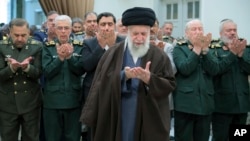
Supreme Leader Ayatollah Ali Khamenei has publicly expressed gratitude to Iran's armed forces one week after they targeted Israel with more than 300 missiles and drones in response to Israel's suspected bombing of Iran's embassy compound in Damascus.
The comments follow Tehran's seemingly measured response to images from April 19 showing the fiery results of what was thought to be an Israeli retaliatory attack near the Iranian city of Isfahan.
Observers suggested the absence of more threats from Iranian officials looked like an attempt to avert a broader conflict.
"How many missiles were launched and how many of them hit their target is not the primary question. What really matters is that Iran demonstrated its willpower during that operation," Khamenei said on April 21, according to official media.
But he encouraged Iran's military to "ceaselessly pursue military innovation and learn the enemy's tactics."

April 19 marked the 85th birthday of Khamenei, who holds final say on religious and political affairs in Iran.
Iranian state media quoted officials in Tehran as saying the explosions were caused by air-defense systems that shot down three drones.
Israel has not commented on the report.
Reuters, citing three sources familiar with the matter, reported that Israeli Prime Minister Benjamin Netanyahu's war cabinet initially approved plans for a strike inside Iranian territory to respond forcefully to Tehran's April 14 missile and drone strike but backed off at the last minute.
The Reuters report said Netanyahu faced cabinet divisions and strong warnings from allies -- including Washington -- not to escalate matters, leading to two postponements of the limited strikes that eventually were launched.
Speaking at a mosque on April 19, President Ebrahim Raisi didn't mention the attack near Isfahan.

Tehran launched more than 300 drones and missiles at Israel in the early morning hours of April 14, almost all of which were shot down by Israeli defense systems, along with intercepts by forces from the United States, France, Britain, and Jordan.
The attack by Tehran had been widely anticipated in Israel following a suspected Israeli air strike on the Iranian Embassy compound in Syria on April 1 that killed two brigadier generals.
Since then, diplomats and politicians around the world, fearing another major escalation of fighting in the Middle East, had urged restraint as they awaited Israel's response.
U.S. President Joe Biden has not made any statement about the alleged Israeli attack.
The International Atomic Energy Agency (IAEA) said it had seen no damage to Iran's nuclear sites. One of Iran’s top nuclear facilities, the installation at Natanz, is located in central Isfahan. "IAEA can confirm that there is no damage to Iran’s nuclear sites," the UN nuclear watchdog said in a post on X, formerly Twitter.
Israel and Iran have been bitter enemies for decades, but this was the first direct attack by one on the other's soil instead of through proxy forces or by targeting each other's assets operating in third countries.
With reporting by Reuters
Iranian Commander Announces New Morality Enforcement Body

The commander of Islamic Revolutionary Guards Corps (IRGC) troops in the Iranian capital on April 21 announced the creation of a new enforcement body to uphold the country's strict dress code for women.
IRGC Tehran chief Hassan Hassanzadeh said members of the squad's members have been trained to enforce the hijab "in a more serious manner" at public locations.
The announcement follows reports that authorities have intensified morality sweeps in recent days, with shared images showing the uniformed officers descending on women as part of an operation officials said was codenamed Nour, or Light in Persian.
In a related message imprisoned Nobel Peace Prize laureate Narges Mohammadi said women's narratives of oppression will be heard and will "disgrace" the "misogynist" government.
"Today, the authoritarian theocracy has drawn a full-fledged war against all women on all streets of the country, not out of a position of power but out of desperation," Mohammadi said from Tehran's Evin prison, according to an audio message posted on April 21 on an Instagram page attributed to her.
The message said that journalist Dina Ghalibaf, who was arrested earlier this month after she published a personal narrative about her previous detention by Iran’s morality police for not adhering to the hijab law, entered the women's ward in Evin prison "with a bruised body and a narrative of sexual harassment."
Mohammadi added that Iran for years has been witnessing "the narrative of women who have been subjected to abuse, harassment, and mayhem by government officials. We women will stop this war ...or the people of Iran and the world will rise up to our aid."
The death in custody of student Mahsa Amini in September 2022 after an alleged beating by morality police sparked massive street protests and provided momentum to the decades-long opposition to the mandatory head scarf since its imposition by religious authorities following the Islamic Revolution in 1979.
Those protests prompted a fierce official crackdown in which more than 500 people have died and thousands have been arrested, with some of those convicted of wrongdoing executed.

Senior Iranian officials said recently that President Ebrahim Raisi's government was behind the new dress-code crackdown, with the Interior Ministry leading the effort.
Some relative moderate lawmakers have questioned a tightening in the current circumstances, with tensions high over military confrontations in the region and Tehran seeking to project influence through allies or proxies and fears high of an escalation of violence between Iran and foe Israel.
Interior Minister Ahmad Vahidi has defended the Nour crackdown, saying "projects implemented in the area of hijab are being carried out within the framework of the law."
Vahidi called the hijab "one of the pillars of the [Iranian] system's identity and a Shari'a principle" that "should not be allowed" to slip into lax enforcement.
Even some strongly pro-Islamic forces in Iran have objected to such rigorous hijab enforcement at the expense of internal solidarity in the face of external threats to the country.
Iran's President Raisi To Make Official Visit To Pakistan This Week
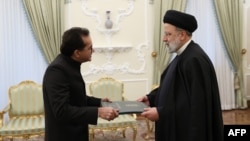
Iranian President Ebrahim Raisi will make an official visit to Pakistan on April 22-24 accompanied by his wife, Foreign Minister Hossein Amir-Abdollahian and other senior Iranian officials, and a business delegation, Pakistan's Foreign Ministry announced on April 21. The visit is the first since the two Muslim neighbors exchanged missile strikes against the backdrop of the Israeli-Gazan conflict and fears of wider conflict along with threats to Red Sea commercial shipping in January. Islamabad said Raisi will meet with Pakistani President Asif Ali Zardari and Prime Minister Shehbaz Sharif, as well as the heads of the Senate and the National Assembly.
- By dpa
Iran Disputes Reports Of First Delivery Of Russian Su-35 Fighter Jets
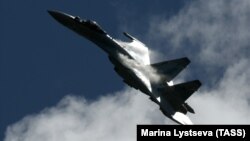
Iranian officials have denied media reports about the imminent delivery of new Russian Sukhoi Su-35 fighter jets to Iran. Reports in the Iranian media that the country is to receive the latest generation of aircraft in the next few days are incorrect, according to the Fararu news website. The media had referred to a report by the SNN news agency, which is close to Iran's Islamic Revolutionary Guard Corps (IRGC). The agency itself denied the report on its Telegram page after consulting with the Defense Ministry, which last year announced that Iran had acquired Mi-28H combat helicopters and Yak-130s from Russia in addition to the SU-35 fighter jets.
- By AP
Bulgaria Seizes Heroin Worth Nearly $9 Million En Route From Iran
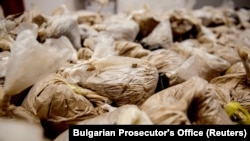
Bulgarian customs officials say they seized 403 kilograms of heroin found in a truck with Turkish registration en route from Iran to Western Europe. The heroin was hidden inside the officially declared 156 mattresses transported in the truck. Officials valued the drug haul at 8.5 million euros (nearly $9 million). The drugs were thought to have originated in Iran and destined for EU nations, officials said. The Turkish driver was detained and could face up to 20 years in jail if convicted on drug trafficking charges. Bulgaria, which lies on a drug route from the Middle East to Western Europe, has taken steps in recent years to prevent drug trafficking.
- By AFP
Deadly Blast At Iraq Army Base Amid Israel-Iran Tensions
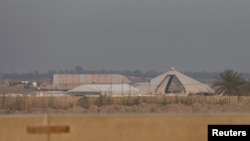
One person was killed and eight wounded in an overnight explosion at an Iraqi military base housing a coalition of pro-Iranian armed groups, officials said on April 20. The full details remain unclear hours after the blast hit the Kalsu military base in Babylon Province south of Baghdad, where regular army, police, and members of Iraq's Popular Mobilization Forces, or Hashed al-Shaabi, are stationed. It comes days after Iran launched an unprecedented assault on Israel, which reportedly responded with a drone strike on the Islamic republic on April 19, amid tensions fueled by the Gaza war.
Iranian Nobel Laureate Fears Israel Confrontation Is Prelude To Tighter Domestic Crackdown

Nobel Peace Prize laureate Shirin Ebadi said she fears Iran could use the confrontation with Israel as a pretext to intensify its domestic crackdown on dissent.
In an interview with RFE/RL's Radio Farda, Ebadi, 76, said Iran's clerical establishment has previously used military confrontations and conflicts to justify "its war against the Iranian people."
Ebadi referred to the devastating 1980-88 Iran-Iraq War during which the authorities allegedly executed thousands of political prisoners and regime opponents.
Her comments came amid fears of a full-scale war between Iran and Israel. The archenemies have traded attacks and threats in recent weeks.
Israel reportedly launched an attack on Iran on April 19, almost a week after an unprecedented drone and missile assault by Tehran. Iran's attack was in retaliation for a suspected Israeli air strike on the Iranian Embassy's compound in Damascus on April 1 that killed seven Iranian commanders.
"Whether a war [with Israel] breaks out or not, we have always been at war: an economic war, a war against the Iranian people, a war against women, a war against Israel, a war against the United States," Ebadi said.
Ebadi, who was a human rights lawyer in Iran for many years before she was forced into exile, cited the renewed crackdown on women who refuse to observe Iran's controversial mandatory hijab law.
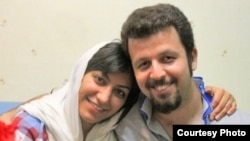
Iranians have accused the police of using aggressive and sometimes violent tactics in their treatment of alleged violators in recent days.
Ebadi said the "real war" was on the streets of Iranian cities, the scene of antiestablishment protests and brutal state crackdowns in recent years.
Iranians have demanded greater social and political freedoms and taken to the streets to demand an end to clerical rule.
Sweden-based Iranian political activist Mahdieh Golrou said she also feared Iran's showdown with Israel will be used by the authorities to justify a harsher clampdown on civil society.
Scores of human rights activists, journalists, and lawyers have been arrested and sentenced to jail in recent years.
Golrou, speaking to Radio Farda, said one of the biggest casualties of any war between Iran and Israel would be people's rights and "desire for freedom and democracy."
Iran, Israel Appear To Step Back From Moves To Spark Wider Regional Conflict
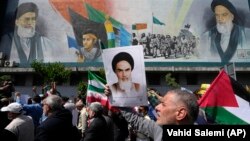
Iran and Israel appeared to be easing off actions and rhetoric that could lead to a wider Middle East conflict after a series of apparent retaliatory attacks, the latest of which featured a suspected Israeli strike on sites near the central Iranian city of Isfahan.
Tehran on April 20 downplayed the scope and impact of the reported Israeli attack that appeared to be in retaliation for an unprecedented air attack the Islamic republic launched last weekend on its sworn enemy.
Explosions rang out early on April 19 -- the 85th birthday of Supreme Leader Ayatollah Ali Khamenei -- near the central city of Isfahan with reports unclear over the cause, while several major U.S. media organizations quoted U.S. government sources as saying Israel had launched an attack on targets inside Iran.
Iranian state media quoted officials in Tehran as saying the explosions were caused by air-defense systems that shot down three drones.
Israel has not commented on the report.
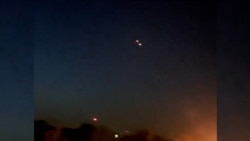
Reuters, citing three sources familiar with the matter, reported that Israeli Prime Minister Benjamin Netanyahu's war cabinet initially approved plans for a strike inside Iranian territory to respond forcefully to Tehran's April 14 missile and drone strike but backed off at the last minute.
The sources said three voting members of the war cabinet ruled out the most dramatic strike: an attack on Iran's nuclear facilities and other sites that would likely have provoked a wider conflict.
The Reuters report said Netanyahu faced cabinet divisions and strong warnings from allies, including Washington, not to escalate matters, leading to two postponements of the limited strikes that eventually were launched.
Sanam Vakil, director of the Middle East and North Africa program at the Chatham House in Britain, was quoted by AFP as saying the reported Israeli strike had been "calibrated to avoid damage and further Iranian aggression."
Iranian Foreign Minister Hossein Amir-Abdollahian told U.S. outlet NBC News that Tehran is investigating the incident but has not seen any indication that the attack was related to Israel.
He warned that if Israel strikes again, Iran will respond immediately and "at maximum level."
"If Israel retaliates, then we will respond. But if not, then we're done," Amir-Abdollahian told NBC News in Persian late on April 19.
He added that there are no signs to prove that this action was the work of Israel.
"They [the drones] took off from inside Iran, they flew like a few hundred meters and then they were downed, they were struck by our air defense. It's not even proven that there is a connection between these and Israel," Amir-Abdollahian said through an Iranian official interpreter.
"Two or three, they're more like toys that our children play with, not drones. It was not worth telling us," he said when asked whether any other country had warned Tehran in advance about an expected attack.
Earlier, Hossein Deliriyan, the spokesman for Iran's National Center for Cyberspace, also dismissed the U.S. media reports saying in a post on X, formerly Twitter, that "there has been no air attack from outside the borders on Isfahan or other parts of the country."
Speaking at a mosque on April 19, President Ebrahim Raisi didn’t mention the attack near Isfahan and with the Israeli retaliation limited in size and scope, experts said it appeared it was aimed at deescalating soaring tensions while still sending a clear message to Tehran.
Tehran launched more than 300 drones and missiles at Israel in the early morning hours of April 14, almost all of which were shot down by Israeli defense systems, along with intercepts by forces from the United States, France, Britain, and Jordan.
The attack by Tehran had been widely anticipated in Israel following a suspected Israeli air strike on the Iranian Embassy compound in Damascus, Syria, on April 1 that killed two brigadier generals.
Since then, diplomats and politicians around the world, fearing another major escalation of fighting in the Middle East, had urged restraint as they awaited Israel's response.
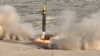
U.S. President Joe Biden has not made any statement about the alleged Israeli attack.
However, according to Italian Foreign Minister Antonio Tajani, Washington informed the Group of Seven nations (G7) that it had received word from Israel on the strikes at the "last minute," but “there was no sharing of the attack by the U.S. It was a mere information.”
“I’m not going to speak to that [the suspected Israeli attack] except to say that the United States has not been involved in any offensive operations,” U.S. Secretary of State Antony Blinken said after a G7 ministerial meeting on the Italian island of Capri.
Iran's state news agency IRNA said air-defense systems fired from a large air base in Isfahan that is home to Iran's aging fleet of U.S.-made F-14 Tomcats acquired before the 1979 Islamic Revolution. Isfahan also houses facilities that are part of Iran's nuclear program, including its underground Natanz enrichment site.
The International Atomic Energy Agency (IAEA) said it had seen no damage to Iran's nuclear sites. Earlier this week, the sites were rumored to be a possible target if Israel launched a strike inside Iran.
One of Iran’s top nuclear facilities, the installation at Natanz, is located in central Isfahan. Such sites have seen several sabotage attacks that Tehran has blamed on Israel.
"IAEA can confirm that there is no damage to Iran’s nuclear sites," the UN nuclear watchdog said in a post on X, formerly Twitter.
"Director General Rafael Grossi continues to call for extreme restraint from everybody and reiterates that nuclear facilities should never be a target in military conflicts. IAEA is monitoring the situation very closely."
Israel and Iran have been bitter enemies for decades, but this was the first direct attack by one on the other's soil instead of through proxy forces or by targeting each other's assets operating in third countries.
Iran Has Strong Options For Retaliation Against Israel, Including Going Nuclear
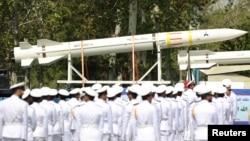
If Iran decides to respond to a suspected Israeli strike on its territory on April 19, it might not have to pull its punches like it did the last time.
Tehran's telegraphed barrage against Israel last week was written off by many as a failure. But Iran has many arrows in its quiver should its standoff with Israel continue to escalate.
Experts say that Iran has more sophisticated weaponry at its disposal, can bring its proxies into the fight, and, unlike its attack on April 13, can utilize the element of surprise. And the ultimate threat -- officially activating its long-suspected effort to develop a nuclear weapon -- could come into play.
Caution First
Iran's initial response after its territory was hit on April 19 was muted. While unidentified U.S. officials reportedly said that Israel had carried out the attack, Tehran did not directly accuse Israel of involvement. Israel has not commented on the incident.
A senior Iranian official told Reuters on condition of anonymity that there was "no plan for immediate retaliation, and no clarification on who is behind the incident."
WATCH: Iranian state media said explosions were heard early on April 19 near the central city of Isfahan, which is home to an air base and a nuclear facility. The IAEA nuclear watchdog reported that there was no damage to Iran's nuclear sites. U.S. sources were cited as saying Israel had attacked the area.
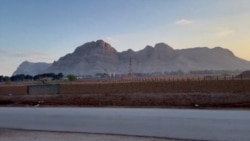
"The foreign source of the incident has not been confirmed," the official said. "We have not received any external attack, and the discussion leans more toward infiltration than attack."
Iranian Army General Siyavush Mihandoust said only that explosions heard in the central city of Isfahan were "due to the work of air defenses against suspicious objects."
Iranian state television reported that three small drones were shot down east of Isfahan, which is home to Iranian nuclear facilities, and broadcast footage that projected an image of calm in the city.
A spokesman for Iran's National Center of Cyberspace, Hossein Dalirian, dismissed reports by U.S. media that quoted unidentified U.S. officials as saying that missiles were used in the attack.
"There have been no air strikes from outside [Iran's] borders against Isfahan or other parts of the country," Dalirian wrote on X, formerly Twitter. "They have only made a failed and humiliating attempt to launch drones, and the drones were shot down."
Timing Is Everything
Analysts said it is common for Tehran to hold off on commenting on such incidents until it can determine a course of action.
But if Iran does choose to respond militarily -- as it did on April 13 in retaliation for the April 1 killing of seven members of the Islamic Revolutionary Guards Corps (IRGC) in a strike on the Iranian Embassy in Damascus that it blamed on Israel -- it can take things much further.
Hamidreza Azizi, a fellow at the German Institute for International and Security Affairs, noted that ahead of Iran's April 13 barrage against Israel, which was effectively thwarted, Tehran ensured that "everybody would know about it beforehand."
There was deliberately "no element of surprise," Azizi said.
But hours before the April 19 strike, Foreign Minister Hossein Amir-Abdollahian told CNN that if Israel again took actions against Iran, "the next response from us will be immediate and at a maximum level."
Iranian Deputy Foreign Minister Ali Bagheri Kani on April 15 said that "there will not be a 12- or 13-day gap" between an Israeli strike and an Iranian answer. Israel, he said, "must now reckon in seconds, not hours.”
The Iranian officials' stress on the immediacy of a possible retaliatory strike signals that Iran would not telegraph its strategy this time, raising the chances of inflicting greater damage.
More In Iran's Arsenal
Tehran launched more than 300 drones and missiles during its April 13 attack, in which the vast majority were either shot down or failed to reach their target, but experts and Iranian officials have suggested it could have used more powerful weaponry.
IRGC Aerospace Force Commander Sardar Hajizadeh said that Iran had used "old weapons with minimal power" on April 13, adding that Tehran had decided against using more powerful missiles, including hypersonic missiles, in its arsenal.

Fabian Hinz, a researcher at the International Institute for Strategic Studies in Berlin, questioned the veracity of Iran's claim it could have used better weapons, saying that one of the missiles launched against Israel, the Kheibar Shekan ballistic missile introduced in 2022, "is one of the best missiles Iran has."
Hinz told RFE/RL's Radio Farda that in terms of quality, he is not sure Iran could make a "qualitative jump" in any future attack.
In terms of sheer numbers, however, Iran has "many, many more missiles and unmanned aerial vehicles (drones) in stock," Hinz said. "There is no doubt about that."
Dangerous Friends
While Iran sent a message with its April 13 attack that it was willing to take on Israel directly and had the capacity to inflict heavy damage, Tehran still has many partners and proxies willing to strike their mutual enemy.
While members of Iran's so-called "axis of resistance" have been battling Israel -- including the U.S.- and EU-designated terrorist organization Hamas, Huthi rebels in Yemen, and Lebanese Hizballah -- those groups for the most part sat out the April 13 attack.
"One thing Iran could do is involve Hizballah, because Hizballah is just much closer to Israel," Hinz said. "And when you deal with amazing defenses, the best thing to do is to overwhelm them, and that is much, much easier at a shorter distance."
Going Nuclear
Just hours before the April 19 strike, an IRGC commander specified that an attack that targeted Iranian nuclear facilities would prompt a reciprocal attack on Israeli nuclear sites and could even lead to a rethinking of Iran's official nuclear doctrine.
Ahmad Haqtalab, who oversees nuclear security for the IRGC, said in comments published by Iranian media on April 18 that "our hands are on the trigger for reciprocal attacks using advanced missiles against their own nuclear sites."
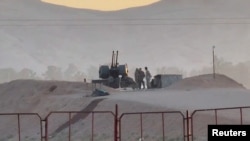
Iran has long been suspected by Israel, the United States, and other countries of pursuing a nuclear weapon, while Tehran has said its nuclear program is for peaceful purposes.
The International Atomic Energy Agency (IAEA) confirmed after Israel's apparent strike that "there is no damage to Iran’s nuclear sites." But prior to the incident, Haqtalab said that even the threat of an Israeli attack on Iran's nuclear sites made it "possible and conceivable that the doctrine and nuclear policies of the Islamic Republic of Iran will be reviewed to reverse the declared considerations of the past."
That decision would ultimately be made by Supreme Leader Ayatollah Ali Khamenei, who has the final call on all major decisions in Iran and has claimed that Iran cannot pursue nuclear weapons for religious reasons.
But Azizi emphasized that the threat is real, saying that an attack on Iranian territory "might be exactly what Iran wants to find an excuse to weaponize its nuclear program."
Hannah Kaviani of RFE/RL's Radio Farda contributed to this report.
- By Kian Sharifi
Iran Versus Israel: Who Has The Military Edge?
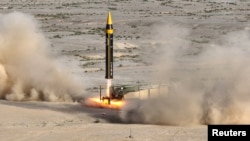
Iran and Israel have traded attacks and threats in recent weeks, increasing fears of a full-scale war between the archfoes.
Israel launched an attack on Iran on April 19, almost a week after an unprecedented drone and missile assault by Tehran. Iran’s attack was in retaliation for a suspected Israeli air strike that killed seven Iranian commanders in Syria on April 1.

In the event of a direct conflict, Israel would have the military superiority, both offensively and defensively, experts say. But they say the threat posed by Iran’s arsenal of drones and missiles should not be dismissed.
Under decades of sanctions, Iran has invested heavily in developing domestic weapons programs, resulting in cheap and effective drones as well as more advanced ballistic missiles.
John Krzyzaniak, a research associate at the Wisconsin Project on Nuclear Arms Control, said Iran’s missiles “pose a serious threat” to Israel. Tehran’s combat and suicide drones, meanwhile, can “wreak havoc on a civilian population” if fired in large numbers, he said.

Even so, Israel maintains military supremacy.
Besides Israel’s operational and intelligence advantage over Iran, it also has a nuclear deterrent, experts said. Israel is widely believed to possess nuclear weapons, with the Washington-based Nuclear Threat Initiative estimating that Israel has around 90 nuclear warheads.
During the April 13 attack, Iran fired over 300 drones and cruise and ballistic missiles against Israel. Tehran claimed that it did not use some of the country’s most advanced weapons. The attack appeared to be highly choreographed and not intended to cause significant damage or casualties.
Israel said almost all of the drones and missiles were intercepted with the help of the United States, Britain, and Jordan. A handful of missiles slipped through the Israeli defenses and hit an air base, causing minor damage, according to the Israel Defense Forces.
Fabian Hinz, research fellow at the International Institute for Strategic Studies (IISS), said Iran simultaneously launching more than 100 ballistic missiles was “quite something” due to the sheer logistics and manpower involved.
“I’m actually not sure if it has ever been done in war before and that makes me wonder how much bigger they could go,” Hinz told RFE/RL’s Radio Farda.
Israel’s defense systems “performed well” against the Iranian missiles, said Jeremy Binnie, a Middle East defense specialist at the defense intelligence company Janes.
But Binnie said the reliability of the Iranian weapons appeared to have been a “major factor.” U.S. intelligence estimated that around half of the Iranian missiles failed on launch or in flight.
Israel’s attack on April 19 appeared to expose the vulnerability of Iran’s defenses. Tehran said small quadcopter drones were used, suggesting the attack was carried out from inside Iranian territory.
Israel’s advanced fighter jets give the country the superiority in the air. But Israel faces several obstacles, experts said, including a lack of aerial refueling tankers. Israel would also need permission to cross the air space of several countries to reach Iran.
If a war breaks out, Israel is likely to deploy long-range missiles against Iran, experts said. Tehran’s air defenses, meanwhile, have not been battle-tested.
Experts said given Israel’s military advantage, Iran is likely to continue to use unconventional warfare and its asymmetric capabilities. That includes the so-called “axis of resistance”: Iran’s loose-knit network of proxies and militant groups who aid it in opposing Israel.
Hannah Kaviani of Radio Farda contributed to this report.
- By Reuters and
- RFE/RL's Radio Farda
Iranian State Media Report Explosions After Suspected Israeli Strike
Iranian state media said explosions were heard early on April 19 near the central city of Isfahan, which is home to an air base and a nuclear facility. The IAEA nuclear watchdog reported that there was no damage to Iran's nuclear sites. U.S. sources were cited as saying Israel had attacked the area.
- By RFE/RL
Video Purportedly Shows Israeli Aerial Attack On Iran
Tehran said it shot down three quadcopter drones outside the central city of Isfahan, which is home to key military and nuclear facilities. Israel's suspected military response early on April 19 appeared to be limited in scale and scope and aimed at de-escalating tensions with Iran.
- By Kian Sharifi
Israel's Limited Attack On Iran Appears Aimed At De-Escalating Conflict
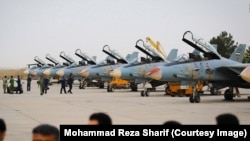
Israel had vowed to make Iran pay for Tehran’s unprecedented drone and missile attack on April 13.
But Israel’s suspected military response early on April 19 appeared to be limited in scale and scope and aimed at de-escalating tensions with Iran.
Tehran said it shot down three quadcopter drones outside the central city of Isfahan, which is home to key military and nuclear facilities. Unnamed U.S. officials said Israel used missiles in the attack.
Experts said the use of small quadcopter drones, which are unable to travel long distances, suggests the attack was carried out from inside Iranian territory.
Israel has not claimed the attack in Isfahan. But experts said the suspected Israeli response sent a clear message to Tehran.
Raz Zimmt, a senior researcher at the Israeli-based Institute for National Security Studies, said Israel’s use of quadcopter drones, if confirmed, suggests its aim was to “expose the vulnerability of the Iranian security forces” on their own turf.
Zimmt said the attack was not without its risks, but out of all the options available to Israel, it was possibly the least risky.
“At this stage, deniability is vital to lower the risk. I think that if Israel takes responsibility for what happened -- and there is sometimes this tendency among Israeli politicians – this would make it more difficult, not impossible but more difficult, for Iran not to retaliate.”
Reuters quoted an unnamed Iranian official as saying that Tehran “has no plan to strike back immediately.”
Israel has been accused of previously attacking military sites in Isfahan with small drones. In January 2023, a military factory was hit. Three months later, Iran said it had foiled a drone attack on a Defense Ministry complex in the city.
Farzin Nadimi, a senior fellow at the Washington Institute, told RFE/RL's Radio Farda that if Israel was behind the Isfahan attack, it was carried out in a manner “that carried the least risk of an Iranian retaliation.”
Iran’s April 13 attack was a response to the suspected Israeli air strike on the Iranian Embassy compound in Damascus on April 1 that killed seven Iranian commanders, including two generals.

Tehran said its attack showed that a “new equation” had been established and that Iran would not let Israeli strikes on Iranian interests abroad go unanswered.
But on the same day as the Isfahan attack, Israel was accused of targeting air defense systems in Syria, a key ally of Tehran where Iran’s powerful Islamic Revolutionary Guards Corps has a presence.
Zimmt said Israel wanted to send the message that “first, we retaliated, and second, we attacked in Syria and not just in Iran, meaning we are not ready to accept this so-called ‘new equation’ that the Iranians are trying to force on us.”
Mohammad Zarghami of Radio Farda contributed to this report.
Apparent Israeli Air Attack Strikes Near Iranian City Of Isfahan
Israel's military reportedly struck targets inside Iran in retaliation for an unprecedented air attack Tehran launched last weekend on its sworn enemy, but the limited scope of the operation and a muted Iranian response appeared to indicate an escalation of the conflict had been avoided.
Explosions were heard early on April 19 -- the 85th birthday of Supreme Leader Ayatollah Ali Khamenei -- near the central city of Isfahan, with reports unclear over the cause.
Several major U.S. media organizations, all citing U.S. government sources, said Israel launched a missile or drones to strike targets inside Iran.
Video posted on social media and broadcast around the world showed several large explosions that were reportedly near Isfahan.
Iranian state media quoted officials in Tehran as saying the explosions were caused by air defenses that shot down three drones in the area of Isfahan.
Hossein Deliriyan, the spokesman for Iran's National Center for Cyberspace, refuted the U.S. media reports, saying in a post on X, formerly Twitter, that "there has been no air attack from outside the borders on Isfahan or other parts of the country."
Speaking at a mosque on April 19, Iranian President Ebrahim Raisi didn’t mention the attack near Isfahan and with the Israeli retaliation limited in size and scope, experts said it appeared it was aimed at deescalating soaring tensions while still sending a clear message to Tehran.
Reuters quoted an unnamed Iranian official as saying that Tehran “has no plan to strike back immediately.”
Tehran launched more than 300 drones and missiles at Israel in the early morning hours of April 14, almost all of which were shot down by Israeli defense systems, along with intercepts by forces from the United States, France, Britain, and Jordan.
The attack by Tehran had been widely anticipated in Israel following a suspected Israeli air strike on the Iranian Embassy compound in Damascus, Syria, on April 1 that killed two brigadier generals.
Since then, diplomats and politicians around the world, fearing another major escalation of fighting in the Middle East, had urged restraint as they awaited Israel's response.
According to Italian Foreign Minister Antonio Tajani, Washington informed the Group of Seven (G7) leading industrialized nations that it had received word from Israel on the strikes at the "last minute," but “there was no sharing of the attack by the U.S. It was a mere information.”
“I’m not going to speak to that [the suspected Israeli attack] except to say that the United States has not been involved in any offensive operations,” U.S. Secretary of State Antony Blinken said after a G7 ministerial meeting on the Italian island of Capri.
Iran's state news agency IRNA said air defenses fired from a large air base in Isfahan that is home to Iran's aging fleet of U.S.-made F-14 Tomcats acquired before the 1979 Islamic Revolution. Isfahan also houses facilities that are part of Iran's nuclear program, including its underground Natanz enrichment site.
The International Atomic Energy Agency (IAEA) said it had seen no damage to Iran's nuclear sites. Earlier this week, the sites were rumored to be a possible target if Israel launched a strike inside Iran.
One of Iran's top nuclear facilities, the installation at Natanz, is located in central Isfahan. Such sites have seen several sabotage attacks that Tehran has blamed on Israel.
"IAEA can confirm that there is no damage to Iran's nuclear sites," the UN nuclear watchdog said in a post on X, formerly Twitter.
"Director-General Rafael Grossi continues to call for extreme restraint from everybody and reiterates that nuclear facilities should never be a target in military conflicts. IAEA is monitoring the situation very closely."
Israeli strikes targeting a Syrian Army position in the country's south were also reported on April 19.
According to AFP, Rami Abdel Rahman, head of the British-based Syrian Observatory for Human Rights, said the strikes, which he attributed to Israel, "targeted a radar installation of the Syrian Army" between the provinces of Sweida and Daraa provinces.
Raisi had warned earlier this week that Tehran would deliver a "severe response" to any attack on its territory and the limited scope of the reported Israeli attack appeared to heed U.S. President Joe Biden's comment to Israeli Prime Minister Benjamin Netanyahu that Israel should show restraint with any response and instead "take the win" since the Iranian attack didn't have a great impact.
"It is absolutely necessary that the region stays stable and that all sides refrain from further action," European Commission chief Ursula von der Leyen said during a visit to Finland on April 19.
Inside Israel, some hawkish lawmakers appeared to acknowledge the strike while criticizing it.
"Feeble," wrote hard-right Security Minister Itamar Ben-Givir in a post on X, formerly Twitter.
Israel and Iran have been bitter enemies for decades but Iran's was the first direct attack by one on the other's soil instead of through proxy forces or by targeting each other's assets operating in third countries.
With reporting by CNN, ABC, CBS, and IRNA
Sister Of Iranian Protest Victim Detained By Tehran's Morality Police
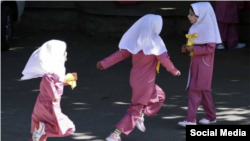
The sister of Nika Shakarmi, a victim of the Women, Life, Freedom movement protests, has been detained by Tehran's morality police for failing to adhere to the Iran's mandatory hijab law.
Aida Shakarmi, a university student, was arrested in the Iranian capital on April 17 and remains in custody, her father said on Instagram.
Nika Shakarmi, a 16-year-old from Khorramabad residing in Tehran, was killed by security forces during nationwide protests that broke out following the September 2022 death of Mahsa Amini while in the custody of the morality police for an alleged hijab offense.
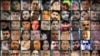
Nika Shakarmi was missing for eight days after being chased by security officers during a protest before her body was discovered. Authorities attributed her death to a fall from a height, a claim her family disputes.
The Shakarmi family has faced continuous threats and harassment from security forces since as they actively pursued justice for their daughter.
The report of Aida Shakarmi's detention comes amid a new crackdown on women for not adhering to the hijab law. Enforcement intensified after Iran’s Supreme Leader Ayatollah Ali Khamenei gave a directive during the recent Eid al-Fitr prayer sermon to step up measures against what he called "religious norm-breaking" within Iranian society.
Khamenei also emphasized the mandatory hijab law as a "definite religious decree," underscoring the obligation of all to adhere to this law the same as other legal decrees.
The resurgence of the morality police has sparked increased tensions and confrontations across various cities.
The hijab became compulsory for women and girls over the age of 9 in 1981, two years after the Islamic Revolution in Iran. The move triggered protests that were swiftly crushed by the new authorities. Many women have flouted the rule over the years and pushed the boundaries of what officials say is acceptable clothing.
Written by Ardeshir Tayebi based on an original story in Persian by RFE/RL's Radio Farda
- By RFE/RL
U.S. Announces New Sanctions On Iran In Response To Attack On Israel
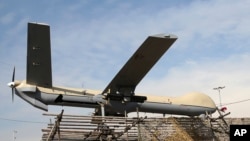
WASHINGTON -- The United States has announced new sanctions on Iran targeting its drone production capabilities after its attack on Israel, the U.S. Treasury Department said in a statement on April 18.
The sanctions designate 16 individuals and two entities enabling Iran’s drone production, including engine types that power Iran’s Shahed drones, which were used in the April 13 attack.
“These actors work on behalf of Iran’s Islamic Revolutionary Guards Corps-Quds Force (IRGC-QF), its UAV production arm, Kimia Part Sivan Company (KIPAS), and other Iranian manufacturers of UAVs and UAV engines,” the Treasury Department’s statement said.
The department’s Office of Foreign Assets Control (OFAC) is also designating five companies in multiple jurisdictions providing component materials for steel production to Iran’s Khuzestan Steel Company (KSC), one of Iran’s largest steel producers, or purchasing KSC’s finished steel products.
Also targeted were three subsidiaries of Iranian automaker Bahman Group, which OFAC said had materially supported Iran's Islamic Revolutionary Guards Corps (IRGC).
In addition, the U.S. Commerce Department is imposing new controls to restrict Iran’s access to technologies, such as basic commercial grade microelectronics.
U.S. President Joe Biden said the United States and its allies had helped Israel beat back the April 13 missile and drone strike and were now holding Iran accountable with the new sanctions and export controls.
“The sanctions target leaders and entities connected to the Islamic Revolutionary Guards Corps, Iran’s Defense Ministry, and the Iranian government’s missile and drone program that enabled this brazen assault," Biden said in a statement. "And our allies and partners have or will issue additional sanctions and measures to restrict Iran’s destabilizing military programs."
He added that the Group of Seven (G7) leaders are committed to acting together to increase economic pressure on Tehran.
Finance ministers and central bank governors of the G7 industrial democracies on April 17 said they would "ensure close coordination of any future measure to diminish Iran's ability to acquire, produce, or transfer weapons to support destabilizing regional activities."
The Treasury Department’s statement noted that Britain is imposing sanctions targeting several Iranian military organizations, individuals, and entities involved in Iran’s drone and ballistic missile industries.
Britain said these sanctions included the General Staff of the Armed Forces and the IRGC Navy.
Tehran says it carried out the April 13 attack in retaliation for a presumed Israeli strike on April 1 on the Iranian Embassy compound in Damascus that killed two generals and several others.
With reporting by Reuters
- By AFP
German Foreign Minister Says G7 Needs 'Response' To Iran's Unprecedented Attack

The G7 must respond to Iran's attack on Israel, Germany's foreign minister said on April 18, adding that measures were being discussed with her counterparts at a meeting in Italy.
"We are also discussing further measures here at the G7, because of course there must be a response to this unprecedented incident," Annalena Baerbock said from the island of Capri.
She added however that "there must be no further escalation in the region; that would be fatal for its people."
UN Secretary-General Antonio Guterres on April 18 painted a dark picture of the situation in the Middle East, warning that spiraling tensions over the war in Gaza and Iran's attack on Israel could devolve into a "full-scale regional conflict."
Guterres said Israel's military offensive in the Gaza Strip had created a "humanitarian hellscape" for civilians trapped there.
"The Middle East is on a precipice. Recent days have seen a perilous escalation," Guterres told a high-level Security Council meeting.
He said one miscalculation or miscommunication “could lead to the unthinkable --- a full-scale regional conflict.”
RFE/RL has been declared an "undesirable organization" by the Russian government.
If you are in Russia or the Russia-controlled parts of Ukraine and hold a Russian passport or are a stateless person residing permanently in Russia or the Russia-controlled parts of Ukraine, please note that you could face fines or imprisonment for sharing, liking, commenting on, or saving our content, or for contacting us.
To find out more, click here.
Editors' Picks










Top Trending
Armenian Border Residents Protest As Yerevan, Baku Agree On Delimitation
2Navalnaya Warns Of Putin's Willingness To Strike In Europe
3Iranian Commander Announces New Morality Enforcement Body
4Zelenskiy Says U.S. Breakthrough On Military Aid Gives Ukraine A 'Chance For Victory'
5Apparent Israeli Air Attack Strikes Near Iranian City Of Isfahan
6Iran Has Strong Options For Retaliation Against Israel, Including Going Nuclear
7Insta-Nazis: How Claims Of 'Rehabilitating Nazism' Are Molding A Militaristic Society In Putin's Russia
8Live Briefing: Russia Invades Ukraine
9Iran Disputes Reports Of First Delivery Of Russian Su-35 Fighter Jets
10Armenia Agrees To Return 4 Villages To Azerbaijan As First Step To Define Borders
Subscribe

