


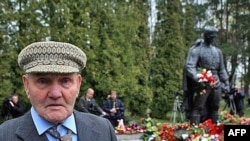
A steady trickle of visitors, mostly local ethnic Russians, has been visiting a military cemetery, which is now home to the Bronze Soldier -- the Soviet World War II memorial that was removed from the center of the city two weeks ago.
The statue is surrounded by red carnations, but there are no red flags in sight -- perhaps in deference to the discrete, but visible police presence. Following a tsarist-era military tradition, many visitors wear the orange and black ribbons of St. George.
Soviet Veterans
Soviet veterans are few and far between. One of them, local 95-year-old ethnic Russian, Pyotr Yessikov, stands erect, his chest awash with medals. He appears slightly ill at ease amid the throng of cameras and microphones that quickly bears down on him.
Yessikov says he was involved in fighting in the Far East in 1938 and was a "commander," without giving his rank. He says he has been visiting both the cemetery and the Bronze Soldier for decades and that the cemetery contains the graves of men who used to serve under him.
Yessikov says he will go to the old site of the Bronze Soldier this year, too, at Tonismae in central Tallinn, but brusquely brushes off questions about what he thinks about its change of location.
At the cemetery, it is a time of solemn remembrance. But there are fears that that may change throughout the course of the day.
Violence Fears
Local Russian militant groups said on May 8 that they are planning to head for Tonismae today. At the former site of the Bronze Soldier, they will face a strong police presence. Around the site, signs on the metal fence say the area is being "landscaped."

Russian Embassy officials lay a wreath at the Bronze Soldier (RFE/RL)
Officials from Russia seem to be keeping a low profile. When Russian Ambassador to Estonia Nikolai Uspensky visited the Bronze Soldier this morning, the only people surrounding him were dozens of journalists.
Uspensky made a short statement, saying that Estonia's and Russia's relationship is going through "stormy times."
"May 9 is our celebration. It's a holiday celebrated in Russia, and I myself feel huge satisfaction that our holiday, May 9, is remembered in Estonia. There are many of our veterans here, we will today be together with them, we're together now in this cemetery, and will be together later [in the day]," Uspensky said.
On May 8, Uspensky was the only foreign ambassador in Tallinn not to join the government in a commemorative wreath-laying tour around the capital's principal war memorials.