


 For RFE/RL's full coverage of the conflict that began in Georgia's breakway region of South Ossetia, click here.
Video: Chronology Of The Conflict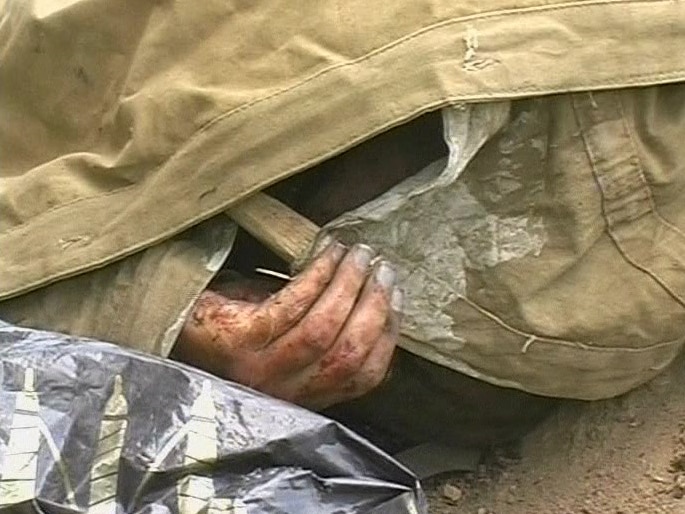
Click for video of the clashes in Georgia's breakaway regions, and the latest effort to end the conflict.
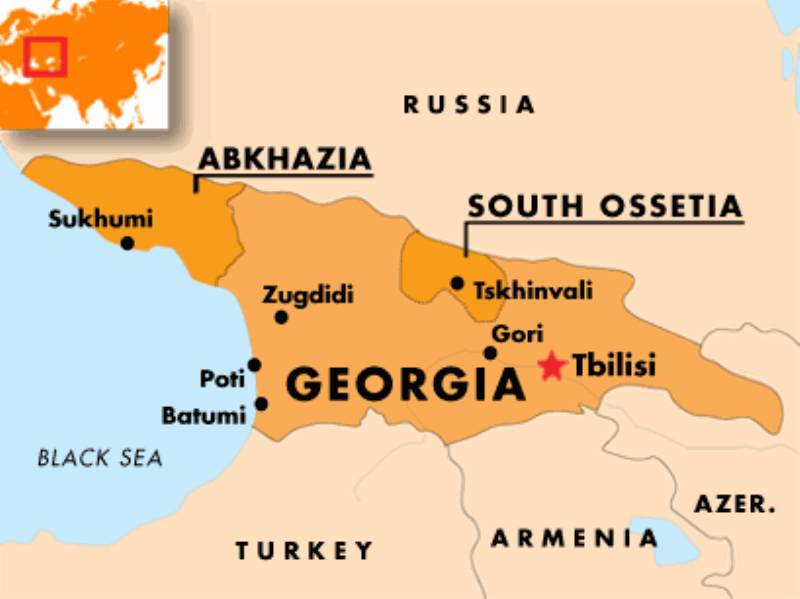

 For RFE/RL's full coverage of the conflict that began in Georgia's breakway region of South Ossetia, click here.
A Russian drone attack on Ukraine's Black Sea port city of Odesa early on April 23 wounded seven people, including two children, regional administration chief Oleh Kiper said, adding that several buildings caught fire. Ukrainian air defense systems shot down 15 out of 16 drones launched by Russia at the regions of Odesa, Kyiv, Mykolayiv, and Cherkasy, the air force said in a statement on Telegram. All drones targeting Kyiv were destroyed, Serhiy Popko, the head of the Ukrainian capital's military administration, said in a message on Telegram adding that there were no casualties or damage in the city. To read the original stories by RFE/RL's Ukrainian Service, click here and here.
The presidents of Serbia and Kosovo traded accusations on April 22 at a session of the UN Security Council in New York called to consider a report on the work of UN Mission in Kosovo (UNMIK).
Kosovo President Vjosa Osmani accused Serbia of preventing the integration of ethnic Serbs in northern Kosovo into Kosovar institutions, while Serbian President Aleksandar Vucic said the world is not paying enough attention to the plight of Serbs living in the region.
Osmani also accused Serbia of "intimidating" the Serbian community in the region, citing as an example the recent detention of Kosovar police officers at the border for what Serbian officials said was "security checks.”
Osmani also noted that a vote on April 21 in four mostly Serbian municipalities in the north of the country fell far short of the 50 percent required to validate the results amid a boycott by Serbian List, the leading Serbian political grouping. The vote was an initiative to remove the current mayors and elect new ones through a recall process.
Speaking at the UN in New York, she said that Serbs in Kosovo “can thank Serbian President Vucic” for the fact that Albanian mayors remain at the head of the municipalities.
Vucic, whose country has refused to recognize Kosovo's 2008 declaration of independence, was also present for the council meeting, telling its 15 members that the international community paid a lot of attention to the incident in Banjska in September but not to the attacks on the Serbian minority.
The incident near Kosovo's border with Serbia escalated tensions dramatically when an ethnic Albanian Kosovar police officer was left dead after an encounter with masked commandos allegedly led by a Kosovar Serb politician who has long enjoyed Belgrade’s support. Three of the gunmen were also killed.
"We will not allow it to be used as an alibi for the persecution of Serbs (in Kosovo)," he said, adding that poor conditions are being deliberately created for the Serbian minority in Kosovo.
The incident is a "consequence of repression" in Kosovo, said Vucic, who also raised the Central Bank of Kosovo’s decision to ban the Serbian currency, the dinar, for cash payments, calling it “an ethnically motivated campaign against Serbs and non-Albanians" in Kosovo.
U.S. Deputy Ambassador Robert Wood said that Serbia has not made significant progress in bringing responsible justice when it comes to the incident in Banjska.
"It is important that Serbia works with KFOR so that this [kind of] attack does not happen again," he told the Council, referring to NATO’s peacekeeping force in Kosovo.
The detention of Kosovar citizens traveling through Serbia and “the arrest of Serbs working in the Kosovo police" are also concerns of the United States, Wood said, calling such actions “a violation of previous agreements on free movement."
Russian Ambassador to the UN Vasily Nebenzya said that the situation in Kosovo is worrying because of the "ethnically motivated violence by the authorities in Pristina."
He said the European Union was “standing by” Kosovar Prime Minister Albin Kurti, and said Brussels and Washington aim for Serbia to recognize the independence of Kosovo and take away its territory.
Caroline Ziadeh, who heads the UNMIK, told the council that tensions have increased in recent months and one of her key observations has been "dissatisfaction with what was achieved in the [Pristina-Belgrade] dialogue," which Brussels and the United States have been trying to restart.
Ziadeh said that it has never been more urgent to carry out "the full implementation of the agreements reached under the auspices of the European Union to help solve the major crises and series of crises that have occurred."

BISHKEK -- British Foreign Secretary David Cameron said he's seeking to highlight the common interests of Britain and Kyrgyzstan on his first visit to the Central Asian country in his new job as foreign secretary.
Cameron told RFE/RL in an interview on April 22 that he believes the two countries had "a whole series" of common interests on their agendas, particularly the areas of climate change, trade, education, and security.
The former British prime minister, who 11 years ago was the first British leader to visit Kyrgyzstan, also said his meetings with President Sadyr Japarov covered the importance of healthy and functioning democracies, and that this is in the interest of both Britain and Kyrgyzstan.
Cameron noted that the world has become a more competitive and contested place in which "big powers are muscling around" trying to win partners. Without naming any country in particular, he said his message to Kyrgyzstan was that it doesn't have to choose one partner over another or reject partners it already has.
"We're saying we are a new partner that is keen to work with you with common interests, where we can make success together," Cameron told RFE/RL.
He noted that Kyrgyzstan was "investing hugely" in education, while Britain believes in the "importance of the English language" and wants to help promote that.
Asked about concerns over the deteriorating state of press freedom and the shrinking civic space in Kyrgyzstan, a country that was once called "an island of democracy in Central Asia," and other states in the region, Cameron said he raised these issues in his meeting with Japarov.
"We talked about the importance of voluntary bodies, charities, nongovernmental organizations, civil society organizations," he said.
Countries should always respect each other's differences and approaches, but he said that in his view, civil society organizations play a role in "helping to make our democracies work better, and that's the approach very much that we take in the United Kingdom."
On Russia's war in Ukraine, Cameron said his message was that it's wrong because Ukraine is an independent sovereign country just like Kyrgyzstan, and Britain is helping Ukraine to fight off the illegal invasion.
"But I think there's a broader message for everyone about the importance of sovereignty, the importance of borders, the importance of respecting those things, and I think that's a message that people want to hear [and are] very receptive to hear," he said.
Cameron visited Israel before arriving in Central Asia. He said his message there was that Britain wants the fighting to stop and the hostages released.
"Our message is one of: let's have a pause in the fighting. Let's turn that into the hostage release. Let's turn that into a sustainable cease-fire where we deal with the problems of the conflict," he said.
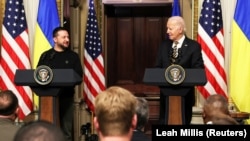
U.S. President Joe Biden assured Ukrainian President Volodymyr Zelenskiy in a phone call on April 22 that he will immediately sign legislation providing military aid as soon as it reaches his desk, and the aid will be dispatched quickly to Ukraine.
The U.S. Senate is expected to vote on a massive national security aid package that includes more than $60 billion for Ukraine on April 23 and send it to Biden for his signature.
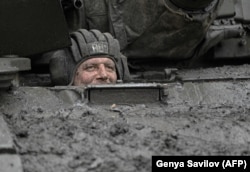
RFE/RL's Live Briefing gives you all of the latest developments on Russia's full-scale invasion, Kyiv's counteroffensive, Western military aid, global reaction, and the plight of civilians. For all of RFE/RL's coverage of the war in Ukraine, click here.
Zelenskiy said on X that Biden assured him during their phone call that the package of aid would include the type of aid that Ukraine needs to fend off advancing Russian forces.
"I have the president's assurance that it will be fast and powerful and will strengthen our anti-aircraft, long-range, and artillery capabilities," Zelenskiy said.
He also told Biden "about Russia's air terror using thousands of missiles, drones, and bombs," including an attack on the Kharkiv TV tower just a few minutes before their conversation.
The digital television broadcasting signal was disrupted, regional Governor Oleh Synyehubov said.
A video circulating on social media showed the main 240-meter-tall mast of the tower breaking off and falling. It was unclear what hit the tower, but Kharkiv prosecutors said Russia had likely used a Kh-59 cruise missile in the attack.
The television tower, which went into operation in 1981, provides the region with radio and television reception and is located 6 kilometers from the city center.
The northeastern Ukrainian city, with a population of more than 1 million, has been under heavy Russian fire since mid-March. The power supply has already been disrupted and electricity is only available on an hourly basis.
"Russia clearly signals its intention to make the city uninhabitable," Zelenskiy said in his post on X on his call with Biden.
Russian forces also shelled areas near the village of Yurchenkove in the Kharkiv region, killing a man who was driving an excavator, according to the regional prosecutor's office.
"A direct hit was recorded on an excavator driven by a 34-year-old driver. A fire broke out, the man died on the spot," the prosecutor's office said on Facebook.
Russian troops also shelled the town of Krasnohorivka in the Donetsk region, killing a 70-year-old woman, said the head of the regional military administration, Vadym Filashkin, adding that three high-rise buildings were also damaged in the attack.
WATCH: On the eve of the Ukraine aid vote in the U.S. House of Representatives, gunners with Kyiv's 148th Separate Artillery Brigade told RFE/RL that Ukraine would lose the war without more ammunition.
The Russian Defense Ministry claimed its forces had captured Novomykhailivka, a village in the eastern Donetsk region, where its forces have steadily been gaining ground.
The claim of Novomykhaylivka's capture came as the Ukrainian military repelled 14 attacks in the area of Lyman and 12 in the area of Bakhmut, according to the April 22 evening summary of the General Staff of the Ukrainian military.
There were a total of 62 combat clashes recorded during the day, the General Staff said.
The assessment did not confirm the Russian claim that Novomykhaylivka had been captured. It said the Ukrainian military "continues to restrain" Russian forces in the areas of Novomykhaylivka and two other settlements west of Avdiyivka, which Russian forces captured in February.
Military analysts have said that Vuhledar, which lies south of Novomykhaylivka, is the next target for Russian forces in this area.

EU foreign ministers agreed in principle on April 22 to expand sanctions on Iran following Tehran's missile and drone attack on Israel, the bloc's foreign policy chief, Josep Borrell, said. The European Union already has multiple sanctions programs against Iran, for the proliferation of weapons of mass destruction, human rights abuses and supplying drones to Russia. But several EU countries had called for widening the drone-related sanctions regime to cover missiles and transfers to proxy forces.

The Minsk City Court on April 22 sentenced a former employee of the Poland-based Belsat television channel, which was declared extremist and banned in the country in November 2021, to two years in prison. The court found Anastasia Matsyash guilty of being a member of an extremist group and also ordered her to pay a 20,000-ruble ($6,100) fine. Matsyash rejected the charge and maintains her innocence. Several journalists from Belsat, as well as individuals who gave interviews to the news agency, have been imprisoned on extremism charges after it was banned in Belarus. To read the original story by RFE/RL's Belarus Service, click here.

A military court in Russia on April 22 sentenced Andy Stone, the spokesman for Meta, the parent company of Facebook and Instagram, in absentia to six years in prison for the "justification of terrorism." Prosecutors sought seven years in prison for Stone. Earlier in February a Moscow court issued an arrest warrant for Stone, who was targeted due to a policy change he announced in March 2022, less than a month after Russia's full-scale invasion of Ukraine. The policy shift by Meta allowed some calls for violence against Russian invaders, including President Vladimir Putin, to be made on Facebook or Instagram. To read the original story on Current Time, click here.

Kyrgyzstan’s Emergencies Ministry said over the weekend that a mudslide in the southern region of Osh killed one person on April 20. Several roads were closed due to the mudslide in the districts of Alai, Kara-Kulja, Ozgon, and Kara-Suu. Another mudslide in the southern region of Jalal-Abad damaged 45 households and four private houses in the village of Barpy. Kyrgyzstan's north has been plagued by severe flooding for weeks. In neighboring Uzbekistan, heavy rains caused mudslides and floods in the eastern region of Samarkand over the weekend. No casualties were officially reported there. To read the original story by RFE/RL's Kyrgyz Service, click here. To watch a video about mudslides and floods in Uzbekistan, click here.

Police in Russia's northwestern Leningrad region detained Aleksei Serov, a former fighter for the Wagner mercenary group, over the weekend on suspicion of killing and dismembering a 20-year-old woman. The 42-year-old man was detained after police found a suitcase in his apartment with parts of a human body. Serov confessed that he killed his acquaintance after a quarrel and dismembered her and planned to get rid of the body. Serov was recruited by the Wagner mercenary group in late 2022 from a penitentiary in Udmurtia, where he was serving a 12-year prison term for murder. He was pardoned after serving for Russia in Ukraine. To read the original story from RFE/RL's North.Realities, click here.
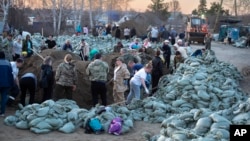
ASTANA -- The Kazakh government has sent additional rescue teams to West Kazakhstan Province to deal with ongoing floods, which have hit much of the country's north and west. Meanwhile, across the border in southern Russia, officials braced for the Ishim River to crest.
The Kazakh government said in a statement on April 22 that 600 military personnel and experts from the Emergencies Ministry had been deployed to the region, where the water level in the Zhaiyq River in the regional capital, Oral, reached 8.5 meters a day earlier, which is above the point where it is considered "dangerous."
Emergencies Ministry spokesman Asqar Sharip said on April 22 that 23,085 people returned to their houses after water levels went down in the northern provinces of Amola, Aqtobe, Atyrau, and North Kazakhstan. According to Sharip, 8,872 people, including 3,852 children, remain in temporary shelters.
"The water was diverted from 4,554 private houses and 2,767 households. More than 11.4 million cubic meters of water have been pumped out, 5.3 million sand sacks were used to stop the water," Sharip said.
"Works to divert and pump out water from 5,842 private houses and 1,061 households are under way in the four regions named."
Kazakh officials said earlier that at least seven people died and two went missing in the floods.
In neighboring Russia, emergency officials said on April 22 that the situation remains tense in several regions flooded by a combination of heavy rains and a massive snowmelt sparked by unseasonably warm weather.
Flooding has washed across the region, forcing tens of thousands to seek shelter and clean water supplies.
The Foundation for Public Control over Environmental and Population Safety said on April 22 that in the Russian region of Kurgan that borders Kazakhstan, floodwaters had pushed uranium waste from the defunct Dobrovolnoye uranium field into the Tobol River.
Subsidiaries of Russia's state nuclear agency Rosatom produced uranium at Dobrovolnoye and on April 16 it said the floods didn't pose a threat to the uranium mines in Dobrovolnoye.
Rosatom said four days later that the floods had bypassed the uranium mines.
However, the foundation on April 22 issued a video showing that the territory in the area between the villages of Trud-i-Znaniye and Zverinogolovskoye were completely underwater, undercutting Rosatom's claim.
Adding to that, Andrei Ozharovsky of the Radioactive Waste Safety program said uranium salts had been washed into the Tobol River and will cause an increase in radiation-related illnesses in the region.
The situation also remains especially dramatic in the Russian regions of Tyumen and Orenburg, officials said, with thousands of people forced to leave their homes.
"The situation with flooding in the Tyumen region remains tense," regional Governor Aleksandr Moor said on Telegram.
"The Ishim River in the city has exceeded 10.5 meters. The rise over the last 24 hours was 140 centimeters. But the intensity of the increase has subsided and we expect the maximum water level to be hit in the near future," he said, adding that the river could crest as early as late on April 22.
As of April 22, officials said 14,743 private houses remain under water in 190 towns and villages in Russia's southern regions bordering Kazakhstan.

A Moscow court on April 22 sentenced a 38-year-old man to five years of so-called forced labor for condemning Russia's invasion of Ukraine during an on-street interview in July 2022 with a reporter from RFE/RL.
The Ostankino district court also banned Yury Kokhovets from administering websites for four years.
The punishment defined as "forced labor" in Russia means that convicts will not serve their terms in prison, but instead may stay home and be sent to work at an industrial facility in their towns, cities, or sent to other places as designated by the Federal Penitentiary Service (FSIN).
A certain portion of their salaries are deducted by the State Treasury.
His lawyer, Yelena Sheremetyeva, said the court ruled that Kokhovets will be paying 10 percent of his monthly salary to the state.
Kokhovets was detained in March 2023 and charged with spreading false information about Russia's armed forces. He was later released but ordered not to leave Moscow.
In July 2022, Kokhovets was approached by an RFE/RL journalist who asked him if he thought a detente between Russia and NATO countries was needed.
"Of course we need (de-escalation), but it all depends on our government. It is our government that started it all.... It is Russia who created all these problems," Kokhovets told RFE/RL. "I don't see any problems with NATO, it is not planning to attack anyone."
He added that Russian forces had killed civilians in the Kyiv suburb of Bucha "for no reason at all." Moscow denies accusations it has committed war crimes in Ukraine.
Kokhovets pleaded partially guilty, denying that his statements during the interview with RFE/RL were hatred-based. He also stated at the trial that he was exercising his constitutional right to freely express his opinion while talking with the RFE/RL journalist.
His lawyer also said at the trial that her client had no hatred toward anyone when he talked to RFE/RL.
According to Sheremetyeva, the "proof" of her client's guilt was based purely on a forensic linguistic examination of Kokhovets's speech, which according to her, had been held with gross violations, namely that the two people who studied his statements are not state-licensed linguists, she said.
The linguistic forensics study was carried out by math teacher Natalya Kryukova and interpreter Aleksandr Tarasov, who also conducted similar linguistic examinations in the cases of shutting down the Memorial Human Rights Center in 2021 and imprisonment of Memorial's co-chairman, Oleg Orlov, in February this year.
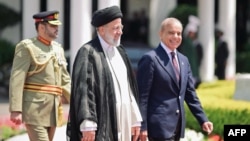
Iranian President Ebrahim Raisi held talks with Pakistani Prime Minister Shehbaz Sharif on April 22 in Islamabad in their first meeting since their countries exchanged missile strikes in February.
Raisi’s three-day trip to neighboring Pakistan is part of efforts by both countries to mend relations that were strained earlier this year.
Iran and Pakistan share a porous 900-kilometer border where separatists opposed to the governments in Tehran and Pakistan operate.
In February, Iran struck what it described as bases used by Iranian Baluch separatists in Pakistan. Islamabad responded by targeting locations in Iran it said were used by Pakistani Baluch separatists.
The Iranian president was greeted at the airport by Housing Minister Riaz Hussain Pirzada before receiving a formal welcome from Sharif.
Authorities have deployed hundreds of additional police and paramilitary forces to ensure security during the visit as Pakistan has witnessed a surge in militant violence.
According to a statement released by the premier’s office, Sharif and Raisi discussed a range of issues to promote bilateral relations and cooperation in various fields and vowed to cooperate to fight terrorism.
They are also expected to hold a joint news conference later on April 22.
Iran’s official news agency IRNA said eight cooperation documents will be signed during Raisi’s visit.
The two sides will also discuss a multibillion gas pipeline project, which has been on hold since 2014. The project -- opposed by Washington for what it says is a violation of sanctions imposed on Tehran over its nuclear program -- was launched in 2013 to supply much-needed Iranian natural gas to energy-starved Pakistan.
Raisi is accompanied by his wife and a high-level delegation. He plans to visit Karachi, the country's biggest city, and Lahore, where he will meet with the Pakistan's recently elected first female chief minister Maryam Nawaz Sharif.
Raisi will travel to Sri Lanka after wrapping up his Pakistan visit.

Russian media watchdog Roskomnadzor said on April 22 that it has "restricted access" to the website of the Reporters Without Borders (RSF) group, which monitors the rights of journalists around the world, the NGO Roskomsvoboda reported. Roskomnadzor said the move was made over RSF's "spreading false news about the special military operation," a term Russian officials use to describe Moscow's full-scale ongoing invasion of Ukraine launched in February 2022. RSF, headquartered in Paris, was established in 1985 to defend press freedom and the right to free and reliable information. To read the original by Current Time, click here.

European Union foreign ministers are meeting in Luxembourg to discuss bolstering the bloc's support for Kyiv as the head of Ukraine's military intelligence warned the situation in the war with Russia could worsen amid intensifying air attacks.
RFE/RL's Live Briefing gives you all of the latest developments on Russia's full-scale invasion, Kyiv's counteroffensive, Western military aid, global reaction, and the plight of civilians. For all of RFE/RL's coverage of the war in Ukraine, click here.
EU foreign ministers were scheduled to meet on April 22 to discuss strengthening Ukraine's air defenses as Russia continues to target Ukraine with drones and missiles.
Russia has stepped up its air attacks on energy infrastructure and other targets, putting pressure on the EU to supply more air defenses to Ukraine.
Kyrylo Budanov, chief of Ukraine's military intelligence agency, told the BBC that his country faced "a rather difficult situation" on the front line against the Russians from mid-May.
"But it is not catastrophic, and we need to understand that," he added. "Armageddon will not happen, as many people are now saying."
Budanov's comments come after Ukrainian President Volodymyr Zelenskiy said in an interview with U.S. broadcaster NBC on April 21 that Russia wants to occupy Chasiv Yar in the Donetsk region before May 9, the day Russia celebrates as Victory Day to mark the defeat of Germany in World War II.
The meeting in Luxembourg comes after the U.S. House of Representatives approved a package worth more than $60 billion in Ukrainian aid that will head to the Senate for discussion this week, clearing the way for President Joe Biden to sign it into law.
Western leaders welcomed the approval of the package, with European Commission President Ursula von der Leyen saying in a post on X, formerly Twitter, that "Ukraine deserves all the support it can get against Russia."
Polish Prime Minister Donald Tusk thanked House Speaker Mike Johnson, while also noting the holdup in Congress. "Better late than too late. And I hope it is not too late for Ukraine."
The Institute for the Study of War, a Washington-based think tank, said the complicated logistics of getting U.S. assistance to the front line would mean that "Ukrainian forces may suffer additional setbacks" while waiting for it to arrive.
Russian Foreign Minister Sergei Lavrov accused the United States, Britain, and France on April 22 of risking a “direct military clash” between nuclear powers by bolstering their support for Ukraine.
Hours before the meeting in Luxembourg, Russia launched seven Shahed-type kamikaze drones at Ukraine, most of which were shot down. Odesa's regional governor, Oleh Kiper, said drones targeted a farm, where they damaged a warehouse and some machinery.
The Shahed drones are cheap and effective unmanned aerial vehicles (UAVs) made by Iran. Tehran insists that it is not supplying Russia with drones to use against Ukraine.
Iran used the same drones on April 14 to target Israel in an unprecedented attack that included more than 300 UAVs and missiles.
During their meeting in Luxembourg, EU foreign ministers also agreed to expand the bloc's sanctions on Iran for its attack on Israel, which Tehran says was retaliation for the bombing of its embassy complex in Syria earlier this month. The attack, which Iran blames on Israel, killed seven military officers, including two generals.
Many EU countries have called for widening the drone-related sanctions regime to cover missiles and transfers to Iranian proxy forces in the Middle East.
The Interior Ministry in Russia's North Caucasus region of Karachai-Cherkessia said on April 22 that unknown attackers opened fire on a police patrol, killing two officers and wounding another one. The two police officers killed in the attack were identified as Lieutenant Murat Kalakhanov and Sergeant Roman Gushchin. The Investigative Committee said it had launched an investigation into "a deadly attack against law enforcement officers and illegal firearms possession." Several Telegram channels reported that during the overnight attack in the city of Karachayevsk, unknown assailants managed to take a pistol, an AK-47, and ammunition from the officers. To read the original story by RFE/RL's Russian Service, click here.

The Ukrainian Air Force shot down five combat drones and one reconnaissance drone launched by Russia in the early hours of April 22. The air force said Russia had launched seven Iranian-made Shahed-type kamikaze drones from Cape Chauda in the Moscow-occupied Crimea region. Russia also launched three antiaircraft guided missiles from the occupied Donetsk region, according to Ukraine. In Odesa, regional Governor Oleh Kiper said the drones targeted a farm, where they damaged a warehouse and agricultural machinery. No human casualties were reported. To read the original story by RFE/RL's Ukrainian Service, click here.
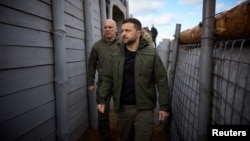
Ukrainian President Volodymyr Zelenskiy said in an interview with a U.S. broadcaster on April 21 that Russia wants to occupy Chasiv Yar in the Donetsk region before May 9, the day that Russia celebrates as Victory Day to mark the defeat of Germany in World War II.
Zelenskiy said on NBC that he expects an influx of weapons will arrive in Ukraine "in time," and its forces will to be able to "repel the enemy, and then defeat the plans of the Russian Federation for full-scale counteroffensive actions in June."
Zelenskiy was interviewed the day after the U.S. House of Representatives finally approved $61 billion in new U.S. aid, giving Ukraine and its soldiers on the battlefield a morale boost just as Russian forces claimed territorial gains near Chasiv Yar.
Colonel General Oleksandr Syrskiy, commander in chief of Ukraine's armed forces, recently said that top Russian military leaders set the capture of Chasiv Yar as a goal for its troops by May 9.
RFE/RL's Live Briefing gives you all of the latest developments on Russia's full-scale invasion, Kyiv's counteroffensive, Western military aid, global reaction, and the plight of civilians. For all of RFE/RL's coverage of the war in Ukraine, click here.
Ukrainian forces currently are holding out in the Chasiv Yar area despite a lack the necessary weapons, according to Zelenskiy.
"I was recently in the region. I spoke with the fighters," he said, reiterating their need for equipment "to fight against Russian reconnaissance drones, which are correcting Russia's artillery fire."
Maksym Zhorin, the commander on the front line in the area, told national television on April 21 that all positions around Chasiv Yar were under Ukrainian control.
The Russian Defense Ministry said in a statement on April 21 that Russian forces had taken control of Bohdanivka, located just to the west of the Russian-held city of Bakhmut.
Ukraine has described Bohdanivka as an important post in keeping the Russians from advancing westward through the Donetsk region to the cities of Kramatorsk and Slovyansk.
In its evening report on April 21, the General Staff of the Ukrainian military mentioned the town of Bohdanivka as one of a series of villages where it said Ukrainian forces repelled 13 enemy attacks. It said about 20 settlements in the Donetsk region, including Chasiv Yar, came under artillery and mortar fire.
Ukraine's Defense Ministry denied last week that Russia had captured all of Bohdanivka, while acknowledging it had lost some positions in the village in eastern Donetsk region.
The Ukrainian military also said in its evening report that its forces shot down two Kh-59 cruise missiles and repelled nine attacks in the area of Terna in the Donetsk region.

The Central Election Commission of Kosovo said turnout for elections on April 21 in four mostly Serbian municipalities in the north of the country fell far short of the 50 percent required to validate the results and therefore the election failed.
Only 253 people out of a combined estimated 46,000 registered voters across all four municipalities turned out, the head of the
Central Election Commission said at a press conference after polls closed.
The head of the commission said the majority of registered voters did not vote as required by law, so the necessary 50 percent was not reached, "therefore we conclude that the citizens' initiative for the removal of the mayors of Leposavic, Zubin Potok, Zvecan, and North Mitrovica municipalities has failed."
The vote took place amid a boycott by the leading Serb political grouping.
Kosovar President Vjosa Osmani said the election had been an opportunity for citizens in the northern municipalities to remove the current mayors and elect new ones through a recall process, but voters "largely did not take advantage" of the opportunity.
"Unfortunately, this was primarily due to pressure from Belgrade, exerted by the Serbian List and illegal criminal structures," Osmani said on X. "Once again, Serbia has illegally interfered in the electoral process of another country. Once again, [Serbian President Aleksandar] Vucic has not kept his word given to international partners."
The United States appreciated the efforts made by Kosovar election officials to allow all citizens registered in the four municipalities to participate in the vote, an embassy spokesperson said in a statement e-mailed to RFE/RL.
"We understand from international observation teams that there was extremely low voter turnout," the spokesperson said. "There is therefore no decision by the voters to recall the mayors. The mayors in place were elected, and remain in place, under Kosovo’s legal framework."
Local Government Administration Minister Elbert Krasniqi said earlier that the powerful Srpska Lista (Serbian List), which called the boycott, wants a "monopoly" on the politics of the Serbian community in Kosovo.
"They see the institutions only for themselves and not for the citizens," said Krasniqi in a statement issued in Leposavic, where he visited polling stations. "They continue to have seats reserved for the Serbian community in the Assembly of Kosovo and do not represent the interests of the citizens, but receive the salaries of the Assembly of Kosovo."
The voting is the latest irritant between Kosovo's majority ethnic Albanian population and tens of thousands of ethnic Serbs in Kosovo who, along with Belgrade, reject the former Serbian province's 2008 declaration of sovereignty and Pristina's authority.
The powerful Srpska Lista (Serbian List) party that represents many Serbs has urged them to boycott the mayoral by-elections in the North Mitrovica, Zvecan, Zubin Potok, and Leposavic municipalities.
Pristina cleared the path to the recall votes last September amid international pressure to hold new elections after ethnic Serbs overwhelmingly boycotted voting in April 2023 to replace Serbs who quit in protest over an intensifying administrative spat between Serbia and Kosovo.
Serbia does not recognize Kosovo's independence and normalization has eluded the former Yugoslav neighbors despite over a decade of EU-mediated talks that has failed to build sufficient trust or a binding road map to ensure Serb representation and Kosovar membership of international institutions including the United Nations.
Recently, Pristina stepped up pressure on its Serb population by suddenly prohibiting use of the Serbian dinar in January despite its continued use throughout many mostly Serb areas for essential payments and pensions and other supports from Serbia.
The abrupt restriction drew criticism from Belgrade and from many of Kosovo's strongest allies, including the United States, of Kosovar Prime Minister Albin Kurti as he continues a long-running test of wills with Serbian President Aleksandar Vucic.
The Serbian List has criticized voter registers in the four municipalities as "outdated," and said on April 7 it would boycott the elections.
Serbian List leader Zlatan Elek alleged "unfeasible procedures" for the April 21 voting and said the number of registered ethnic Albanians on the lists of local voters "has grown" since voting a year ago. He said voter lists "do not reflect the real situation on the ground."
"The position of the Serbian List is not to participate in the referendum called by Albin Kurti, because he did everything to make it fail," Elek said.
The dispute over the mayoralties escalated after ethnic Serbs in late 2022 quit those and other official posts -- including on the police force and posts within the so-called parallel institutions that operate in Kosovo with Serbian support despite Pristina's insistence that they are illegal.
After elections to replace the mayors in the four towns, Kurti's government ignored international pleas to de-escalate the situation and sought in May 2023 to forcibly seat ethnic Albanians who'd been declared the winners despite paltry turnout reflecting the ongoing boycott.
Local resistance -- some allege with direct support from Belgrade -- erupted into violence that injured dozens of NATO peacekeepers and reminded the international community of the depth of tensions in a region only decades removed from ethnic cleansings and bitter warfare.
After the Kosovar government established a procedure for possible recall votes, Serbs were said to have collected signatures from the required one-fifth of voters in the four regions -- reportedly with the open encouragement in January of Serbian List.
EU officials expressed disappointment at the Serbian List boycott effort.
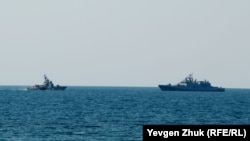
Ukraine says its navy struck another ship belonging to Russia's Black Sea Fleet. The Ukrainian Navy hit the Russian salvage ship Kommuna in occupied Sevastopol, Dmytro Pletenchuk, spokesman for the Ukrainian Navy, said on April 21. "The nature of the damage is being verified," Pletenchuk said on Facebook. Mikhail Razvozhayev, the Russian-installed governor of the Ukrainian peninsula seized by Moscow in 2014, said an attack by an "anti-ship missile" on a Russian warship had been repelled. "The falling fragments caused a small fire, which was quickly extinguished," Razvozhayev said on Telegram. To read the original story by RFE/RL's Ukrainian Service, click here. To read the original story by Crimea.Realities, click here.
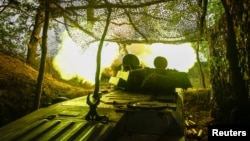
Ukrainian President Volodymyr Zelenskiy said he sees "a chance for victory" for Ukraine over invading Russian forces after passage of a long-delayed aid bill critical to Ukraine's defense by the U.S. House of Representatives.
"I think this support will really strengthen the armed forces of Ukraine," Zelenskiy told U.S. broadcaster NBC on April 21. "And we will have a chance for victory if Ukraine really gets the weapons systems [that] we need so much."
RFE/RL's Live Briefing gives you all of the latest developments on Russia's full-scale invasion, Kyiv's counteroffensive, Western military aid, global reaction, and the plight of civilians. For all of RFE/RL's coverage of the war in Ukraine, click here.
Ukraine will prioritize long-range weapons and air-defense systems, which Zelenskiy said would enable Ukraine to "break the plans of Russia" to mount an expected full-scale offensive.
"This is crucial. These are the priorities now," Zelenskiy said.
Elaborating on X, formerly Twitter, Zelenskiy said the democratic world has the strength to defeat Russia and shouldn't "be afraid of its own power," referring specifically to Ukraine's need for Patriot air-defense systems and modern fighter jets.
"’Patriots can only be called air-defense systems if they work and save lives rather than standing immobile somewhere in storage bases," he said. “Modern fighter jets are required where modernity is put to the test and it is determined whether children and grandchildren of today's generations will live in peace and security."
Later in his evening address, Zelenskiy encouraged quick delivery of the aid to the front line, where ammunition shortages have led Ukrainian military commanders to ration shells.
"The time between political decisions and actual damage to the enemy on the front lines, between the package's approval and our warriors' strengthening, must be as short as possible," he said.
Ukraine and its European allies earlier welcomed the U.S. House of Representatives's passage on April 20 of the bill, which includes $61 billion in Ukrainian aid as part of a $95 billion package that also includes aid to Israel and other U.S. allies.
The Senate's Democratic leadership has pledged to vote on the entire package in the next 72 hours to get it to President Joe Biden, who urged the Senate to quickly "send this package to my desk so that I can sign it into law and we can quickly send weapons and equipment to Ukraine to meet their urgent battlefield needs."
Senate Majority Leader Chuck Schumer (Democrat-New York) said overnight the Senate "is ready to take the next step on additional national security legislation." Debate is scheduled to begin on April 23.
Zelenskiy said he hoped the bill would quickly pass the Senate and be sent to Biden.
"We appreciate every sign of support for our country and its independence, people, and way of life, which Russia is attempting to bury under the rubble," Zelenskiy said on X. "America has demonstrated its leadership since the first days of this war. Exactly this type of leadership is required to maintain a rules-based international order and predictability for all nations."
In his evening address, Zelenskiy added that his office and Ukrainian diplomats "are actively working to ensure a positive political outcome of the swift approval" by the Senate, which originally passed the bill in February, but it must go back to the Senate for approval of changes in the legislation.
The Kremlin responded to the House vote by saying the U.S. move would cost further Ukrainian lives "because of the Kyiv regime." It suggested the U.S. support was intended to "enrich" the United States and "further ruin" Ukraine, which was already battling Russian-backed separatists after 2014 before the unprovoked full-scale invasion in February 2022.
Russian Deputy Ambassador to the United Nations Dmitry Polyansky said there is "nothing to celebrate here." He repeated the Kremlin arguments on social media and added in English, "But the inglorious end of the Kiev [sic] regime is inevitable regardless of this new package and all the futile efforts of its U.S. and NATO backers to keep it alive."
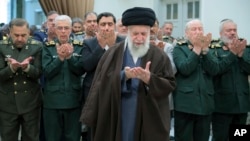
Supreme Leader Ayatollah Ali Khamenei has publicly expressed gratitude to Iran's armed forces one week after they targeted Israel with more than 300 missiles and drones in response to Israel's suspected bombing of Iran's embassy compound in Damascus.
The comments follow Tehran's seemingly measured response to images from April 19 showing the fiery results of what was thought to be an Israeli retaliatory attack near the Iranian city of Isfahan.
Observers suggested the absence of more threats from Iranian officials looked like an attempt to avert a broader conflict.
"How many missiles were launched and how many of them hit their target is not the primary question. What really matters is that Iran demonstrated its willpower during that operation," Khamenei said on April 21, according to official media.
But he encouraged Iran's military to "ceaselessly pursue military innovation and learn the enemy's tactics."
April 19 marked the 85th birthday of Khamenei, who holds final say on religious and political affairs in Iran.
Iranian state media quoted officials in Tehran as saying the explosions were caused by air-defense systems that shot down three drones.
Israel has not commented on the report.
Reuters, citing three sources familiar with the matter, reported that Israeli Prime Minister Benjamin Netanyahu's war cabinet initially approved plans for a strike inside Iranian territory to respond forcefully to Tehran's April 14 missile and drone strike but backed off at the last minute.
The Reuters report said Netanyahu faced cabinet divisions and strong warnings from allies -- including Washington -- not to escalate matters, leading to two postponements of the limited strikes that eventually were launched.
Speaking at a mosque on April 19, President Ebrahim Raisi didn't mention the attack near Isfahan.
Tehran launched more than 300 drones and missiles at Israel in the early morning hours of April 14, almost all of which were shot down by Israeli defense systems, along with intercepts by forces from the United States, France, Britain, and Jordan.
The attack by Tehran had been widely anticipated in Israel following a suspected Israeli air strike on the Iranian Embassy compound in Syria on April 1 that killed two brigadier generals.
Since then, diplomats and politicians around the world, fearing another major escalation of fighting in the Middle East, had urged restraint as they awaited Israel's response.
U.S. President Joe Biden has not made any statement about the alleged Israeli attack.
The International Atomic Energy Agency (IAEA) said it had seen no damage to Iran's nuclear sites. One of Iran’s top nuclear facilities, the installation at Natanz, is located in central Isfahan. "IAEA can confirm that there is no damage to Iran’s nuclear sites," the UN nuclear watchdog said in a post on X, formerly Twitter.
Israel and Iran have been bitter enemies for decades, but this was the first direct attack by one on the other's soil instead of through proxy forces or by targeting each other's assets operating in third countries.

The commander of Islamic Revolutionary Guards Corps (IRGC) troops in the Iranian capital on April 21 announced the creation of a new enforcement body to uphold the country's strict dress code for women.
IRGC Tehran chief Hassan Hassanzadeh said members of the squad's members have been trained to enforce the hijab "in a more serious manner" at public locations.
The announcement follows reports that authorities have intensified morality sweeps in recent days, with shared images showing the uniformed officers descending on women as part of an operation officials said was codenamed Nour, or Light in Persian.
In a related message imprisoned Nobel Peace Prize laureate Narges Mohammadi said women's narratives of oppression will be heard and will "disgrace" the "misogynist" government.
"Today, the authoritarian theocracy has drawn a full-fledged war against all women on all streets of the country, not out of a position of power but out of desperation," Mohammadi said from Tehran's Evin prison, according to an audio message posted on April 21 on an Instagram page attributed to her.
The message said that journalist Dina Ghalibaf, who was arrested earlier this month after she published a personal narrative about her previous detention by Iran’s morality police for not adhering to the hijab law, entered the women's ward in Evin prison "with a bruised body and a narrative of sexual harassment."
Mohammadi added that Iran for years has been witnessing "the narrative of women who have been subjected to abuse, harassment, and mayhem by government officials. We women will stop this war ...or the people of Iran and the world will rise up to our aid."
The death in custody of student Mahsa Amini in September 2022 after an alleged beating by morality police sparked massive street protests and provided momentum to the decades-long opposition to the mandatory head scarf since its imposition by religious authorities following the Islamic Revolution in 1979.
Those protests prompted a fierce official crackdown in which more than 500 people have died and thousands have been arrested, with some of those convicted of wrongdoing executed.
Senior Iranian officials said recently that President Ebrahim Raisi's government was behind the new dress-code crackdown, with the Interior Ministry leading the effort.
Some relative moderate lawmakers have questioned a tightening in the current circumstances, with tensions high over military confrontations in the region and Tehran seeking to project influence through allies or proxies and fears high of an escalation of violence between Iran and foe Israel.
Interior Minister Ahmad Vahidi has defended the Nour crackdown, saying "projects implemented in the area of hijab are being carried out within the framework of the law."
Vahidi called the hijab "one of the pillars of the [Iranian] system's identity and a Shari'a principle" that "should not be allowed" to slip into lax enforcement.
Even some strongly pro-Islamic forces in Iran have objected to such rigorous hijab enforcement at the expense of internal solidarity in the face of external threats to the country.
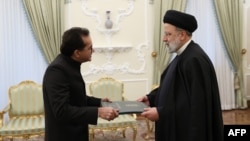
Iranian President Ebrahim Raisi will make an official visit to Pakistan on April 22-24 accompanied by his wife, Foreign Minister Hossein Amir-Abdollahian and other senior Iranian officials, and a business delegation, Pakistan's Foreign Ministry announced on April 21. The visit is the first since the two Muslim neighbors exchanged missile strikes against the backdrop of the Israeli-Gazan conflict and fears of wider conflict along with threats to Red Sea commercial shipping in January. Islamabad said Raisi will meet with Pakistani President Asif Ali Zardari and Prime Minister Shehbaz Sharif, as well as the heads of the Senate and the National Assembly.
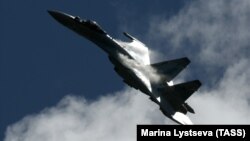
Iranian officials have denied media reports about the imminent delivery of new Russian Sukhoi Su-35 fighter jets to Iran. Reports in the Iranian media that the country is to receive the latest generation of aircraft in the next few days are incorrect, according to the Fararu news website. The media had referred to a report by the SNN news agency, which is close to Iran's Islamic Revolutionary Guard Corps (IRGC). The agency itself denied the report on its Telegram page after consulting with the Defense Ministry, which last year announced that Iran had acquired Mi-28H combat helicopters and Yak-130s from Russia in addition to the SU-35 fighter jets.

Moldova's pro-European government faces a new challenge from its restive pro-Moscow Gagauzia region after its leaders denounced proposed judicial reforms and demanded enhanced status for the Russian language. Gagauzia's 140,000 residents, mainly ethnic Turks who adhere to Orthodox Christianity, have had uneasy relations with central authorities since Moldova threw off Soviet rule in 1991. On April 19, Gagauzia's local assembly rejected judicial reforms which would shut down an appeal court in the region and called for special status for Russian, alongside Moldova's sole state language, Romanian. Under Moldova's constitution, Gagauzia's leader is automatically a member of the government.
RFE/RL has been declared an "undesirable organization" by the Russian government.
If you are in Russia or the Russia-controlled parts of Ukraine and hold a Russian passport or are a stateless person residing permanently in Russia or the Russia-controlled parts of Ukraine, please note that you could face fines or imprisonment for sharing, liking, commenting on, or saving our content, or for contacting us.
To find out more, click here.