


To be sure, the Taliban are not able to hold on to ground for long against the better armed and trained NATO troops. But the NATO-led International Security Assistance Force (ISAF), Afghan government troops, and the U.S.-led antiterrorism coalition also do not have enough soldiers to control all of the territory and deny it to the insurgents.
The latest reports suggest that three of the four main roads out of Kabul are no longer safe for government employees, aid workers, or foreigners to travel.
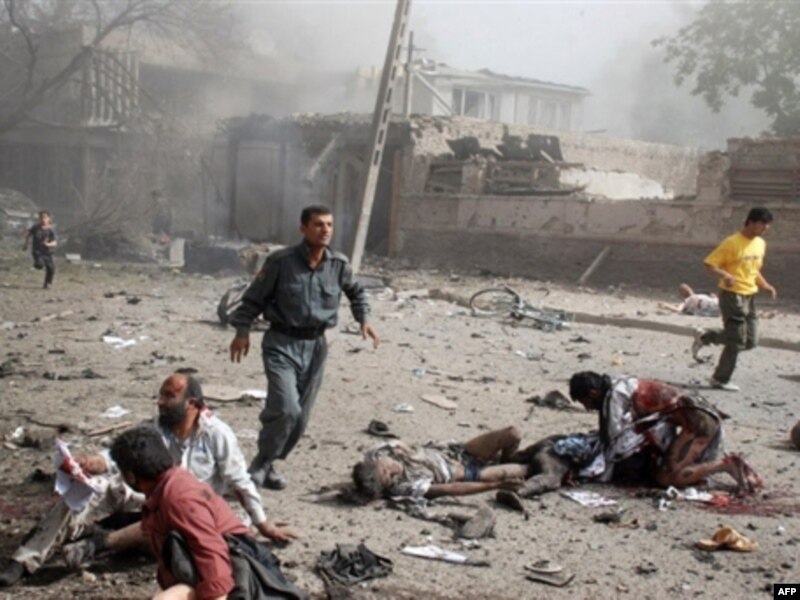
Dozens of supply trucks have been attacked on roads leading into Kabul. Foreign aid workers have been kidnapped or killed nearby. And deadly suicide bombings have targeted the five-star Serena Hotel in the capital, as well as the Indian Embassy.
Last week, militants scored their greatest success yet in a ground battle against NATO forces -- killing 10 French troops and injuring 21 in Kabul's eastern district of Sarobi.
Transformation Taking Place
Experts say insurgents are trying to slowly drain away Western support for keeping soldiers in Afghanistan by steadily inflicting casualties upon them. But at the same time, a transformation appears to have taken place within the insurgency -- a diversification that belies the unity of the Taliban.
Jean MacKenzie, the Kabul-based country director for the Institute for War and Peace Reporting, says there is no doubt that insurgent violence has been creeping closer to Kabul:
"The Taliban and the insurgents in general are getting closer to Kabul. There are some outlying districts of Kabul where the government is reluctant to go," she says. "And certainly Wardak [Province], which is right [to the west of] Kabul, is largely under the control of the insurgents. Logar, which is another province very close to Kabul, is also very heavily populated by the Taliban and by insurgents. So we are seeing very heavy activity in places that were previously considered fairly stable or safe -- right around Kabul."
But MacKenzie says that increased insurgent violence near Kabul does not mean that the Taliban movement itself is proliferating.
"We have to take a closer look at what we mean by Taliban. [Western media] have put the label 'Taliban' on anyone with a grievance against the central government or the foreign forces. And that group of people is growing day by day," she says. "There have been attacks on government forces and on coalition forces that we assume or are saying come from the Taliban. That does not necessarily mean that it is. It could be [militants linked to] other political groups, such as [renegade commander Gulbuddin Hekmatyar's] Hezb-i Islami. It could be ad hoc or an independent insurgency, if you will."

"They are actively carrying out a policy which will eventually lead them to lose their monopoly over the insurgency. In fact, it is already happening," Giustozzi says. "The Taliban are the predominant group in the insurgency. But decreasingly so. And there might be political consequences for them in the long run. Many insurgent groups would prioritize the consolidation of the insurgency under their leadership rather than have a diversified insurgency. The fact that they go the other way, I think, is very significant. Why they do so is not totally clear, except that, of course, the advantage is that it facilitates their geographical expansion."
Loose Alignments
Indeed, Giustozzi says it appears the Taliban movement reached the limits of where its fighters could infiltrate back in 2006 -- namely, their old strongholds in the south and southeast of Afghanistan.
Since then, he says, they appear to have entered into loose alignments with factions that have followers or fighters closer to Kabul -- as well as in eastern and northern parts of Afghanistan.
"I believe that they probably tried very hard over the last few years to expand their own organization eastward and northward and they found that there are big difficulties because they didn't have much of a base in these areas. They never had," Giustozzi says. "And after trying and trying, they decided that, probably, they didn't have the potential to do much military action, and therefore, resorted to alliances with other groups in order to transform their jihad movement into a national movement."
Indeed, Afghan security officials blame the Sarajuddin Haqanni network for the suicide attack at Kabul's five-star Serena Hotel in January, as well as much of the recent violence in southeastern Afghanistan. The Haqanni network is a former mujahedin party that had fought Soviet troops in Afghanistan during the 1980s and now has links with the Taliban and the Al-Qaeda network.
Taliban Propaganda
Nick Grono, deputy president of the International Crisis Group, tells RFE/RL that insurgent propaganda shows that other factions also are diversifying the insurgency.
"In a recent report we did, we were looking at Taliban propaganda. And one of the interesting findings there was that, in fact, there wasn't the kind of coordination between the different groups -- the antigovernment forces -- whether it was Haqanni or the Taliban or those that are more closely associated with Al-Qaeda," Grono says. "There wasn't a strong degree of cooperation that we could identify, at least from their writings. In fact, often they were blaming each other or criticizing people who were claiming to speak for the Taliban -- saying they do not represent the Taliban. But what you are seeing is that they are all more successfully pursuing their objectives."
There has been a growing body of people who are opposed to the central government and are opposed to the presence of foreign forces here.
But MacKenzie says the patchwork of factions and disenfranchised Afghan groups now comprising the insurgency is different than the unified movement the Taliban had been during the 1990s when it rose to power.
"There has been a growing body of people who are opposed to the central government and are opposed to the presence of foreign forces here," MacKenzie says. "Some are ready to make alliances among themselves, at least in the short term. That does not mean that they are all Taliban. And I think that, should they prevail and the foreign forces were to leave, there would be a lot of political fallout. I do not think that these diverse groups share a common vision of what Afghanistan could or should be minus the central government or the international presence."
'Too Big, Too Powerful'
Giustozzi concludes that elements in Pakistan's intelligence community that support the insurgency in Afghanistan also have been diversifying their support:
"That component of the Pakistani state that supports the insurgency does not necessarily want an outright victory by the Taliban, nor does not necessarily believe that such a victory is possible or even positive," Giustozzi says. "There are people, I think, who would like that in [Pakistan's] intelligence and military. But in the army, there might have been feelings since 2006 at least that the Taliban were becoming too big, too powerful. And, of course, they have increasingly expanded their influence on the [Pakistani] side of the border.
"In any long term, as the insurgency continues to expand and the bigger it becomes, the more difficult it will be for the Pakistanis to control and restrain it. So I think an insurgency divided into several groups makes it easier to control from the Pakistani side."
RFE/RL Afghanistan Report
RFE/RL Afghanistan Report

SUBSCRIBE For regular news and analysis on Afghanistan by e-mail, subscribe to "RFE/RL Afghanistan Report."