



Tajikistan: 20 Arrested After Protesting Demolition Of Homes
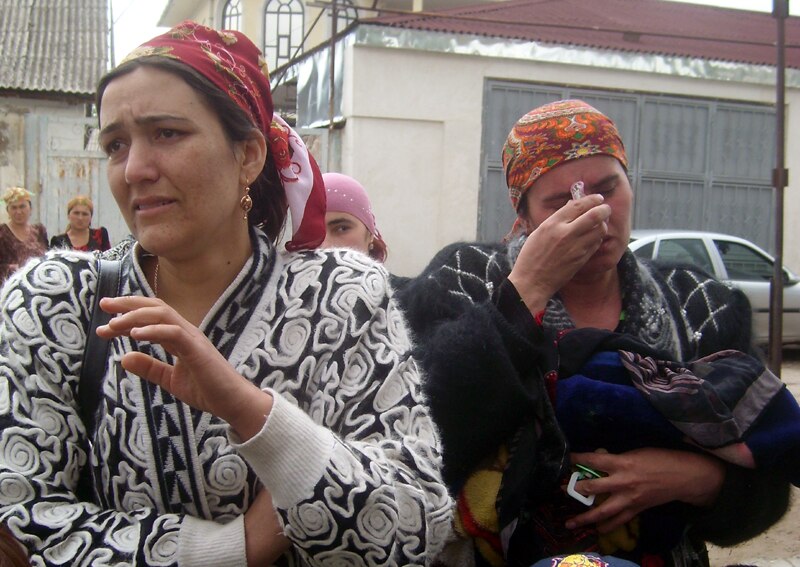
These women were among some 20 taken away by police after protesting against the demolition of their homes
The demolitions are part of a plan to destroy dozens of old houses in the city to make way for modern buildings under a general plan to renovate and reconstruct the Tajik capital. The plan affects hundreds of residents, many of whom are being evicted without compensation.
The women were among some 40 demonstrators -- residents of the capital's Somoni district -- who gathered in front of President Emomali Rahmon's office on April 15. Eyewitnesses say they were struck by police and forced into a bus to be taken to jail.
The women say they were freed a few hours later after pledging to never take part in such demonstrations again. The demonstrations followed another protest by Somoni district residents who rallied on April 14 outside the local authorities' administration building.
The protesters live in about 30 houses that were built around the city's cement factory. City authorities have decided to demolish all of the houses, accusing the residents of building the houses without official permission.
Improvement Plan From 1980s
Hundreds of private houses would be affected by the Dushanbe authorities' general plan for reconstruction and renovation of the capital that was launched about three years ago.
The Dushanbe Mayoral Office says the reconstruction plan was initially designed in the 1980s but was postponed due to a lack of money. It aims to build modern buildings -- offices and residential apartments -- to replace private homes that were built in a mix of shapes and styles in many parts of the city.
The number of residents who would lose their homes under the reconstruction plan was not disclosed by the officials. The mayor's office insists the reconstruction plans only involve private homes that were built without official permission from city authorities.
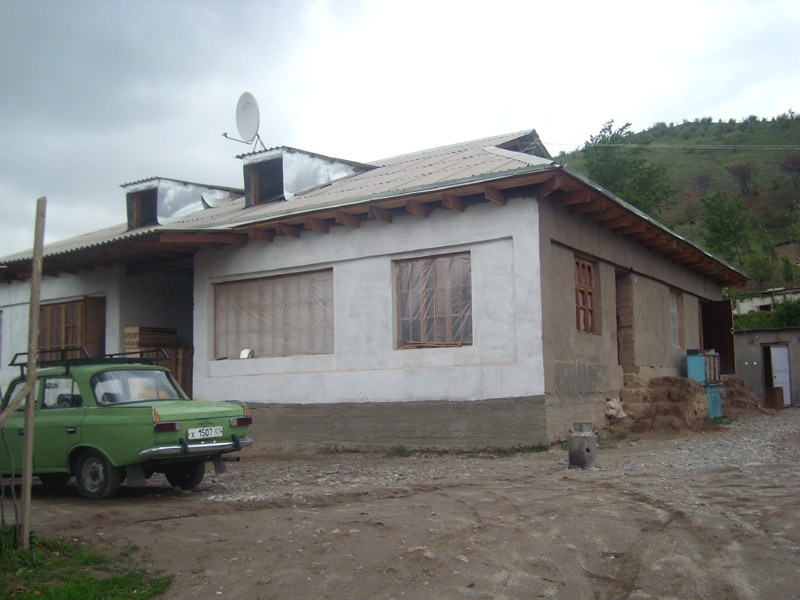
One of the homes in Dushanbe slated for demolition (RFE/RL)
Jamollidin Sirojov, a Dushanbe resident, took part in the demonstration in Dushanbe's Somoni district. Sirojov said his house was bulldozed two years ago, and he and his family have rented apartments since then. Sirojov said he was not offered any compensation by the local government.
"My house was destroyed," he said. "I don't know where to go or what to do. I don't understand the government at all. I don't know if they want to build or to destroy."
The mayor's office claims that it offers each family that loses a home 900 square meters of space in Dushanbe's eastern suburbs on which to build a new house. However, it doesn't provide the materials or the money to construct a new home.
Some families who lost their homes have reportedly been offered flats in the city's vast supply of Soviet-style apartment blocks, which are generally in poor condition.
Compensation Limited
Compensation for a lost home is available, but it is limited only to the poorest people. Only families who live below the official poverty line -- that is, those whose monthly income does not exceed the minimum salary of some $6 -- are entitled to get financial compensation for losing their homes. Under such a precondition, hardly anyone has been able to claim financial reimbursement from the government.
Guliston Temurova lives in Dushanbe's Koohdoman area, where all private houses are slated to be bulldozed. Temurova complains that water and electricity were cut off in the area two years ago. "Our authorities should be ashamed that they have left our children to live in such places with no water and electricity, and people face so much cruelty and pressure," she says.
There have been a number of protests by residents and extensive media coverage since the reconstruction project was launched in 2005. However, the authorities appear determined to go ahead with the reconstruction plan "to give the city a better look" and to offer the capital's residents "modern and affordable apartments."
Many Dushanbe residents say they hope the reconstruction plan will improve their city's image, although it is not clear how long it will take for city authorities to replace the destroyed buildings with new, attractive ones.
Unlike some Tajik cities -- such as Khojand or Kulob, which have thousands of years of history -- Dushanbe became a city in the 1920s when it was chosen as the place for the new Tajik capital to be built. Most of the buildings in the residential areas are aging, unattractive concrete apartment blocks that were built during the Soviet era. There are also many neighborhoods with privately built houses that are more original and varying in their looks and sizes.
RFE/RL's Tajik Service contributed to this report
Afghanistan: Warlordism 'Is Winning' Versus Democracy

A former government minister accused by some of war crimes, Abdul Rashid Dostum remains a leading power broker
RFE/RL's Radio Free Afghanistan broadcaster Jan Alekozai spent the past month in Kabul and eastern Afghanistan, where he was often approached by students, local officials, and Afghan tribesmen who expressed their concerns about corruption, security, and distrust in the government. He spoke to RFE/RL correspondent Ron Synovitz about those concerns.
RFE/RL: During the past month when you were in Afghanistan, outside of your own efforts to speak with people from different segments of Afghan society, how were ordinary Afghans able to approach you and what were some of their concerns?
Jan Alekozai: I participated, for example, in a meeting [in Jalalabad]. It was the celebration of orange blossoms -- a huge traditional gathering with 10,000 to 12,000 people. Someone announced my name -- Jan Alekozai from Radio Free Afghanistan. When the meeting was over, hundreds of people approached me -- students from high schools and from universities. They were asking, "Do the Westerners and the Americans know our problems -- that aid money is coming from the Westerners but it goes into the pockets of [corrupt] people in the government offices."
That was their concern when they talked to me because they know I am running a call-in program on the airwaves of Radio Free Afghanistan. There were lots of concerns. They were desperately approaching me and asking those things -- if we could bring their concerns to government officials. And they were expressing their concerns about their future and their lives, security, and education.
RFE/RL: What did Afghans tell you bothered them most about the security situation in Afghanistan?
Alekozai: People think now that [troops from] 37 countries or more are there in Afghanistan the security should be much, much better. They should terminate the warlordism and the private militias. [Instead], those people have connections with the governmental officials and they still have protection from the government. And that brings insecurity. In Kabul, especially, but also elsewhere in other parts of the country.
People want the international community to stop the private militias -- the groups that are so powerful. That's the main concern of the people, for security. And also, they should promote democracy. Real democracy. And work for that.
People are scared. They cannot say anything because of [the warlords]. We are an international radio [station]. We do something. But our correspondents, even, cannot say something against those warlords because they are very powerful. They could be killed easily or harmed easily. That's the situation. Everybody is asking why the international community doesn't hear.
Warlord Parliament
RFE/RL: Who do Afghans think is responsible for the strengthening of warlords in Afghanistan today?
Alekozai: No. 1, the international community -- or especially the Americans. They say: "Why have the Americans brought those people into power -- the warlords? They knew they were warlords." And [Afghans] can name them for you -- from the vice president to the deputy ministers and ministers. Quite a few were brought from outside.
In parliament, well-known warlords are there. In that situation, how do you expect [the] implementation of democracy and the rule of law -- unless those people are removed from their positions and weakened, at least, and educated people are given a chance -- [those] who think positively about the betterment of their country. Not for themselves. Those [warlords] are collecting money and putting the money in their pockets. They do little or nothing for the society and for the people.
RFE/RL: How do Afghans think the warlords have been able to consolidate this power?
Alekozai: In parliament, 65 percent [of the lawmakers] are warlords. There is no question. A few of them are ordinary Afghans or politicians. But most of them are warlords. They are much stronger than they were six years ago or five years ago, because now they get more money, more security from the international community, more bodyguards. They get stronger and stronger.
RFE/RL: Are there any specific examples of complaints from people about the increased power of warlords?
Alekozai: If you started from parliament or from the high governmental officials, you can see that warlordism is stronger than in years past. Television and other media cannot operate independently, if they do something and the next day they are in trouble in the parliament or with the high governmental officials.
Foreigners Must Deal With Warlords
RFE/RL: So if there is a conflict in Afghanistan now between warlordism versus democracy, which is winning?
Alekozai: At present, the warlordism is winning. If the international community does not pay attention -- strongly -- not by words. By action. They should eliminate the warlords. [The international community] thinks some of them are very strong. But they don't have public support.
I'm stressing this point. They are not that strong. They don't have public support because always they were thinking about themselves, their own pockets. They invest money outside of the country. People say that the Westerners, or in some ways they say the Americans, support these warlords. Otherwise they are nothing. They [say the warlords] were not powerful but [the Americans] made them powerful. And that was a main concern [of the Afghans].
It's very easy to remove them and bring in some people who have no connection with the warlords. And that would be real democracy that the people would enjoy.
RFE/RL: Does this disdain for warlords contribute to feelings of anti-Americanism or to negative views about the international community?
Alekozai: I never heard people saying that they don't want Americans or international forces in their land. That was interesting for me. Even mullahs -- the clerics I talked with and tribesmen. There were just a few who -- like Taliban or pro-Taliban people -- who said, "Oh, they are infidels."
But the majority of people, they never talked about that issue -- why [foreign troops] are here. [Ordinary Afghans] think there is some propaganda from other neighboring countries saying, "They are occupying your country." But to be honest, I haven't heard that from [ordinary Afghans]. They say, "Those people are here to help us." The only problem is that they don't trust the [Afghan] government. They also think that money is coming [to Afghanistan] from the international community and from the Americans. But it goes into the wrong hands and into the wrong pockets.
New Schools, Old Thinking
RFE/RL: What about the reconstruction work being done by international nongovernmental organizations (NGOs) or by foreign troops on the provincial reconstruction teams, the so-called PRTs?
Alekozai: People say their general feeling is that they think the PRTs are doing well. They trust them because they say they are foreigners and they are not corrupt -- so far. But they don't like NGOs and there is no question that they don't trust the Afghan government at all. Still, people hope the PRTs will be doing well and probably will do something about road construction, about schools and other things. People count on PRTs.
RFE/RL: U.S. officials often talk about the schools that have been built by PRTs as a positive step in the reconstruction of Afghanistan. Is this enough?
Alekozai: I've seen many schools that have been built and that are being built right now in different parts of eastern Afghanistan. There's no doubt about it. Nice schools. But there is no teacher. No chairs -- students are sitting on the floor. No electricity. No running water. No books. No [teaching materials]. No lab. What will be the quality of education in that situation?
RFE/RL: International media also report about greater rights and freedom for Afghan women since the collapse of the Taliban regime. How did that situation appear to you in the provincial regions as opposed to Kabul?
Alekozai: About the civil society or civic society, the participation of women is zero in the provinces. Girls are going to school. There is no doubt about it. But they cannot walk, for example, in a park -- or even with their families.
Still the work is not done for the promotion of democracy and freedom. I think the culture is the same, with little changes in the mentality of the society. It is very bad. And it will continue like that now six years after the Taliban. The mentality is still very strong. The Talibanization or fundamentalist ideas are still very, very strong.
Presidential Challenger
RFE/RL: All of these insights from ordinary Afghans suggests that Afghan President Hamid Karzai's popularity has declined dramatically since he was elected in 2004. Does Karzai have a chance to win reelection in the ballot that is scheduled for 2009?
Alekozai: As a journalist, one should talk with various people or people [with different political perspectives.] I learned [from doing this that something like] 25 percent or 20 percent will vote for Karzai. And I have doubts about [whether Karzai will even win that much of the vote.] It will be very difficult for him to get 20 percent. They need an alternative or another government.
RFE/RL: Are ordinary Afghans talking about any potential candidate who they think would help reign in the power of warlords?
Alekozai: In the eastern part of Afghanistan -- even in Kabul -- people were talking [about this] when I was sitting with them. They said [former Interior Minister] Ali Ahmad Jalali. His name was being mentioned by people now. [They were saying] he is coming and he is a stronger man and he can do something. He can eliminate warlordism. They were talking about him, saying that if he is [a candidate] that people will vote for him and he will be the winner. That was the expectation of some when I talked to them.
Uzbekistan: Family Says Jailed Poet, Sons Are Being Tortured

Yusuf Juma
A trial for alleged battery, use of insulting language, and resisting arrest opened on April 8 against Yusuf Juma and his 25-year-old son, Bobur, before the court quickly adjourned the proceedings to next week.
The two men were arrested in December after staging a protest in their native city of Bukhara against Uzbek President Islam Karimov
Speaking by telephone from undisclosed locations in connection with that hearing, Juma's fugitive wife and a third son told RFE/RL's Uzbek Service that their jailed family members have been "tortured," including being forced to watch the other sibling being beaten.
Juma, his son Bobur, and other family members conducted a "picket on wheels" in their hometown of Bukhara ahead of the December presidential election to call for a boycott and the resignation of Karimov, who won a controversial new term that appears to violate a constitutional ban on third terms.
Juma drove a vehicle around Bukhara displaying a banner that urged, "Dictator Karimov: Resign and Leave."
Juma also wrote a letter to the Uzbek Constitutional Court accusing Karimov of violating the constitution by seeking the third term and calling for his prosecution.
The preelection stir was not the first time that Juma has protested government actions. He is a well-known government critic and has written poems and articles criticizing Karimov and Uzbek authorities in the past.
Those efforts -- including a poem calling for Uzbeks to cast off the shackles of "slavery" -- landed him in prison in 2001. His 10-year-jail sentence was reduced under international pressure.
Now, Juma and his sons Bobur, 25, and Mashrab, 22, are all in jail.
Mashrab is serving a prison term for hooliganism. Family members and Uzbek human rights activists claim the charges were trumped up in an attempt to silence Juma.
Juma and Bobur face charges of using insulting language, battery, and resisting arrest.
The poet's lawyer, Ruhiddin Komilov, told RFE/RL that the hearing in a Bukhara regional court was quickly adjourned on April 8 "because Juma has not received material related to the case and the indictment."
The lawyer says Juma and his son face up to five years in prison if found guilty.
The poet's wife and three other children fled Uzbekistan following the arrest of the two men in mid-December. His wife, Gulnora -- who also participated in the December protest -- is reportedly sought for what the Uzbek authorities said were anticonstitutional activities.
Speaking to RFE/RL from an undisclosed location outside of Uzbekistan, Gulnora Juma said she fears for her husband's life.
"It's been almost five months that he's been in jail," she said. "Only twice was he taken to see a doctor after he complained about his heart. Otherwise, he has been in a single cell under strong psychological and physical pressure. People who saw him did not recognize him. He might die if he is not released [soon]."
She added that her two sons have also been abused in prison, according to relatives' who have been allowed to visit them.
"Both my sons were brought to the same prison cell and tortured there in front of each other -- one is being beaten up after the other," she said. "On top of that, they also endure strong psychological pressure. Our relatives have phoned us from Qorakol [a district of Bukhara] and told us this."
Juma's eldest son, Alisher, who also spoke to RFE/RL from an undisclosed location, expressed concern over the fate of his father and brothers.
"Our family has always fought against the Karimov regime. We intensified our fight before [the December 23 presidential] election. Now I don't know what to do," Alisher said. "Karimov considers my father a personal enemy and he is likely to imprison my father. But because [Karimov] is trying to improve relations with the European Union and America, he also may order the release of my father. Who knows?"
He suggested that authorities will ensure that "even if [Karimov] releases my father and brother, Bobur, he is likely to keep my brother Mashrab in his 'concentration camp' as leverage [against my father]."
The opening of Yusuf Juma and Bobur's trial took place one day before the start of a meeting between the EU "troika" and five Central Asian foreign ministers in the Turkmen capital, Ashgabat.
London-based Amnesty International on April 9 called on the EU to fully implement the human rights aspects of the bloc's Central Asia strategy, adopted in June. The group warned that there has been a "signal failure" by both sides to pursue the implementation of the strategy's human-rights elements.
One day earlier, New York-based Human Rights Watch (HRW) had urged the EU to establish human rights benchmarks for Central Asian governments and "make their fulfillment a core objective of its Central Asia Strategy."
HRW said the EU should redouble efforts to secure the release of all human rights defenders unjustly imprisoned in Uzbekistan and end the harassment of civil-society activists.
Andrea Berg, HRW's Central Asia researcher, says the EU should reinstate sanctions it imposed on official Tashkent following the 2005 bloodshed in Andijon, where hundreds of unarmed protesters are thought to have been gunned down by government troops.
"The sanctions should be reinstated until Uzbekistan fulfills all recommendations set by the European Union," Berg says.
The EU is scheduled to review its sanctions policy toward Uzbekistan later this month. In October, Brussels suspended some of the sanctions that had in place for over a year.
RFE/RL's Uzbek Service contributed to this report
Uzbek Justice Ministry Revokes Accreditation Of Chief Rabbi

Uzbekistan's chief rabbi, Abe Dovid Gurevich
The dwindling population of Jews in Central Asia represents one of the oldest religious communities in the region -- established more than 2,000 years ago, even before the predominant Muslim faith.
Though there are only thousands of Jews left in Central Asia, they still have a chief rabbi. But as of April 10, Gurevich has no official right to serve the Jewish community.
The Justice Ministry had warned on April 5 that the accreditation for Gurevich -- who has lived in Uzbekistan since 1990 -- may not be renewed. The ministry says it has multiple complaints against Gurevich and the Chabad-Lubavitch movement of Orthodox Judaism that he heads. Among those are that the group is not submitting its financial records, making its funding impossible to trace; that the organization meets at a different address than the one given to Uzbek authorities; and that Gurevich "says the laws of the Republic of Uzbekistan are not applicable to him."
Jalol Abdusattarov, the head of the Justice Ministry's Department of Religious Affairs, said on April 10 that Gurevich's activities exceeded his authority and were not in accordance with the stated goals and duties of his organization. He gave no specific examples of such activities.
'Not A Grain Of Truth'
Prior to the announcement that he was being stripped of his accreditation, correspondent Sadriddin Ashurov of RFE/RL's Uzbek Service spoke to Gurevich about the Justice Ministry's announcement. He said he had no idea why the ministry would refuse to prolong his accreditation.
Since the Justice Ministry mentioned the possible refusal of accreditation to the rabbi, the state press has published articles vaguely referring to the numerous violations of the law that Gurevich has committed and questioning whether Gurevich really has any official authority to head the Jewish community in Central Asia.
Gurevich said allegations that he violated the law are inaccurate. "None of the material written about us contains even a grain of truth," he said, "not a grain of truth."
The Jewish community in Uzbekistan has seen several setbacks in the last decade. When Uzbekistan adopted a new law on religion in 1998, it abolished the rabbinate, the Jewish community's administrative office. Subsequent attempts to reopen the rabbinate have failed, leaving the Jewish community without theological schools to train rabbis.
In February 2006, Avraam Yagudaev, a Jewish leader from Tashkent, was killed in an automobile accident that some said was suspicious. A few months later, tragedy struck again when Gurevich's secretary and her mother were found strangled to death in Tashkent.
Failed To Accompany Delegation
The news about Gurevich's accreditation problem came as more than 100 members of the World Congress of Bukharan Jews arrived in Uzbekistan, led by its president, Lev Leviev. The ancient Silk Route city of Bukhara is located in Uzbekistan, and the Bukharan Jews are perhaps the best-known Jewish group of Central Asia.
Gurevich said his current difficulties -- which the rabbi says also include visa problems -- prevented him from accompanying the delegation to the city, regarded as the Uzbek Jews' homeland. Gurevich said not even an April 4 meeting with Abdusattarov, of the Justice Ministry's Department of Religious Affairs, could clear up the accreditation problem and allow him to go to Bukhara.
State media outlets in Uzbekistan do not report on issues unless the government has a reason for the news to be made public. The campaign against Gurevich in the Uzbek press looks to be paving the way for Gurevich's eventual removal as head of the Chabad-Lubavitch movement.
As for the Bukharan Jewish community, it numbered some 40,000 when the Soviet Union collapsed in 1991. Today, it is about half that as thousands took the opportunity to move to Israel, the United States, or elsewhere.
CIS: Hunger Strikes Highlight Mounting Civic Despair
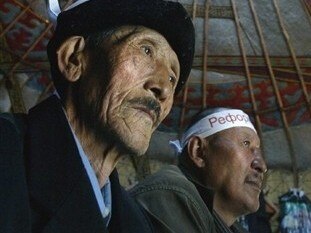
Kyrgyz opposition supporters in a yurt during a mass hunger strike
On March 10, the 45-year-old lawyer set up a tent outside the public defender’s office in downtown Tbilisi, and declared a hunger strike.
"As a lawyer, it was the only remaining option," says Jangirashvili, speaking by phone from Tbilisi this week, after calling an end to his strike after 29 days. "There are no free courts in Georgia; the role of lawyers is almost nil. We have no mechanism to oppose this."
Jangirashvili, who was lobbying for greater media access to court proceedings and less secrecy in appeal procedures, ingested nothing but water for almost a month; in the process, he lost 15 kilograms and says he feels exhausted.
But Jangirashvili is hailing the strike as a triumph. He says his campaign, which was joined by a number of fellow lawyers, succeeded in raising attention to the dire need of legal reform in Georgia.
"I think it was a success," he says. "My colleagues declared a strike, a legal initiative was introduced in parliament, 40,000 citizens gave their signatures, deputies and opposition figures helped me. My demands have started being fulfilled."
Growing In Use
Jangirashvili is not the first in Georgia to resort to this radical form of protest. Some 60 opposition activists last month staged a protest fast for 17 days to press their call for changes to the country's electoral system ahead of a key parliamentary poll in May.
Georgia itself is no exception -- hunger strikes are becoming increasingly common in neighboring countries, too.
Several journalists in Azerbaijan have been refusing food for more than a week to protest the jailing of three of their colleagues and the general crackdown on independent media.
In Armenia, a collective hunger strike by jailed opposition activists overshadowed the April 9 inauguration of Serzh Sarkisian as the country's new president. About 100 supporters of Levon Ter-Petrossian, who unsuccessfully ran against Sarkisian in the February 19 presidential election, have been in prison since massive protest rallies following the vote.
The Belarusian opposition also regularly resorts to hunger strikes. Former presidential candidate Alyaksandr Kazulin, who is serving a 5 1/2-year sentence for organizing antigovernment protests, starved for 53 days in late 2006 with one demand -- that the UN Security Council officially discuss the situation in Belarus. His plea was not fulfilled, but his ordeal became a powerful statement of protest against Belarus's authoritarian regime.
No Other Way
Throughout the world, hunger strikes are seen as one of the most radical forms of dissent, a protest of last resort.
They have been used by people fighting for a wide range of causes, from Indian spiritual leader Mahatma Gandhi to U.S. and British suffragettes in the early 20th century.
Perhaps the best-known hunger strike was held by Irish republicans in 1981. Twenty-seven-year-old Bobby Sands died in a British jail after an agonizing 66 days without food. Nine other jailed Irish republicans starved themselves to death to protest prison conditions.
But few hunger strikers show that kind of determination. Dr. Otmar Kloiber, the secretary-general of the World Medical Association, says hunger strikes have become a very elastic concept.
"We've seen various kinds of hunger strikes -- by prisoners, by workers. Hunger strikes take place for very different issues and with all kinds of degrees of severity," Kloiber says. "Some people take nothing; but sometimes a hunger strike means not eating anything during the day but eating something at night. Then there are hunger strikes where people refuse only solid food."
Nothing New
Hunger strikes were not uncommon in the Soviet Union, although censors made sure few details trickled down to the public.
Prison authorities often force-fed hunger strikers to avoid the embarrassment of their deaths -- a practice that continues today in places including the U.S. military prison at Guantanamo Bay. The tactic has been widely denounced by critics and medical ethicists as tantamount to torture.
Vladimir Bukovsky, the Soviet-era dissident who recently returned to the headlines with his bid to run in Russia's March presidential elections, was subjected to force-feeding as a political prisoner in Moscow's Lefortovo prison in 1971. He described the experience in an article published in "The Washington Post" in 2005 that is widely quoted as testament to the horrors of force-feeding:
"About a dozen guards led me from my cell to the medical unit. There they straitjacketed me, tied me to a bed, and sat on my legs so that I would not jerk. The others held my shoulders and my head while a doctor was pushing the feeding tube into my nostril.
"The feeding pipe was thick, thicker than my nostril, and would not go in. Blood came gushing out of my nose and tears down my cheeks, but they kept pushing until the cartilages cracked. I guess I would have screamed if I could, but I could not with the pipe in my throat. I could breathe neither in nor out at first; I wheezed like a drowning man -- my lungs felt ready to burst. The doctor also seemed ready to burst into tears, but she kept shoving the pipe farther and farther down. Only when it reached my stomach could I resume breathing, carefully. Then she poured some slop through a funnel into the pipe that would choke me if it came back up. They held me down for another half-hour so that the liquid was absorbed by my stomach and could not be vomited back, and then began to pull the pipe out bit by bit."
'Few Options' Left
Russia's veteran human rights campaigner, 80-year-old Lyudmilla Alekseyeva, recalls the use of hunger strikes during the Soviet era.
"Hunger strikes occurred in camps during the Stalin period. I was a little girl back then," Alekseyeva says. "As an adult, when there was already a dissident movement, I remember that political prisoners in camps also often resorted to this method."
Refuseniks -- Jews and other Soviet citizens who had applied for and been denied the right to emigrate abroad -- also used hunger strikes to pressure authorities into allowing them to leave the country.
Hunger strikes gained pace in the early 1990s following the collapse of the Soviet Union. As the economy unraveled throughout the former Soviet bloc, desperate workers turned to hunger strikes to protest payment arrears.
The 1981 hunger strike by Irish republicans has been instrumental in promoting this form of protest.
But the recent spike in hunger strikes in CIS countries also highlights a new degree of civic despair in the post-Soviet neighborhood. Faced with official indifference and corrupt courts, growing numbers of people see public starvation as the only way of drawing attention to their plight.
Aleksandr Tarasov, a Russian sociologist and expert on contemporary labor movements, says the growing number of hunger strikes reflects a rise in "authoritarian tendencies."
"Compared to late perestroika and the period that immediately followed perestroika -- until 1993-94 -- there has been a massive rollback in terms of the possibilities to defend one's rights through democratic means," Tarasov says. "When people realize that strikes, pickets, and demonstrations don't have the desired result, they are left with very few options."
Still Effective?
At least three hunger strikes are currently taking place in Russia.
Sixteen tradesmen in the city of Komsomolsk-na-Amure, in Russia's Far East, have been refusing food since April 2 to protest the closure of their market.
In Yuzhno-Sakhalinsk, on Russia's Pacific coast, six local deputies are on hunger strike in one of the parliament's cabinets to call for the dismissal of the city mayor.
In Krasnoyarsk, restaurant employees on April 8 barricaded themselves in their workplace and declared a hunger strike to demand the restitution of salary arrears. The restaurant owner has since admitted paying them in foodstuffs instead of money for the past five months, but claims he is currently unable to settle his debt.
Last week, a group of 97 exhausted miners left a mineshaft in the Ural Mountains where they had spent more than a week in protest over pay and work conditions. They had been without food for four days. The mine is owned by Oleg Deripaska, Russia's richest man, and declared a turnover of $14.3 billion for 2007 -- up 11 percent from the previous year.
Hunger strikes, however, appear to have lost some of their power as a pressure tool over the years. While hunger strikers were largely successful in the 1990s, Tarasov says only about half of them now achieve their stated goals.
But because of its length and the physical pain it entails, self-imposed starvation continues to be regarded in many former Soviet countries as the most effective -- and often only -- form of protest.
"I am a categorical enemy of hunger strikes. I always try to talk people out of this cruel way to seek solutions to their problems," Alekseyeva says. "But I am increasingly unsuccessful, because people don't see any other way out."
U.S. Organizer Of 1980 Boycott Talks About Politics And The Olympics
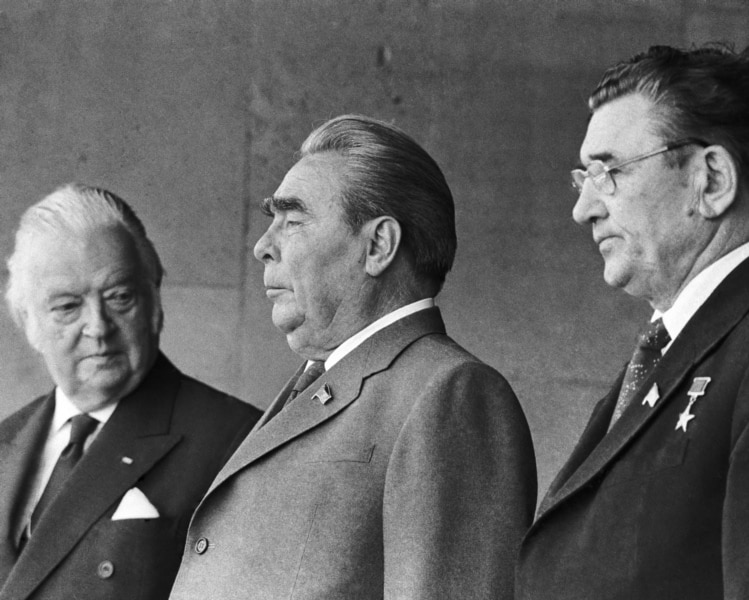
Leonid Brezhnev (center) at the opening ceremonies of the XXII Summer Olympics in 1980
RFE/RL: What was your position at the time of the boycott? You were working in the [U.S. President Jimmy] Carter administration....
Nelson Ledsky: I was the director in the State Department of the Olympic boycott office, an office which was set up at the beginning of 1980 to encourage countries to boycott the Moscow Olympics because of the Soviet Union's invasion of Afghanistan.
RFE/RL: Was Afghanistan the only reason?
Ledsky: It was the primary reason. The United States in 1980 lacked means of properly responding or responding in any meaningful way to the Soviet invasion of Afghanistan. And one of the instruments that the White House chose was to join with other interested countries who opposed the Afghan invasion by boycotting the Olympics, which had been awarded to Moscow well in advance of 1980. The Olympics, though, were to take place in 1980, and this was deemed a useful response, an embarrassment to the Russians, and a useful response to the Soviet invasion of Afghanistan.
RFE/RL: Can you tell us how the decision was made, and who the major players were?
Ledsky: The major players in making the decision to try to boycott the Olympics were the British, the Canadians, and the Americans. The three governments reached that agreement in January of 1980. It is true that the British and Canadians eventually did not join in that boycott, but they were among the original advocates of the boycott. The boycott was joined by some 60 to 70 countries, including China, including Saudi Arabia, including most of the Muslim world, which resented the Soviet attempt to take over Afghanistan. The joiners of the boycott were many third-world countries as well as some of the countries of Europe and Latin America.
RFE/RL: Were there commercial interests lobbying strongly for the U.S. to participate?
Ledsky: Yes, there were commercial interests who favored American participation. One such commercial enterprise was the National Broadcasting Company, which had paid the Russians some $75 million to broadcast the Moscow Olympics -- and they were anxious to keep broadcasting of course, they had paid money for it, but in the end they were persuaded by the U.S. government not to broadcast, and most American commercial enterprises that wanted to participate also did not participate.
Double-Edged Sword
RFE/RL: You say China was also boycotting the Moscow Games...
Ledsky: Looking back to 1980, it is ironic that those who participated in the 1980 boycott subsequently changed their mind. We were very resentful when the Russians boycotted the Olympics in the 80s in the United States, and you can understand that the Chinese -- having won the Games for themselves for 2004 -- would be upset at the thought that people would boycott the Beijing Games. But there is talk of it all over the international community.
RFE/RL: Do you think the 1980 boycott was a success?
The National Stadium in Beijing, a main venue for the 2008 Olympics (AFP)
RFE/RL: So you think it could be a serious option to get China to improve its human rights record?
Ledsky: It is not an idle threat. I have no idea what the U.S. government is thinking about -- or what other governments are thinking about, but the Tibetan situation is an interesting case where there is not a whole lot that the Western world or the Eastern world can do in Tibet. But they can send a signal through the Olympics. Now I know the Olympics movement [and] the Olympics committees of the various countries would be strongly opposed to such a move, and, as I say, I am only responding to your questions and am not raising the possibility myself.
'Useful Effort'
RFE/RL: If you were asked to head a committee to boycott the Chinese Olympics, would you do it?
Ledsky: I would be tempted to. I mean, as a matter of fact, I think the effort in 1980 was a necessary effort, it was a useful effort, and it did have consequences on Russian behavior and their purchase to Afghanistan. So it may be the only tool that the Western world can apply in situations like Burma or Tibet -- but it's not without its effect.
RFE/RL: How big was the office you oversaw, the boycott committee?
Ledsky: We had three or four people working in the office in the State Department. And we had a good liason with other countries who were participating in the boycott. I remember a series of international meetings that we attended, and it is ironic that the Chinese at the time were very supportive of the boycott.
RFE/RL: What was the Chinese reason for boycotting the Moscow Games?
Ledsky: Well, I think they also objected to the invasion of Afghanistan; their policy at that moment was anti-Soviet. And the Chinese did go around Africa and Asia urging people to participate in the boycott.
Sports And Politics
RFE/RL: Do you think mixing sports and politics is a good idea?
A monument to the 1980 Olympics on Moscow's Kutuzovsky prospekt
RFE/RL: Was there any moment where you felt it was the wrong decision to boycott the Olympics? Did you have interaction with the Russians?
Ledsky: Yes, we had a conversation with the Russians. I personally never thought it was the right thing to do in 1980 -- I'm not saying it's the right thing to do in 2008 -- I'm not an advocate of it. But it is a tool, in situations where there are very few tools to respond to a human rights or political situation.
RFE/RL: Were there any interesting moments during your work in preparing for the boycott? And how long did the process last?
Ledsky: It lasted almost a year. There were all sorts of curious incidents. The Chinese participating in the Olympics was one strange event. The other was Romania under Ceaucescu participating in boycotting. We had a lot of funny events. We had Muhammad Ali -- the famous boxer, the world champion -- first signing up with President [Carter] to advocate a boycott, and then -- at the last moment on a trip to Africa and Asia -- he changed his mind and was convinced by the Nigerians not to boycott. So, yes, there was a series of comic, semi-comic, semi-tragic events connected with the boycott. And that's why I'm not an advocate of it; I'm just responding to your questions about the past.
RFE/RL: Did you receive any complaints from U.S. athletes?
Ledsky: [There were] many American athletes who resented the decision of the U.S. Olympic Committee to go along with the U.S. government in boycotting the Olympics. There was a lot of mail. There were a lot of angry meetings, and I remember a few of those meetings where we had a hard time explaining to athletes who had spent years getting ready for the Olympics why they were being asked by their government not to participate. So there were some very unpleasant letters, some unpleasant meetings, but the U.S. government, at least in 1980 under President Carter, held its ground. And the U.S. Olympic Committee did not send a team to Moscow.
RFE/RL: Were you surprised when the Soviets decided to boycott the Los Angeles Olympics in 1984? Which boycott was more effective?
Ledsky: Well, the boycott of Los Angeles was not effective. Not only did the games go on, but the games generated income for the organizers. The Moscow [Olympic] games went on -- they took place -- but there was very little international participation, and the Russians lost a great deal of money and a great deal of prestige.