



Child Labor Alive And Thriving

Central Asian children pick cotton (International Labor Organization (ILO), ILO-IPEC PROACT-CAR project)
While some children toil out of necessity for their families, in some countries the use of child labor is a state policy.
Children, some of them as young as 7 years old, can be found working at virtually every bazaar in Central Asia. They sell anything from food to clothing and cosmetics, and preteen boys often push carts in outdoor markets while young girls from the countryside offer to work as housekeepers.
The money they earn is often a lifeline for their families. Poverty is the main reason these kids leave school and work.
"I am proud that I work and get paid; I distribute bread," says 13-year-old Safar from the Tajik capital, Dushanbe, adding, "I wish I could go to school together with my classmates, but life is hard and I have to work."
Officials in Central Asia have long denied that children are forced to work. Many contend that the kids are helping their parents after school and that it is rural residents themselves who send their children into the fields to earn much-needed cash.
Firuz Saidov, an expert on child labor at the Center for Strategic Studies under Tajik President Emomali Rahmon, admits that there is no way to stop child labor because many Tajiks live in poverty and children are crucial for families to have enough money to survive.
"Children work mostly in trade, agriculture, and in the street -- they wash cars. It's hard to stop this in Tajikistan," Saidov says. "Their rights are violated both by employers and police."
But in many rural areas, particularly in places like Uzbekistan, it is the government that forces children to pick cotton. The practice has existed since the Soviet era and continued when the Central Asian countries gained independence in 1991 -- even after they joined international agreements banning child labor.
Not An Official Priority
Human rights activists say that cotton brings cash to the state coffers as well as to the pockets of the ruling elite in some countries.
Jovid Juraev, of the international organization Save the Children in Dushanbe, is critical of the Tajik authorities' stance on the use of child labor. He says there is no political will to end it despite official pronouncements to the contrary.
"The use of children in cotton picking has become a national catastrophe -- some 200,000 Tajik children are forced to do hard and harmful work [with the number increasing during the main harvest season]," Juraev says. "It amazes me that despite the decrees made by the president and the government, children are still subject to economic exploitation. And no one dares to fight it."
In neighboring Uzbekistan, the world's third-largest cotton exporter, the use of child labor in the cotton sector is a state policy.
As the cotton harvest begins in September, schools are shut down and thousands of children are bused to fields, sometimes with a police escort. They pick what is dubbed the "white gold" that brings around $1 billion in annual exports for Uzbekistan.
Uzbek authorities have been under fire from international human rights groups to stop using forced child labor in the cotton industry. A campaign launched in November brought some results, as major clothing chains including Tesco, Marks & Spencer, Gap, and H&M -- as well as textile producers in South Asia -- resolved to stop buying Uzbek cotton fiber.
The Long Haul
Nadezhda Atayeva, who heads the Paris-based Association on Human Rights in Central Asia, says that "noticeable progress" has been made in the campaign to boycott Uzbek cotton. She says the Uzbek authorities seem to have stopped denying the use of child labor and are willing to hold a dialogue with human rights groups and international organizations.
The Uzbek parliament adopted a law in January on "Guarantees of the Rights of the Child." It was followed by ratification of the International Labor Organization's (ILO) convention on the worst forms of child labor and minimum age.

In Kyrgyzstan, a girl collects tobacco leaves (ILO courtesy photo)
She also says the coming cotton harvest will be a litmus test for the Uzbek government.
"Despite those positive changes, it is important that international organizations have the possibility to monitor the situation in the autumn," Atayeva says. "Every interested party should be able to go to [Uzbek] cotton fields and check if there are children below the age of 15 working there and, if so, what their working conditions are."
History Of Ambivalence
In Turkmenistan as well, child labor is widely used during the cotton harvest, although the country is a signatory to the UN Convention on the Rights of the Child. It also passed laws in 2002 and 2005 prohibiting the employment of children under the age of 16 and regulating a child's right to protection from exploitation.
The late Turkmen President Saparmurat Niyazov frequently issued statements on the necessity of ending child labor, but the situation remained largely unchanged throughout his presidency.
The U.S. State Department estimated that more than 1 million children were part of the labor force in 2000. More recent statistics are hard to find.
Last year, Niyazov's successor, Gurbanguly Berdymukhammedov, made a similar statement. But human rights activists say children are still widely used for labor in Turkmenistan.
In Kazakhstan, children work in cotton and tobacco fields and as unskilled laborers in urban areas. In recent years, children from neighboring Uzbekistan and Kyrgyzstan have been working in Kazakhstan along with their parents.
Dana Zhandayeva, Kazakh project coordinator of ILO's child-labor project, tells RFE/RL that the situation with forced child labor has improved since the Kazakh government ratified two ILO conventions (one on a minimum employment age and the other on the worst forms of child exploitation) and asked for international organizations' assistance to stop the use of child labor.

A boy hauls potatoes in Amina, Kazakhstan (ILO courtesy photo)
There are bright spots. Zhandayeva says that in Kyrgyzstan, for instance, the government has been at the forefront of the fight against child slavery. She says the Kyrgyz government is the only one in Central Asia that not only cooperates with international organizations to fight child labor but also allocates funds to stop it.
RFE/RL Tajik Service correspondents Zarangez Navruzshoeva in Dushanbe and Mirzo Salimov in Prague contributed to this report
Russia: Hate-Crime Deaths Mounting, As Nationalists Close Ranks
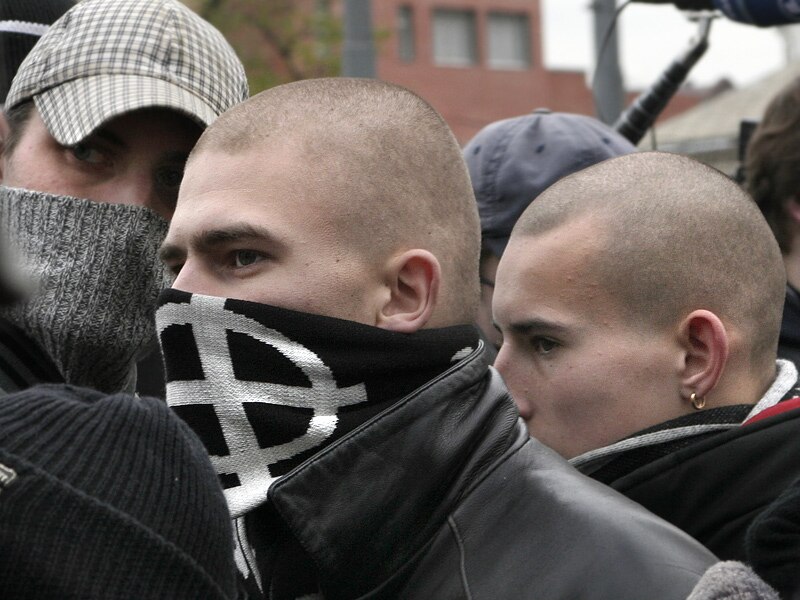
Young nationalists march in Moscow
The punch came without warning, dealt by a young man wearing brass knuckles. A second assailant then picked up the woman's limp body while his friend struck her repeatedly in the face and stomach.
"Two men came up from behind and hit me," she recalls. "First they hit my right eye and then broke my nose and cheekbone. I fainted immediately. I hadn't done anything wrong, they attacked me because I was veiled."
Kamola doesn't remember being rushed to a nearby hospital. She regained consciousness four days later with injuries so severe that she now faces major brain surgery and facial reconstruction work.
But the mother of two considers herself lucky to be alive. Like most foreigners and ethnic minorities in Russia, she is painfully aware that dozens of people die every year in racially motivated assaults.
According to Sova, a Moscow-based organization that monitors such crimes, extremists have already killed 57 people and wounded another 117 this year in Russia. Only six months into the year, hate-crime figures already look set to exceed those of 2007, when a total of 80 people were murdered.
The real number of victims, however, is probably much higher.
"The figure of 57 is much lower than some estimates; gathering solid information has become very difficult," says Galina Kozhevnikova, Sova's deputy director. "We already wrote last year about our serious difficulties in obtaining information, and this year I can't even describe how difficult it has become. Such cases are not reported in the media, and law-enforcement agencies don't give us anything at all."
Climate Of Impunity
The intensity of the assaults is also on the rise, evolving from simple beatings to torture and mutilation.
The cruelty hit a horrifying peak in August 2007, when a video was posted on ultranationalist websites showing a group of masked men killing two dark-skinned captives execution-style.
Russia's Interior Ministry and secret services at first dismissed the grisly footage -- in which one of the bound men is beheaded, and the other shot in the head -- as a fake.
Some hate-crime experts had also cast doubt on the video's authenticity until a man in Daghestan recognized the beheading victim as his brother. The Russian Prosecutor-General's Office on June 5 publicly confirmed the video was genuine.
Racism was an unspoken fact of life during the Soviet era, even as the USSR publicly celebrated the utopian harmony of its myriad ethnicities and cultures.
Since the collapse of the Soviet Union, however, once-dormant prejudices have been allowed to devolve into active racism -- particularly in Russia, where resurgent national pride and heavy labor migration from neighboring states have proven an explosive combination.
The Kremlin has done little to curb the problem. Critics say the government has even poured fuel on the fire with nationalist measures such as the mass deportation of ethnic Georgians in retaliation for the 2006 arrest of Russian officers in Tbilisi, or the ban on all foreign traders in retail markets -- a move then-President Vladimir Putin said was intended to protect the interests of "native Russians."
Russia's judicial system has been equally reluctant to combat hate crimes. Although the number of prosecutions for racially motivated attacks has increased in recent years, many assailants continue to get away with little more than a slap on the wrist.
At the same time, Russian skinheads and neo-Nazis are seeking to organize their ranks. On June 8, at least four large nationalist groups signed a pact to unite forces in order to better address the problems of "migration and corruption." An estimated 70,000 Russians are believed to be members of nationalist organizations.
It is undeniable that hate crimes are on the rise. The question is why. Some experts say neo-Nazis and other assailants are reacting to a rare police crackdown earlier this year. Others believe that increasing numbers of young Russians, frustrated by poor educational and professional opportunities, are taking their anger out on migrant workers.
Shift Of Target
Desire Deffo came from Cameroon to St. Petersburg almost two decades ago to study hydrology. Africans, who once flowed into the country to pursue higher education studies, were a primary target of hate crimes in St. Petersburg. But Deffo says assaults against Africans have dropped sharply over the past year -- and that Central Asian migrants now appear to be the bearing the brunt of the city's racist attacks.
"The growing number of arriving Tajiks and Uzbeks work on building sites, in markets, and young Russians are not pleased about that," he says. "The majority [of Africans] are students, and the attitude toward us has improved. If before dark skin was the main factor, today the migrants' occupation also plays a role."
Groups like Sova say Central Asians, the vast majority of whom come to Russia in search of work, have replaced dark-skinned foreigners and people from the North Caucasus as the main victims of racist attacks. Of the 57 people killed this year, 31 are from Uzbekistan, Tajikistan, and Kyrgyzstan.
Veteran rights activist Svetlana Gannushkina says deep-running ties between government authorities and the construction industry, which depends on cheap Central Asian labor, may help explain the official laxness in combating racist violence.
"Now the main victims are people from Central Asia. Authorities allow this to happen because Central Asians are currently the chief resource for slave labor," she says. "Their vulnerability is profitable to those who exploit them, it's profitable to have workers who are frightened and broken-spirited. Authorities profit from this because they are closely connected to these structures."
Rampant discrimination, combined with the threat of attacks, have contributed to an atmosphere of fear that puts immigrants under severe emotional and psychological stress.
Gavkhar Dzhuraeva, who heads a Moscow-based support group for migrants, says this anxiety is pushing many to suicide. Other migrants, bent on revenge, have begun to resort to vigilante justice.
Dzhuraeva, who herself is an ethnic Tajik, has lived in Moscow for the past 15 years. She speaks flawless Russian and holds a Russian passport. But she feels just as victimized as newcomers.
"To feel comfortable," she sighs, "I'd have to stop looking at myself in the mirror."
Kyrgyzstan: Chingiz Aitmatov, A Modern Hero, Dies

Chingiz Aitmatov in January
He had suffered lung and kidney failure after falling ill three weeks ago while on a film set.
On May 16, Aitmatov was in the central Russian city of Kazan, where a Russian film crew was making a film based upon his novel and a documentary about his life, when he complained of feeling ill. He was quickly rushed to a local hospital, and two days later flown out to a hospital in Germany.
Aitmatov's condition was reported to be serious but stable until June 10. That morning, Kyrgyz Culture Minister Sultan Rayev told RFE/RL's Kyrgyz Service that the writer's health had significantly worsened, but few expected that this was the last day for the man who was regarded as the conscience of his nation.
Aitmatov's works have been translated into more than 170 languages and UNESCO said he was among the world's most read contemporary authors. Some of Aitmatov's books have been made into films in Kyrgyzstan, Russia, and Turkey.
'An Author Of World Significance'
Among his many fans was former Soviet leader Mikhail Gorbachev (Aitmatov also was one of his advisers during the perestroika era.) On learning the news of Aitmatov's death, Gorbachev called the writer "my great friend" and said, "a person has passed away who was close to us all."
Former Russian President and current Prime Minister Vladimir Putin called Aitmatov's passing a "great and irreplaceable loss for all of us," adding that Aitmatov "will remain in our memories" as a "great writer, thinker, and humanitarian." New Russian President Dmitry Medvedev also expressed his condolences.
Academician Abdyldajan Akmataliev, a scholar of literature and the director of the center for the study of "Manas," a Kyrgyz epic heroic poem, at Kyrgyzstan's Academy of Sciences, describes Aitmatov as "an author of world significance."
The Ataturk Culture, Language, and History High Agency of Turkey set up a special committee earlier this year to nominate Aitmatov for the Nobel Prize in literature. Turkish Minister of Culture and Tourism Ertugrul Gunai recently said that representatives of culture ministries from Turkic-speaking countries and regions, including Azerbaijan, Kazakhstan, Kyrgyzstan, Turkmenistan, Uzbekistan, and also representatives from Russia's republics of Tatarstan and Bashkortostan, planned to forward Aitmatov's candidacy.
Turkish President Abdullah Gul was among the first world leaders to respond to the news of Aitmatov's death. He said it was a "loss not only for Turkic countries, but for the whole world." Gul went on to say Aitmatov's contribution to literature and to the 20th century would "be remembered with warmth and respect."
Writer For All Nations
Aitmatov was the son of a Kyrgyz father and Tatar mother, but his writing transcended ethnic barriers to the point where all Central Asians considered him "their" writer, and indeed, citizens of the Soviet Union came to consider him "their" writer as well. His books were popular for truthfully describing life in the Soviet Union, but were sufficiently tempered to avoid being considered outright criticism of the Soviet authorities.

Aitmatov with his daughter, Shirin, in 1975
Well-known Uzbek writer and political dissident Muhammad Solih tells RFE/RL's Uzbek Service that Aitmatov's death was a great loss for the Turkic-speaking people. "He was one of the great writers in the Turkic-speaking world," he says. "He was a thinker, philosopher, and a great symbol of the Turkic world." Solih says Aitmatov embodied "the honor and dignity of al the Turkic world in the 20th century. He was one of the greatest geniuses of the Turkic literary world, I would say."
Representatives of other minorities of the former Soviet Union, such as Nivkhis, Tajiks, and others, would say the same. Russians also regard him as "their" writer because Aitmatov wrote in both Kyrgyz and Russian and his novels are taught as modern Russian literature in Russia's secondary schools.
Representing Kyrgyzstan
For years, Aitmatov preserved his good image and politicians of all stripes in his native Kyrgyzstan sought his public support, hoping to tap into Aitmatov's popularity. He was one of the main intellectuals who endorsed the Kyrgyz language's status in the 1980s, when few schools were teaching in Kyrgyz in Bishkek (formerly Frunze), the capital of Kyrgyzstan.
He was also good for Kyrgyzstan's image, drawing positive attention to the small Central Asian country similar to the kind of publicity that former Czech President Vaclav Havel earned for his country. His intellectual gathering, the famous Issyk-Kul (Yssykkol) Forum founded in 1986, was credited as being a major breakthrough in creating a dialogue between intellectuals of the West and the Soviet Union.
After independence in 1991, Aitmatov also served as Kyrgyzstan's ambassador to European countries (Belgium/Netherlands/Luxembourg and France), UNESCO, the European Union, and NATO. Works by Aitmatov have received numerous awards, including Soviet-era accolades like the Order of Lenin, the Gold Olive Branch of the Mediterranean Culture Research Center, the Academy Award of the Japanese Institute of Oriental Philosophy, and the Austrian State Prize for European Literature. He was also an academician of the Kyrgyz National Academy (1974) and the Hero of Kyrgyzstan (1997).
Aitmatov's father, Torokul Aitmatov, one of the first Soviet-period national officials in Kyrgyzstan, was executed by the Stalin regime in 1938 on charges of being an enemy of the people and a pan-Turkist. His body, along with those of other Kyrgyz intellectuals and leaders, were recovered only after the Soviet collapse and the Ata-Beyit (Father's Graveyard) memorial complex to the victims of Stalinism was erected near Bishkek in 1992 to inter them. The name Ata-Beyit was given by Chingiz Aitmatov, who was one of the first Kyrgyz writers to openly expose the Stalinist purge in the 1980s.
RFE/RL's Kyrgyz Service interviewed the renowned Kyrgyz writer on his 79th birthday on December 12, 2007, while he was still serving as ambassador to Brussels. He praised the role of RFE/RL for the Soviet and post-Soviet societies, saying that "we could not live without listening daily" to RFE/RL in the 1980s. Aitmatov encouraged RFE/RL and other media and democratic institutions to continue their work. "Democracy cannot be built at once, cannot be developed overnight," he said. "Democracy has to be in motion, as a stream, all the time."
For Aitmatov, mankind's main achievements were spiritual. As he put it in August 2006, during a meeting with Kyrgyz writers, poets, and journalists in Bishkek, "Whatever the economic or industrial achievements are, in the end any achievements will be measured by culture and spirituality."
Aitmatov leaves behind a wife, three sons, and a daughter.
The Kyrgyz people say that two heroes made their nation world-known: one is the epic hero of "Manas," the other is Chingiz Aitmatov. They will say their last goodbye to this great son on June 14, when Aitmatov will be buried with his father in the Ata-Beyit memorial cemetery he helped found. The Kyrgyz government has declared June 14 a day of mourning in his honor, and a special state commission has been established to organize his funeral.
RFE/RL's Kyrgyz and Uzbek services contributed to this feature
Uzbekistan: Freed Rights Activist Calls Uzbek Prisons 'Islands Of Torture'

Mutabar Tojiboeva
Tojiboeva was serving an eight-year sentence for criticizing officials for violently ending a protest in the southern town of Andijon in 2005.
"There is only one thing I can liken my life [in prison] to: Uzbekistan's prisons are like islands of torture," Tojiboeva told RFE/RL's Uzbek Service shortly after reuniting with her family. "They are isolated from society and from people."
Tojiboeva, who is from Ferghana in the country's east, was arrested in October 2005 and sentenced to eight years in prison on more than a dozen charges, including slander and extortion.
Independent observers and human rights activists said the charges were fabricated and aimed at silencing Tojiboeva, a fierce critic of the Uzbek government.
Deteriorating Health
Tojiboeva, who is 46 years old, had sent letters from prison saying she was being ill-treated and tortured. She was temporarily held in a psychiatric detention center and forced to undergo medical treatment in 2006.
Domestic and international organizations had long urged the Uzbek authorities to release Tojiboeva, whose health was deteriorating.
Tojiboeva's release came as U.S. Assistant Secretary of State Richard Boucher visited Tashkent for high-level meetings with Uzbek leaders. Boucher said on June 2 after meeting with President Islam Karimov that talks had focused on improving human rights and that some progress had been made.
The Uzbek government has a practice of freeing jailed human-rights defenders ahead of important meetings. Earlier this year, a number of opponents of the government were set free ahead of a key bilateral meeting between Uzbekistan and the European Union, which has suspended sanctions imposed against Uzbekistan following the Andijon violence. Independent observers and human rights organizations called the move by Tashkent mere window dressing on the country's poor human-rights practices.
Not Told Of Release
Tojiboeva says her release came as a surprise to her and her fellow inmates and that she was not told until the last minute.
"One of the inmates said, 'There will be visitors tomorrow and they want to hide you in another prison.' So I expected to be transferred to the Tashkent prison," she says. "The prison administration and representatives of the Interior Ministry were standing there, and I asked them where I was going. They didn't say anything."
Tojiboeva will remain on parole for the next three years.
"It means for the next three years they will watch every step I take," she says. "If I say anything unpleasant about those in power or for any other government officials, they will find a reason to put me behind bars again."
Despite that pressure, Tojiboeva says she will continue to fight for human rights and the freedom of those men and women living in the harsh Uzbek prison conditions.
"You know, as I said, Uzbekistan's prisons are islands of torture. I cannot ignore the plight of imprisoned men and women caught on those islands," Tojiboeva says. "I believe I have to continue my activity now in order to end torture in Uzbek prisons and defend the rights of male and female inmates. This is my duty now."
Top Human Rights Award
Earlier this month, Tojiboeva won an international human rights prize -- the Martin Ennals Award for Human Rights Defenders -- which is awarded jointly by the world's 10 leading human rights organizations, including Amnesty International and Human Rights Watch.
Hans Thoolen, the chairman of the jury for the award, described Tojiboeva as "an exceptionally brave woman in a country where standing up for human rights is a dangerous activity, which can lead to imprisonment and death."
Tojiboeva's release might make it possible for her to receive the award in person in Geneva later this year.
RFE/RL Uzbek Service correspondent Shuhrat Babajanov contributed to this report
Central Asia: Ambition Often The Downfall Of Powerful Presidential Relatives
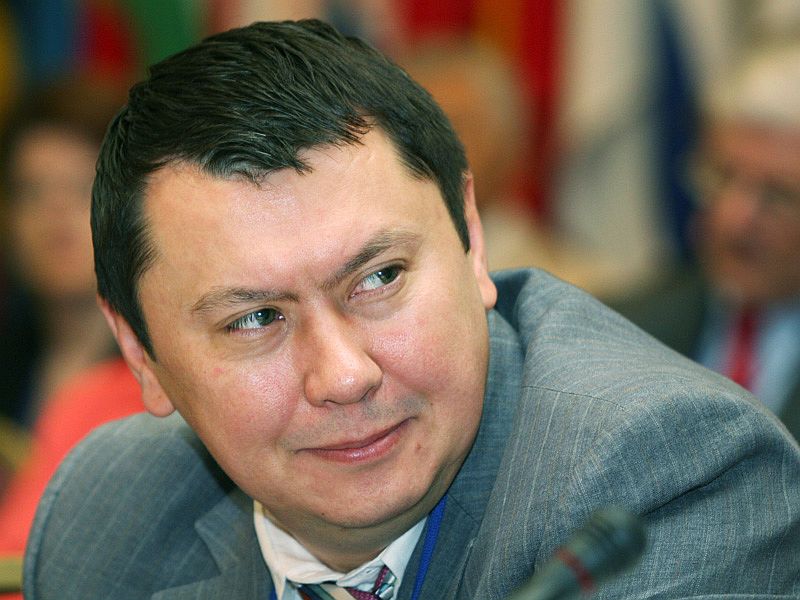
Once one of the most powerful men in Kazakhstan, Rakhat Aliev is now in exile
So go the lives of many of Central Asia's rich and well-connected. Sadulloev, if the allegations about his demise are confirmed, is hardly the only important figure in the region to rise to power and wealth through bloodlines or marital ties, only to later court ruin through unconstrained ambition. It's a plotline found in similar stories in Kazakhstan, Kyrgyzstan, and Uzbekistan.
Sadulloev, the latest such case, disappeared nearly a month ago, prompting a regional media frenzy about his possible murder by a member of the country's first family. Sadulloev heads Orienbank, one of the largest Tajik financial institutions. He reportedly owns at least 13 other large companies in the country.
For Tajiks, however, Sadulloev is best-known as President Emomali Rahmon's brother-in-law, a man who in a short period of time rose from humble village origins to become the owner of a vast business empire. He gathered his wealth, many observers say, thanks to connections. His sister Azizamoh, after all, is the president's wife.
Regional media reports regularly speculate that Sadulloev was killed, or seriously wounded, by one of Rahmon's children, amid the first family's discontent with Sadulloev's growing influence and ambition.
Dodojon Atoullo, an independent Tajik journalist, is a long-standing critic of Rahmon. Atoullo says that the president was disappointed by Sadulloev's "political ambitions."
"Lately, Hasan Sadullaev had started to consider himself an alternative to the president, saying if something happens to the president he would take the job," Atoullo says. "There were two centers of power in Tajikistan: one around Rahmon and another around Sadulloev."
Reaching Too High
Such a story certainly rings a bell in neighboring Kazakhstan. Rakhat Aliev, former son-in-law of President Nursultan Nazarbaev, was a medical doctor before marrying the president's daughter, Darigha.
Aliev eventually rose to head the country's chief tax body before becoming first deputy security minister, a banker, media tycoon, and ambassador. Needless to say, he accumulated an immense fortune along the way. But he did not stop there.
In 2007, when he was charged by a Kazakh court with kidnapping and murder, Aliev claimed he was being punished for having presidential ambitions.
The court, however, found him guilty of kidnapping two bank workers and extorting financial assets from a number of people and companies. In a separate trial by a Kazakh military court, Aliev was also convicted of masterminding a plot to overthrow the government.
Aliev, whose wife divorced him last year, remains out of the country. If he set foot in Kazakhstan, he would face immediate arrest as the courts have sentenced him to a total of 40 years in prison.
Despite divorcing Aliev, Darigha Nazarbaeva also received her own share of "punishment."
She used to accompany her father on important trips abroad. Her party, Asar, was the country's second-largest political bloc. Nazarbaeva was widely seen as her father's successor as president.
However, shortly after the Aliev scandal erupted, Nazarbaeva's party was virtually dissolved and her influence in politics has receded.
Atoullo, the Moscow-based Tajik journalist, says Central Asian presidents do not tolerate anyone, including the closest family members, "who even dream about the presidency."
A Hard Fall From Grace
Indeed, since gaining independence in 1991, Central Asian countries have experienced many changes -- but they have not seen many changes in president. Nazarbaev and Islam Karimov, his Uzbek counterpart, have ruled since the Soviet era, as did former Turkmen leader Saparmurat Niyazov until his death in 2006.
In Kyrgyzstan, former President Askar Akaev stayed in power for nearly 15 years and did not leave until people took to the streets accusing him and his family of corruption and taking over the country's main industries.
Rahmon has ruled Tajikistan since 1992.
All of the presidents have sent their main political opponents into exile or prison. And it seems the punishment for harboring presidential ambitions has been extended to family members, too.
As in Rakhat Aliev's case, those whose presidential ties were somehow severed had to cope with far more than just a broken heart. When Rahmon's daughter Tahmina divorced her first husband, her former father-in-law, Yormuhammad Gulov, was sacked as head of the State Food Company.
But Mansur Maqsudi, an Afghan-American and the former son-in-law of the Uzbek president, lost much more after his marriage to Gulnora Karimova hit the rocks. Soon after marrying into the first family, Maqsudi formed a joint venture with the Coca Cola bottling company in Uzbekistan, becoming the new firm's president.
Although Coca Cola denies receiving any favorable treatment from the government, regional media reports said the joint venture was given access to "the only big bottling plant in Tashkent that met U.S. standards," in the process pushing its chief rival, Pepsi, out of the Uzbek market.
After the couple's divorce, however, Maqsudi's businesses, as well as his Afghan emigre family living in Tashkent, suffered the consequences.
Coca Cola's three plants were raided and their employees harassed. Meanwhile, Uzbek police reportedly rounded up more than 20 of Maqsudi's relatives, driving them to the Afghan border and dropping them off on the other side.
Such stories are starting to weigh on Central Asians, who are growing tired of high-level corruption while ordinary people face rising food prices, unemployment, and poverty.
Alima Sharipova, a university professor in the Kyrgyz city of Osh and an independent expert on social issues, says people in the region are fed up with "presidents giving away their country's wealth to relatives and new relatives as a gift and appointing them to official posts.
"It was presidential family members' greed that brought Askar Akaev's demise," she adds. "And it's not impossible that the same scenario can be repeated in Kyrgyzstan and elsewhere in Central Asia any day."
Analysis: Political Prisoner As Swap Commodity
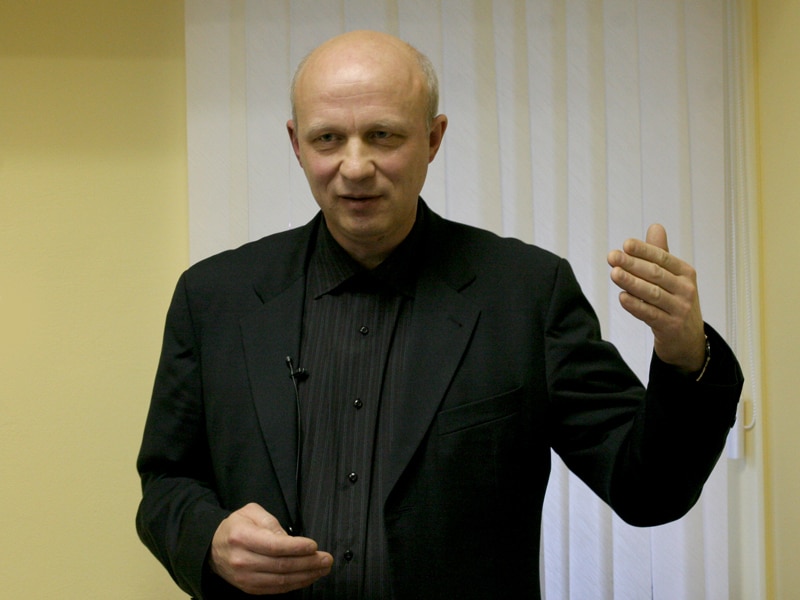
Alyaksandar Kazulin -- one political prisoner too many?
On January 23, Belarusian authorities released Zmitser Dashkevich, the leader of the opposition Youth Front, after he served 16 months of an 18-month sentence for heading an unregistered organization.
Dashkevich's release was followed by a that of another Youth Front leader, Artur Finkevich. Finkevich spent two years under a "restricted freedom" regime for writing political graffiti, and then in October 2007 had his sentence extended by another 18 months for violating the rules of his correctional facility. On February 5 of this year, however, the court considered Finkevich's appeal, unexpectedly shortened his second term to six months, and released him immediately.
Ten days later, President Lukashenka ordered the released of Andrey Klimau, an opposition politician who in August 2007 was sentenced to two years in prison for insulting the president and calling for revolution in an article posted on the Internet. Klimau, who served as a legislator in the Supreme Soviet of Belarus in 1995-96, had been jailed twice before. He served four years of a six-year sentence he received in 1998 on charges of embezzlement; in 2005, he was sentenced to 18 months of "restricted freedom" for his role in organizing a demonstration in Minsk.
Following the decision on Klimau, it became apparent that some backstage deal had been made between Minsk and Brussels on the issue of political prisoners. So it was no surprise at all when on February 22, Belarus's Supreme Court shortened a three-year prison term given to journalist Alyaksandr Zdzvizhkou to three months. Zdzvizhkou was sentenced in January for republishing the controversial Danish cartoons displaying the Prophet Muhammad in an independent newspaper in 2006.
In the meantime, it became known that in the first half of February, Belarusian Foreign Minister Syarhey Martynau -- who is among Belarusian officials currently subject to an EU travel ban -- secretly visited Germany. There, it can be presumed, Martynau suggested how Europe might reward Minsk for releasing its political prisoners.
The details of the deal were not made public. But it was clear to all that its ultimate success depended on the release of the last of Belarus's prisoners of conscience, former presidential candidate Alyaksandr Kazulin, who was serving a 5 1/2-year prison term for leading an antigovernment demonstration in the wake of the 2006 presidential election.
Carrot And Stick From EU
For the past 10 years, the European Union has concocted a rich brew of measures meant alternately to punish Lukashenka for un-European behavior, to lure him into behaving in a more respectable manner, or to financially and morally support his opponents in their attempts to oust him. As of yet, such efforts have been to no avail.
Lukashenka tops the list of 36 Belarusian officials banned from entering the EU because of their role in vote-rigging and cracking down on human rights. The last country to invite the Belarusian leader for an official visit was France, in 1996. Ironically, after his meeting with French President Jacques Chirac, Lukashenka said he greatly admired France's presidential form of government -- to the degree that he wanted Belarus to emulate it without delay. In November 1996, Lukashenka staged an infamous and heavily rigged constitutional referendum that handed him authoritarian powers and did away with the fledgling democracy Belarus had acquired at the time.
To that stricture, Brussels added a sweetener, issuing in November 2006 a "new message to the people of Belarus," in which the European Commission promised to rain the benefits of its European Neighborhood Policy upon Belarus in exchange for democratic concessions from the governing regime. There are 12 conditions the EU extends to partnership governments in this money-for-democracy trade -- including transparent elections, freedom of expression and association, fair treatment by the judicial system, and the release all political prisoners.
When Lukashenka freed Dashkevich, Finkevich, Klimau, and Zdzvizhkou, it was clear that he was acting under a swap deal concluded with Brussels. But the deal collapsed when it came to Kazulin.
The Kazulin Case
In 1994, when Lukashenka was first elected president, Kazulin was a deputy education minister. In 1996, Lukashenka appointed Kazulin rector of Belarusian State University (BDU) in Minsk. Kazulin, who was known at the time to refer to himself as "the president's man," was reelected to the same post by BDU professors in 2000. From 1998-2001, Kazulin held the rank of minister in the Belarusian Cabinet of Ministers. In 2001, however, Kazulin's luck began to turn. Lukashenka fired him in connection with a criminal investigation into a company affiliated with the BDU, although Kazulin's complicity in the case has never been confirmed.
In 2005, Kazulin switched to the opposition, joining one of Belarus's cantankerous social-democratic parties. In 2006, he unsuccessfully challenged Lukashenka in the presidential race. Kazulin positioned himself as an opposition candidate, although the united opposition stood behind another hopeful, Alyaksandr Milinkevich. In his words and actions both before and after the March 19 election, Kazulin proved to be much more radical than Milinkevich.
In the second of his two campaign appearances on state-run television, Kazulin stunned the nation by touching upon Lukashenka's family life and morals. He disclosed that the incumbent president had a mistress, and a young son from the relationship. The nominal first lady, Halina Lukashenka, had meanwhile been living in a provincial city since Lukashenka's inauguration in 1994. Lukashenka was far from pleased to have his personal life parsed by a political opponent. Kazulin was subject to a harsh beating by presidential bodyguards when he tried to enter the so-called All-Belarusian Assembly, a grand propaganda event intended to endorse Lukashenka as "the people's candidate" two weeks before election day.
On March 25, 2006, during an opposition march led by Kazulin from downtown Minsk to a prison holding several hundred protesters incarcerated in the wake of the presidential election, Kazulin was arrested. In July 2006, he was sentenced to 5 1/2 years in prison on charges of hooliganism and disorderly conduct. At the time, some commentators suggested that Lukashenka saw Kazulin -- a charismatic and strong-willed politician -- as a potential threat, and was determined to keep him in jail past the point of a second presidential challenge in 2011.
During his incarceration in a penal colony in northern Belarus, Kazulin staged a 53-day hunger strike, demanding that the UN Security Council place Belarus's human rights situation on its agenda. His demand was not fulfilled but, nevertheless, his protest had resonance on the international scene, and even prompted the U.S. ambassador to the United Nations to raise the issue at a closed-door Security Council session.
On February 23, 2008, Kazulin's wife Iryna died after a long battle with breast cancer. Kazulin was given a three-day release from the penal colony to attend her funeral in Minsk. While at home, he confirmed the previously reported rumors that Lukashenka offered him an early release to help his wife seek treatment abroad but only on the condition that they would never come back to Belarus. He said both he and his wife refused to accept this condition. Kazulin, who gave a spate of interviews to both international and independent domestic media during those three days, returned to prison with the bearing of a man with unbending political convictions, if not that of a national hero and martyr.
Lukashenka subsequently tried to quell the furor incited by Kazulin's appearance in the capital by publicly vilifying the Belarusian opposition in general as paid mercenaries of the West, and Kazulin in particular as "used toilet paper." But it is now obvious for everyone that, with the Kazulin case, the Belarusian president showed not only his well-known malevolence but also a less well-known political weakness -- wanting to get rid of a political rival by forcing him to emigrate.
Another Lukashenka Growing Up?
There are apparently no immediate threats to Lukashenka's rule in Belarus. Russia's continued benevolence in subsidizing gas supplies to Belarus supports the Belarusian "market-oriented socialism" as a viable economic model. But recently, perhaps inspired by the Vladimir Putin-Dmitry Medvedev power deal in Russia, Lukashenka has begun to publicly muse about his successor.
In April, state-run television showed Lukashenka in the company of a small, fair-haired boy. While visiting a provincial city, Lukashenka reiterated a curious but casual remark dropped earlier this year that his youngest son would be Belarus's future president. And the Interfax news agency, while commenting on this news, noted in passing that Lukashenka has "three sons, and the youngest, Mikalay, is four years old." The identity of the boy has not been officially confirmed, but there is some speculation in the independent Belarusian press that Lukashenka is indeed thinking about preparing this mysterious child to succeed him.
If so, Lukashenka would have to continue in his current post for the next 31 years until his purported youngest son reaches 35 and becomes constitutionally eligible to run for the presidency. By then, Lukashenka would be 85 years old. Given his current good health, and the political-longevity model of fellow leaders like Zimbabwe's Robert Mugabe, who remains vigorous at the age of 83, Lukashenka could well attempt such a strategy.
But there are other potential options. Some publications, citing Lukashenka's predilection for changing the constitution (he's already done it twice), suggested he could adjust it again to lower the age of presidential eligibility to 18. In that case, a changeover could be expected in 2022 -- meaning just another 14 years of Lukashenka's rule to go.
More Political Prisoners Coming
Lukashenka, for the time being, has abandoned any plan to swap Belarusian political prisoners for better relations with Europe.
On April 22, a Belarusian court sentenced opposition activist Andrey Kim to 18 months in prison for allegedly attacking a police officer during a protest in January. Two days later, another activist, Syarhey Parsyukevich, received a 30-month sentence for allegedly beating a guard while serving a 15-day sentence for participating in the same protest.
On May 22 and 27, in relation to the same protest, a court in Minsk sentenced nine youth activists to two years and one to 18 months of "restricted freedom" without sending them to correctional institutions. The verdict implies that if they violate the regime of serving their sentences, they may be sent to real penal colonies.
In other words, the pool of political prisoners in Belarus has been partially restored in preparation for any possibility that Brussels will once again launch negotiations with Minsk about improving relations. However, it seems advisable for any future EU negotiators to take into account the other 11 demands formulated in November 2006 -- not only the one about releasing political prisoners. Apparently, releasing some political prisoners is a serious problem for President Lukashenka. But putting them behind the bars is not a problem at all.
Uzbekistan: Government Launches Campaign Against Missionaries
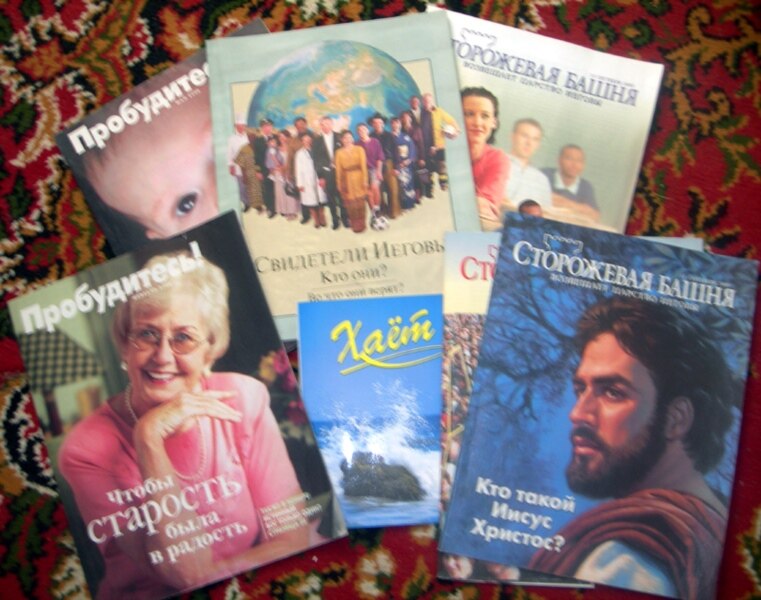
Religious literature is strictly banned in Uzbekistan
Now, the government of President Islam Karimov is taking a broader aim against believers -- this time targeting primarily fringe Christian missionary groups.
A recent documentary on Uzbek state television condemned such groups as the Jehovah's Witnesses, Christian Gospel Church, and Blagodat (Grace) as creating a "global problem, along with religious dogmatism, fundamentalism, terrorism, and drug addiction."
The documentary, "In the Clutches of Ignorance," featured several Uzbek religious and political experts, state officials as well as representatives of the Orthodox and Catholic churches in Uzbekistan. All took a critical view of missionaries.
Jasur Najmiddinov, a theologian from Uzbekistan's Islamic University, was among the many religious experts interviewed. Najmiddinov accused Christian missionary activities, especially by Protestant groups, of becoming a "political tool" and a "part of geopolitical games."
"Their center or place of origin traces back to the United States," Najmiddinov says. "They have even gone so far as meddling in politics. We all know representatives of the Protestant movement played a significant role in the Orange Revolution in Ukraine."
In an interview with RFE/RL's Uzbek Service, Najmiddinov later said that Christian missionary movements are a "hidden threat to Uzbek society" and that their activities are "as dangerous as terrorist activities or the illegal drug trade."
The Uzbek theologian added: "Missionaries' activities here can lead to disruptions in our society. If a member of an Uzbek family -- our family member or one of our relatives -- change their faith, the family would not tolerate it."
The documentary also showed video footage of people gathering and praying. It said Uzbek Christian converts, having betrayed their Islamic faith, could easily betray their country, too.
Uzbek law prohibits all religious missionary activity, unregistered religious groups, and the unapproved publication of religious literature.
Defenders of religious freedom, such as the Norway-based group Forum 18, say there has been a steady rise in repression against religious communities in Uzbekistan, including police raids on private homes, detentions of believers and converts, and deportations of foreigners involved in religious activities.
According to Forum 18, a young female Jehovah's Witness was detained and physically assaulted by a police officer after a raid on a private home in the city of Samarkand in March. In another police raid in Samarkand on April 3, security forces detained a Christian convert, Bobur Aslamov. He remains missing. Forum 18 also says several other Protestant church members were beaten during the raid and that police seized Christian literature as well as a laptop computer.
On April 9, police in Tashkent reportedly raided a service held by a group called the Full Gospel, an offshoot of Pentecostalism. Church leader Serik Kadirov was arrested along with four others. They were released the following day.
The state television documentary, broadcast on May 16, accused missionaries of targeting "those with low political awareness and weak-willed young people, as well as minors." It added that missionaries that "get funds abroad" undermine the Uzbek people's Islamic faith and values.
Islam, But Only Government Islam
That's a charge that strikes many as ironic, however.
Religious-freedom defenders and Uzbek government critics say the country's Muslim community is more tightly controlled than any other religious group in the country. Activists say hundreds of ordinary Uzbek Muslims are put behind bars on a regular basis for merely practicing their religion.
Obidkhon Qori Nazarov, a prominent Uzbek imam, tells RFE/RL's Uzbek Service that he blames the Uzbek government's pressure on Muslims for alienating many Uzbeks from their centuries-old faith.
"This is the result of the government's policies. The government is not leaving Muslims alone," Nazarov says. " People are being fired from their jobs or expelled from universities for merely growing a beard or wearing head scarves. Some people are even sent to prison. People are afraid of following the most basic Islamic requirements. For instance, parents do not allow their children to pray or to go to mosques, because they are afraid of the government."
The Uzbek government maintains that Muslims, Christians, and followers of all other religions enjoy full freedom in following their faith. However, government critics such as Nazarov say the government controls all religious activities -- and that even imams are appointed by authorities.
"It's like Soviet times," Nazarov says. "In the Soviet days, we also had mosques and churches everywhere. But in reality, they all operated under the tightest government control."
RFE/RL's Uzbek Service contributed to this report
Russia: Disabled Still Largely 'Invisible' In Society
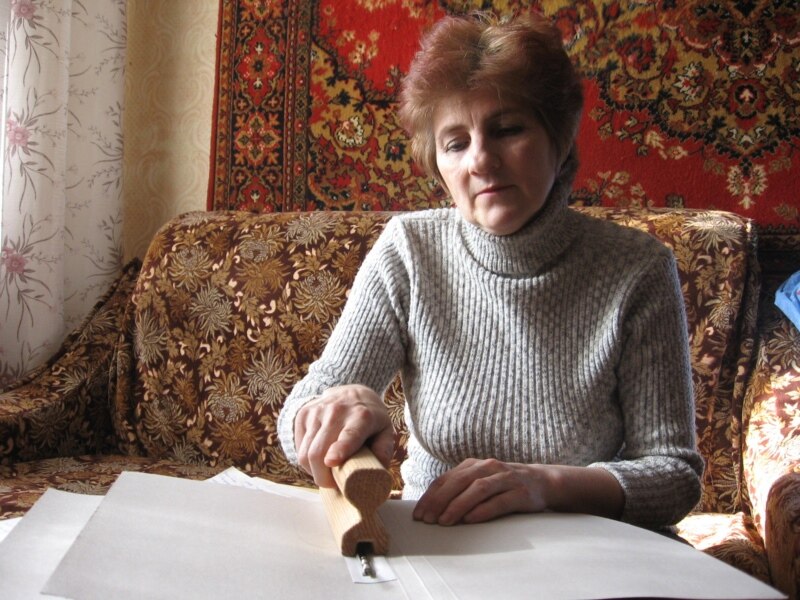
Zifa Sadriyeva says the jobs on offer are "humiliating"
Her husband, too, is disabled. Sadriyeva has a job -- she works from home, making cardboard folders for a local office-supplies company. But the work pays just 1,000 rubles ($40) a month, hardly enough to cover expenses for food and the medications she and her husband need.
All the same, it is a job, she says, something most disabled people in Russia do not have. By law, employment agencies in Russia are obliged to seek out work for disabled people. But the reality is very different, according to Sadriyeva.
"What they offer at the job centers for disabled people simply isn't suitable for us. They are all low-paid jobs," she says. "It is so humiliating. The idea of working cheers anyone up, especially disabled people like us. I know disabled people who were offered jobs like nursery-school teacher or boiler worker. Men are offered jobs as plumbers; but tell me, can a disabled person work as a plumber?"
In Tatarstan, as in the rest of Russia, companies are legally obliged to employ a certain percentage of people with disabilities. But Dania Galiullina, a spokeswoman for Tatarstan's Labor and Employment Ministry, says most companies simply ignore the law.
"Companies that refuse to employ disabled people have to pay fines," Galiullina says, "but the amount of the fine is so low, most companies prefer to accept that they are breaking the law and just pay the fine."
Out Of Sight
According to the United Nations, 14 million Russians are disabled. But it's rare that you will see a wheelchair user, a person with Down's syndrome, or a blind person on the streets.
Denise Roza, director of Perspektiva, an NGO that champions the rights of people with disabilities in Russia, says that during the Soviet period, people with disabilities were almost never seen.
"Most disabled people were invisible. They had no rights, there was no legislation. It was as if they weren't there -- I mean they weren't out in the community," Roza says. "If you ask disabled people who lived through the Soviet era, they'll tell you that, that 'We were invisible.'"
Two prominent Soviet societies that began operating in the 1920s did much to help certain areas of the disabled community: the blind and the deaf. But children with developmental disabilities, including Down's syndrome and cerebral palsy, were mostly taken away from their families and put into institutions, Roza says, where they received little, if any, education.

Social-system reforms drew Moscow's community of disabled people out for a rare public protest in mid-2004 (epa)
Today, Roza says, the emphasis for disabled children is to include them in ordinary schools, rather than sending them to specialist institutions, where they are cut off from the rest of society.
"Children need to be with their families, they need to be near their homes. And they need to have a community. But that argument unfortunately doesn't always work, because we have special educators [in Russia] -- they call themselves 'defektologists,' a term that we dislike -- who tell us that children are better off in this other setting," Roza says. "All you have to do is look around you to see that you don't see people with disabilities, because they've been isolated in special institutions. We meet a lot of these people when they're 18, 19, 20, and it's very hard to find them jobs, because they're not ready to go off to work, because they don't have social skills; they don't have a network."
Societal Friction
This different approach causes some friction between the more traditionalist groups of people with disabilities in Russia and groups that take their leads from Western organizations.
"On the whole, we support integration, because the main aim of our society is to integrate the deaf person into society, into ordinary society," says Aleksandr Ivanov, the head of the Rehabilitation Department at the Russian Society for the Deaf, which has 200,000 members across the country. "The trouble is that this is very individual -- one deaf child might be able to study at an ordinary school using special equipment, but there are other children who, for various reasons, find it very difficult to learn, and so of course it's better for them to go to specialist schools."
Natalia Prisetskaya has been in a wheelchair since a spinal injury left her paralyzed in the lower half of her body at the age of 15. Not only did she lose many of her teenage years, her confinement to a wheelchair meant her studies were cut short, for the simple reason that she wasn't physically able to get to her lectures.
"After my accident, I went to university to study," Prisetskaya says. "But it was very difficult because there were so many stairs, and because of that I gave up my studies."
Only now, at 34, has she completed a degree in economics, half a lifetime after she began.
Nevertheless, more traditional schools are starting to accept children with disabilities. In Moscow alone, 10 schools now take children with developmental disabilities, blind and deaf children, and children in wheelchairs -- and more are expected to welcome these children in the near future.
Citizens In Peril
For Pavel Opiyev, who has been blind since birth, integrating into society was less difficult than for his peers. His was a rare case: his mother taught at the local school, so unlike most blind children he was able to study at a mainstream school for a few years before he was sent for more specialized education. His main complaint about Russia is how difficult it is, as a disabled person, to get around.
"Taking into account that in Moscow nothing at all is very accessible, then, yes, [it's very difficult]," Opiyev says. "In Russia there aren't that many disabled people who can find the strength to move around on their own. And you can understand why: Our public transport system isn't just inaccessible, it's downright dangerous. You take your life in your hands. On the metros and on buses, nothing is provided for disabled passengers. And on the streets, perhaps only one in 10 traffic lights" emits a coded audible signal for blind pedestrians.
In the last few years, Opiyev, who is 28, has twice been knocked down by a car, and has nearly fallen beneath an underground train on several occasions.
At Perspektiva, Roza's top priority today is to persuade the government to adopt the new UN convention on disabled rights. She is positive about the future, particularly after a recent speech given by the new Russian president, Dmitry Medvedev, in which he promised to take greater steps to help the country's disabled population.
"This was an issue we did not talk about at all for a long time," Medvedev said. "But the situation is changing now, and the state has made this issue one of its priorities."
In Prisetskaya's estimation, life is starting to improve, albeit slowly, for Russians with disabilities.
"I think we have more opportunities than before because society is starting to change, rather a lot, and it seems to me that these days it's difficult to force someone to stay at home," Prisetskaya says. "Also, you see more and more disabled people on television, on the streets. You see more and more how people who are disabled are leading ordinary lives."
RFE/RL's Tatar-Bashkir Service contributed to this report