


Leaders from the world's energy sector have told the World Economic Forum in Davos that the current price of oil -- about $40 per barrel -- is too low to allow them to make investments needed to ensure that they can meet energy demands in the future.
Tony Hayward of the U.K.-based oil firm BP told the gathering he thinks a fair market price would be somewhere between $60 and $80 per barrel.
Hayward says that price range would allow OPEC countries to balance their national budgets and fund necessary social programs, as well as to make investments which will guarantee future energy supplies beyond the current economic downturn, after which demand is expected to increase.
"The price is low because demand has fallen because economic growth in most parts of the world has stopped," Hayward said. "This is not about low prices because we've added lots of new capacity. It's about demand destruction, at least in the short term. And the big challenge for all of us is to recognize that when economic recovery returns, demand will come back very fast.
"And it won't be very long before demand runs into supply constraints unless we are all able to invest through this downturn," he continued. "The most important thing is having a price that allows the industry to continue to invest through the downturn."
'Name Of The Game'
OPEC Secretary-General Abdalla Salem el-Badri also warned the Davos forum that current prices are too low to allow for reinvestment into exploration or new transport infrastructure.
"The investment is the name of the game. If we don't invest now, we are just postponing the problem for the next three or four years," el-Badri said. "When your economies pick up, when the demand picks up, you will not find the excess capacity to satisfy that demand. We are not happy, as a matter of fact, with $40 [per barrel or] with even $50 [per barrel]. We think that even with $50 [per barrel], we cannot really have a decent income for all [OPEC] member countries and, at the same time, reinvest for additional capacity."
The OPEC secretary-general and the leader of BP agreed that there are dangers in allowing the price of oil to rise too high. Hayward noted that changes in consumer behavior could be seen last year when the price of oil reached $100 per barrel. And el-Badri admitted that last year's peak price of $150 a barrel was well beyond what the market could bear.
"In 2008, when I was in my office looking at $147 to $150 [per barrel oil] price, I was not really happy at all to see that high of a price. Maybe that seems strange, but it's true, because that wasn't based on any fundamentals. That price was created by speculation and nothing else," El Badri said. "We were seeing a very high price that we didn't believe in. We knew that one day the price would come down [and that] that price would have a destructive effect on the demand side."
El-Badri called for some type of international guidelines to prevent market speculation from driving prices to demand-damaging levels in the future.
"We cannot eliminate speculation. Speculation will be there. But I think we should have guidelines for this speculation process," he said. "It does damage the market. It does damage demand and spill all over the economy of the world. I would like to encourage cooperation and dialogue between producers and consumers where we can understand each other, where we can have a reasonable price -- where we can have enough income for our countries and also where we can invest for future capacity."
'We Will Not Suffer'
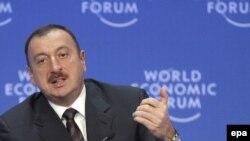
Azerbaijan's President Ilham Aliyev, whose country is not a member of OPEC, told the Davos forum that state-controlled energy firms in Baku are now exporting all of the oil and natural gas that they can.
"We have seven pipelines for oil and gas which can transport our hydrocarbons to various directions. We do not depend on only one route and we do not depend on only one market," Alliyev said. "The countries that are surrounding us are actually in need of our resources. Even the countries which produce much more oil and gas than Azerbaijan made an offer to us to purchase our gas and oil. Therefore, for the coming years, we will not suffer from any kind of difficulties related to diversification."
Aliyev also said that Azerbaijan's state-controlled energy firms are ready to continue investing in transport infrastructure to expand their markets.
"What we are concentrating now on is how to find new markets -- how to extend the existing pipelines in order to be able to produce as much as we want," he said. "And new markets are ready. New markets are in the West, in Central Europe. New markets can be [along the proposed] Nabucco [natural gas pipeline -- including Bulgaria, Romania, and Austria]. New markets can be Turkey, Greece, Italy, [countries linked to] trans-Adriatic pipelines, and others."
Regarding the proposed Nabucco pipeline -- which would deliver gas to Europe while circumventing potentially troublesome supplier and transit countries like Russia and Ukraine -- Aliyev said there are still a lot of problems.
Among the challenges he mentioned were political support, political will, financial commitments, transit issues and, in Aliyev's words, "too many players" involved in the project.
"The countries of Nabucco and the organizations which support this project, I think, must act more courageously," Aliyev said. "They should not look at this project only as a profit resource. It's a matter of energy security. Energy security leads to general security, to independence in the long run."
Geopolitical Tensions
The European Union, which was badly stung by a Russian-Ukrainian gas shutoff earlier this month, has failed to commit direct resources to the 10-billion-euro Nabucco project.
Until proposed pipelines like Nabucco are completed, Aliyev suggested there will continue to be geopolitical tensions over control of energy deliveries from the Caspian and Caucasus regions.
 Abdalla Salem el-Badri, secretary-general of OPEC"Demand for our resources now is much higher than the existing transportation infrastructure can supply. Therefore, for the coming years, we will just be an observer to very sometimes unpleasant developments in our neighborhood," he said.
"Of course, we would like to see more cooperation in the region because in this or that way, these tensions play a negative role. And actually, they create additional tensions in the global energy sector. We don't want to see that," he continued. "We want to have predictable, sustainable supply routes and mutual understanding between all the players."
Mukesh Ambani, chairman and managing director of Reliance Industries in India, told the Davos forum that the world is moving increasingly away from coal and oil toward natural gas and other forms of energy. He said the task now is to create a "bridge to a decarbonized world" where energy prices are stable and reflect a balance that is good for everyone -- including consumers, energy producers, and governments that rely on revenues from their energy sectors.
Time For Nuclear Power
Pierre Gadonneix, chairman and CEO of the French energy firm EDF, said he agrees that demand for energy supplies will increase as soon as the global economy rebounds. He said that makes the present the right time to invest in alternatives to oil and natural gas -- including the nuclear power projects that his firm is involved with.
"The long-term prospective of the energy sector has nothing to do with the economic downtrend that we are living now. All of us know that the economy will start again. Nobody knows if it will be in months or in years. But we know that it will start again," Gadonneix said.
"The energy needs that I mention are really there. So we should invest. And I think all this analysis is a very good environment for the renewal of nuclear [power]. And clearly, my company EDF is bound to play a major role in the renewal of nuclear [power] in France, in Great Britain, in China, and maybe in the United States," he said.
But Gadonneix admits that the biggest obstacle facing nuclear energy producers are the safety and environmental concerns of the general public.
Those kind of concerns show that the global energy outlook is related to more than just supply and demand. Providers must be as sensitive to the political will of consumers as well as to the price that consumers are able to pay for energy.

Tony Hayward of the U.K.-based oil firm BP told the gathering he thinks a fair market price would be somewhere between $60 and $80 per barrel.
Hayward says that price range would allow OPEC countries to balance their national budgets and fund necessary social programs, as well as to make investments which will guarantee future energy supplies beyond the current economic downturn, after which demand is expected to increase.
"The price is low because demand has fallen because economic growth in most parts of the world has stopped," Hayward said. "This is not about low prices because we've added lots of new capacity. It's about demand destruction, at least in the short term. And the big challenge for all of us is to recognize that when economic recovery returns, demand will come back very fast.
"And it won't be very long before demand runs into supply constraints unless we are all able to invest through this downturn," he continued. "The most important thing is having a price that allows the industry to continue to invest through the downturn."
'Name Of The Game'
OPEC Secretary-General Abdalla Salem el-Badri also warned the Davos forum that current prices are too low to allow for reinvestment into exploration or new transport infrastructure.
In 2008, when I was in my office looking at $147 to $150 [per barrel oil] price, I was not really happy at all to see that high of a price. Maybe that seems strange, but it's true...
The OPEC secretary-general and the leader of BP agreed that there are dangers in allowing the price of oil to rise too high. Hayward noted that changes in consumer behavior could be seen last year when the price of oil reached $100 per barrel. And el-Badri admitted that last year's peak price of $150 a barrel was well beyond what the market could bear.
"In 2008, when I was in my office looking at $147 to $150 [per barrel oil] price, I was not really happy at all to see that high of a price. Maybe that seems strange, but it's true, because that wasn't based on any fundamentals. That price was created by speculation and nothing else," El Badri said. "We were seeing a very high price that we didn't believe in. We knew that one day the price would come down [and that] that price would have a destructive effect on the demand side."
El-Badri called for some type of international guidelines to prevent market speculation from driving prices to demand-damaging levels in the future.
"We cannot eliminate speculation. Speculation will be there. But I think we should have guidelines for this speculation process," he said. "It does damage the market. It does damage demand and spill all over the economy of the world. I would like to encourage cooperation and dialogue between producers and consumers where we can understand each other, where we can have a reasonable price -- where we can have enough income for our countries and also where we can invest for future capacity."
'We Will Not Suffer'
Azerbaijan's President Ilham Aliyev, whose country is not a member of OPEC, told the Davos forum that state-controlled energy firms in Baku are now exporting all of the oil and natural gas that they can.
"We have seven pipelines for oil and gas which can transport our hydrocarbons to various directions. We do not depend on only one route and we do not depend on only one market," Alliyev said. "The countries that are surrounding us are actually in need of our resources. Even the countries which produce much more oil and gas than Azerbaijan made an offer to us to purchase our gas and oil. Therefore, for the coming years, we will not suffer from any kind of difficulties related to diversification."
All of us know that the economy will start again. Nobody knows if it will be in months or in years. But we know that it will start again.
"What we are concentrating now on is how to find new markets -- how to extend the existing pipelines in order to be able to produce as much as we want," he said. "And new markets are ready. New markets are in the West, in Central Europe. New markets can be [along the proposed] Nabucco [natural gas pipeline -- including Bulgaria, Romania, and Austria]. New markets can be Turkey, Greece, Italy, [countries linked to] trans-Adriatic pipelines, and others."
Regarding the proposed Nabucco pipeline -- which would deliver gas to Europe while circumventing potentially troublesome supplier and transit countries like Russia and Ukraine -- Aliyev said there are still a lot of problems.
Among the challenges he mentioned were political support, political will, financial commitments, transit issues and, in Aliyev's words, "too many players" involved in the project.
"The countries of Nabucco and the organizations which support this project, I think, must act more courageously," Aliyev said. "They should not look at this project only as a profit resource. It's a matter of energy security. Energy security leads to general security, to independence in the long run."
Geopolitical Tensions
The European Union, which was badly stung by a Russian-Ukrainian gas shutoff earlier this month, has failed to commit direct resources to the 10-billion-euro Nabucco project.
Until proposed pipelines like Nabucco are completed, Aliyev suggested there will continue to be geopolitical tensions over control of energy deliveries from the Caspian and Caucasus regions.

"Of course, we would like to see more cooperation in the region because in this or that way, these tensions play a negative role. And actually, they create additional tensions in the global energy sector. We don't want to see that," he continued. "We want to have predictable, sustainable supply routes and mutual understanding between all the players."
Mukesh Ambani, chairman and managing director of Reliance Industries in India, told the Davos forum that the world is moving increasingly away from coal and oil toward natural gas and other forms of energy. He said the task now is to create a "bridge to a decarbonized world" where energy prices are stable and reflect a balance that is good for everyone -- including consumers, energy producers, and governments that rely on revenues from their energy sectors.
Time For Nuclear Power
Pierre Gadonneix, chairman and CEO of the French energy firm EDF, said he agrees that demand for energy supplies will increase as soon as the global economy rebounds. He said that makes the present the right time to invest in alternatives to oil and natural gas -- including the nuclear power projects that his firm is involved with.
"The long-term prospective of the energy sector has nothing to do with the economic downtrend that we are living now. All of us know that the economy will start again. Nobody knows if it will be in months or in years. But we know that it will start again," Gadonneix said.
"The energy needs that I mention are really there. So we should invest. And I think all this analysis is a very good environment for the renewal of nuclear [power]. And clearly, my company EDF is bound to play a major role in the renewal of nuclear [power] in France, in Great Britain, in China, and maybe in the United States," he said.
But Gadonneix admits that the biggest obstacle facing nuclear energy producers are the safety and environmental concerns of the general public.
Those kind of concerns show that the global energy outlook is related to more than just supply and demand. Providers must be as sensitive to the political will of consumers as well as to the price that consumers are able to pay for energy.
World Economic Crisis
World Economic Crisis
Multimedia coverage on the impact of the global financial crisis on markets and individuals across RFE/RL's broadcast region. More