


map
Our Affiliates
Listen In 28 LanguagesRFE/RL Radio
In 28 Languages

'Berlin Wall's Lessons For Today'

In an op-ed for "USA Today," Jeffrey Gedmin discusses RFE and the role of free media in societies living under repressive regimes. More
More Articles

Features

U.S.-Georgia Security Pact Said To Be In The Works

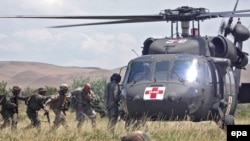
U.S. and Georgian soldiers take part in a joint military exercise at Georgia's Vaziani base in July.

December 18, 2008
By Brian Whitmore
With Georgia's hopes of quickly joining the NATO alliance deferred for the moment, Tbilisi is placing its hopes in the next best thing -- a bilateral security pact with the United States.

Details of the emerging accord are still unclear, but Georgian Deputy Foreign Minister Nino Kalandadze said the two sides are already discussing a "framework agreement" proposed by U.S. officials.

"Intensive negotiations are under way," Kalandadze told reporters in Tbilisi on December 17. "This treaty is being discussed mainly at the Defense Ministry, but also at the Foreign Ministry.... We will jointly analyze all its provisions in detail and in the end we will come to an agreement."

The negotiations come as the United States and Ukraine prepared to present a new strategic partnership statement on December 19.

Georgian officials say they hope a bilateral arrangement could not only enhance their security, but also jump-start their NATO bid. But analysts say it could also significantly raise the stakes in the South Caucasus by bringing the United States closer to a direct confrontation with Russia, which is solidifying its military and political presence in the pro-Moscow breakaway regions of Abkhazia and South Ossetia.

"It's potentially a very big deal," says Lincoln Mitchell, a Columbia University professor and the author of the book "Uncertain Democracy: U.S. Foreign Policy and Georgia's Rose Revolution." "But the question is, does it formalize something that de facto already exists? What level of commitment does it really make?"

News of the emerging pact leaked earlier this week during a visit to Tbilisi by U.S. Deputy Assistant Secretary of State for European and Eurasian Affairs Matthew Bryza. At a press conference on December 16, Bryza said that "no agreement exists," but then went on to strongly suggest that something was indeed in the works.

"What we talked about in detail, was U.S.-Georgia cooperation on security and strategic partnership," Bryza said. "We're still working through how to reflect the beautiful words 'strategic partnership' in our actual actions and actual life."

Officials close to the negotiations say the pact will closely follow a model established by the Baltic states in the late 1990s.

Baltic Model

After gaining independence from the Soviet Union in 1991, Estonia, Latvia, and Lithuania were seeking to join NATO in the face of fierce opposition from Moscow. In January 1998, the three countries and the United States signed the U.S.-Baltic Charter.

That agreement did not have an explicit security guarantee, but said that the United States had a "real, profound, and enduring interest" in the Baltic states' security. It also committed Washington to assisting the three countries with military and other reforms with the aim of helping them integrate into Western institutions.
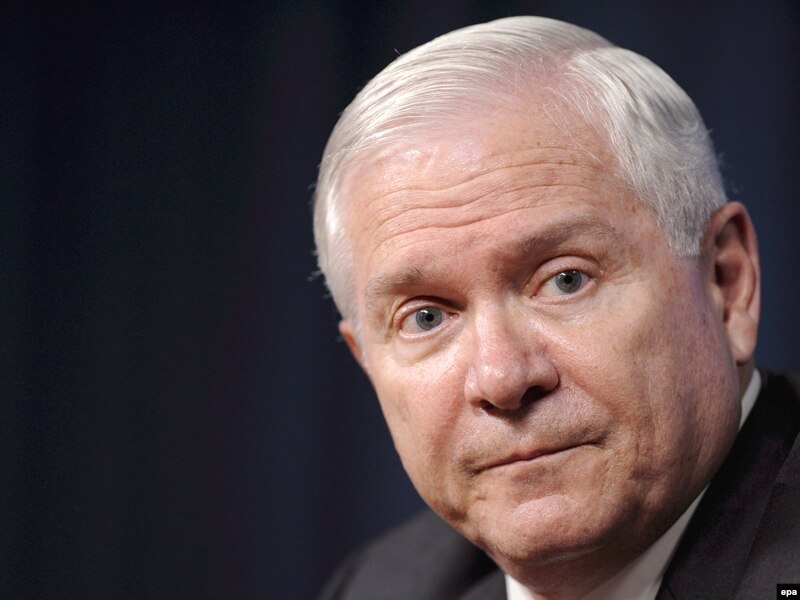
While it's unclear whether the incoming U.S. administration will approve, the secretary of defense will be the same.
The agreement "will be similar to the charter that was signed between the United States and the Baltic countries," Temur Iakobashvili, Georgia's reintegration minister, told RFE/RL's Georgian Service in a recent interview.

"It is not just about security, it will include the whole spectrum of the bilateral relations -- along with security, it includes economy, culture, civil society, democratic development, etc., etc. It's certainly a very broad document."

Latvian Foreign Minister Maris Riekstins calls the U.S.-Baltic Charter "the first very serious and real step towards our membership" in NATO, which the Baltic states joined in 2004.

"Although the charter doesn't specifically mention our membership in NATO, or any kind of guarantee that we will be granted such membership, I think it was a political signal that the Americans are very serious about our security," Riekstins says.

In the face of fierce Russian opposition, NATO declined to give Georgia and Ukraine Membership Action Plans (MAPs), a key step to formal membership, at the alliance's summit in Bucharest in April. The allies did, however, pledge that the two former Soviet states would eventually join.

At a foreign ministers' meeting in Brussels on December 2-3, just months after Georgia and Russia fought a bitter five-day war in August over South Ossetia, the Western alliance again declined to give Georgia and Ukraine MAPs. The allies, however, reiterated their commitment to admit Georgia and Ukraine and to assist them in that goal via the NATO-Ukraine Commission and NATO-Georgia Commission.

No Shortcuts

Riekstins says that while a bilateral agreement with the United States could smooth Georgia's path to joining NATO, Tbilisi would be advised to follow the path to membership the alliance has established.

"I think it can play some role," Riekstins says of the potential U.S.-Georgian agreement. "But I think at the same time, we should not disregard the existing framework that has been established by NATO and Georgia, and also with Ukraine. Namely, the NATO-Georgian Commission, which at the last NATO ministerial meeting was accepted as an essential instrument for negotiating all issues pertaining to military reforms and also including the potential membership issue."

The United States, Britain, and new member states like Poland, the Czech Republic, and the Baltic states have strongly supported the aspirations of Georgia and Ukraine to join NATO. Germany and France have largely opposed their bids, arguing that it would unduly antagonize Moscow, which still sees those two former Soviet states as part of its sphere of influence.

It it not certain what fate either the Georgian or the Ukrainian pacts will have once Barack Obama takes office on January 20. U.S. President George W. Bush's defense secretary, Robert Gates -- who would be a key player in any security agreement -- will retain his position under Obama, signalling the deals may not die with Bush leaving office.

Analysts in Tbilisi say that while a bilateral agreement with the United States would have symbolic political importance and would help Georgia implement much-needed reforms, it would do little in terms of providing additional security.

"We can expect a broadening of military cooperation but I think it's too early to expect America to commit itself to defend Georgia at this point," says Tornike Sharashenidze, head of the Foreign Relations Program at the Georgian Institute for Public Affairs.

RFE/RL's Georgian Service contributed to this report

This forum has been closed.
 Previous   Next 
Comments page 2 of 3
by: Andrew from: Auckland New Zealand
December 24, 2008 14:37
Anton, the Colchians are mentioned in most of the classic histories, by Xenophon (Anabasis), Strabo, The histories of Alexander by Plutarch & others, they are also mentioned in the oldest western work, the Illiad by Homer as Trojan allies. If you had bothered to read your Herodotus you would see he mentions the Colchians too.

Also this link:
http://en.wikipedia.org/wiki/Colchis

For a more recent work on the history of Georgia that might open your mind a little, try "A History of the Georgian People" by W E D Allen published 1935 & 1975, or "A Modern History of Soviet Georgia" by D M Lang published 1962. The first one can be heavy going but gives the origins of most of the races in the Caucasus (north & south) in great detail and has a comprehensive bibliography. The latter is has, as the title suggests, a focus on the modern history of Georgia but also gives a good background in the ancient history of the caucasus.

Of course I don't expect you to read any of the works or authors listed above.

By the way, I prefer the term "european" if you do your research you will find a lot of white New Zealanders can't stand the term Pakeha. When I was at high school (Hutt Valley high school near Wellington) one of my friends Riki was the son of a Rangitira & kohmatua. When Riki called me a pakeha, his father washed his mouth out with soap and said how would he like it if he was referred to with the "N" word.

by: Andrew from: Auckland New Zealand
December 24, 2008 10:54
Anton, you are sadly mistaken if you think I am a Georgian. I find your constant insinuations rather offensive and pathetic. Be sure I will get my friends at NZIS to look into your case as an undesirable alien.

Try reading Xenophon, Thucidides, Homer (all Greeks) Aristotle and various histories of Alexander, plus just about any Roman historian, and you will find plenty of refer to Cholchians, Imeretians, Migrelians, Svans, but no mention of Ossetians/Alans south of the Caucasus mountains, or for some considerable distance north too.

The link I gave was to give you an example of your Russian motherlands rather unplesant behaviour in the Caucasus. There are other links to the South Ossetian conflict from that page.

The Alans you mention were forced south by the turcic people, but they are not "native" to the south caucasus,which includes the mountain range.Chechens, Ingush, and Dagesh are not "Turcic" by genealogy (muslim yes, Turcic no), as with the Georgians they are the indigenous mountain people of the caucasus. If you have ever seen their traditional dancing and music you would know this. They are all linked. The Alans were a horse people, plains (steppe) dwellers not mountaineers untill the went in and displaced the mountain people from the valleys. In addition look at the Ossetian theft of Ingushetian homes when the Ingush were deported after WW2, and the refusal to return lands to their rightful owners in the 1980's which resulted in a nasty little bout of ethnic cleansing by the Ossetians against Ingush returning from Siberia towards the end of the USSR. You are backing a very nasty horse Anton.

Unfortunately for your arguments about politics, Russian politics is run on emotions not rationality, racism and hatred being at the top of the list. Not to mention murder of independant journalists, opposition activists etc, minor sentences for racially motivated hate crimes in Moscow. The creation of Narco-mafia statelets such as Abkhazia & SO. The list goes on. Russia cannot come to terms with the fact that most of it's former vassals are only too keen to escape it. The more Russia cracks down on its neighbours and internal dissent, the more the victims will strive to be free of Russian interference in their internal affairs.

You (as usual) seem to have missed the point with my euphemisim about the car.
What I was trying to point out is that in order for the world not to degenerate into chaos requires signatories to international agreements to keep to their word. Unfortunately Russia seems to be incapable of keeping any of it's agreements, and is becoming increasingly dangerous to the states that have escaped its clutches in the last 20 years.
Russia does not negotiate, like a spoilt little brat it tends to make demands, and then throw its toys out of the sandpit when nobody else agrees (see the OSCE decision for details), 55-1 in favour of extending the mission, but Russia vetoes. Typical bully boy behaviour.

For your information the Abkhazian and South Ossetian issues are linked, and quite closely. The Russian occupation of Abkhazia gives the Russian state the second best harbor on the Black Sea as an alternative if they lose Sevastapol, and SO is a dagger pointed at the BCT oil & gas lines. If you think the Russian government cares about the lives of 30,000 Ossetians, you are sadly deluded. Look at how they treated people in Chechnya. This is about the Russians wanting to reinstitute their empire in the south caucasus. When it comes to matters of self determination and war crimes etc, like most Russians you are a total hypocrite.

by: Anton from: Auckland
December 24, 2008 08:26
Once again, Andrew - the only Kiwi-looking part of your post is that you confuse Abkhasia (of which I did not say a word) with South Ossetia, of which I was talking, when answering your Perevi question. In all other respects to my view you appear as a Georgian (which national belonging I do not find to be a felony and am surprised why are you stubbornly posing as a Pakeha). It is normally very hard to try pretending being someone else, specially being completely unaware of the specifics of the local dialect...

It did not happen to me to read Georgian historians of Bronze Age, and the only mentioning of one now-Georgian tribe of Kolkhs I found in the myth of Jason and Argonauts; while if you open Clio by Herodotus, you would read there about Ossetians, whom he calls Alans and considers the people, indigenous for the entire area of North and East Caucasis, whose lands were later in 13th century AD taken over by the Turkic tribes, particularly by the Chechens, Daghestani, Ingush and Azeri.

Mongol invasion created a new reality,so it does not matter who lived where in Bronze Age, as Russians and Saxons in Bronze Age were probably residing in Asia Minor but you still can not kick them out of Russia or UK on these grounds. You can either accept the reality or not - and the reality of today is that South Ossetia is not Georgia anymore, same as a car you purchased does not belong to the sellers anymore.

If you are willing to discuss the issue of Abkhasia, this would be entirely another issue, having little to do with the Perevi problem. Your feelings are understandable, but they are just emotions, and politics is not run on emotions, it is run on the rationality and will to negotiate, specially if one can not enforce anything.

by: Andrew from: Auckland New Zealand
December 23, 2008 08:58
Anton, the ethnic cleansing in the 1992-94 conflicts in Georgia was comitted by the separatists, see the UN reports from the time, HRW reports from the time, and OSCE reports from the time. You can find links to them here http://en.wikipedia.org/wiki/Ethnic_cleansing_of_Georgians_in_Abkhazia

Georgia "violated" the autonomous areas due to attacks on ethnic Georgians and other non Abkhaz & non Ossetian groups (such as ethnic Greeks & Turkomen who sided with the central Georgian government).
Another fact, the original Ossetian population in "South Ossetia" were mercenaries who had served in the Georgian kings bodyguard in the 17th century, they were a minority (albeit a significant one)until the Russians built the Roki tunnel in the 1950's, when a flood of immigrants from North Ossetia were brought in by Russia. The Georgian presence in both areas dates from the bronze age.
I suggest you read a book called "Conflict in the Caucasus" by Svetlana Chervonnaya, who was a head researcher with the Moscow institute of ethnography. She was sent by the Russians to write a book supporting the Abkhazian separatists, and her research and eye witness to the war resulted in the opposite opinion. It is a damning indictment of Russian & Separatist crimes in the region.
As for Akalgori & Perevi, do some more research than "official RF & SO" propaganda, try reading the opinions of UN reports, and human rights activists, not to mention independant journalists. Perevi sits several km outside the old administrative border, in what the Russians now refer to as "Georgia proper" the only Ossetians protesting were Kokoity and co in Tskhinvali. Akalgori is a majority Georgian settlement, as were the towns north of Tskhinvali (before they were bulldozed by the glorious Red Army and the Ossetian militia that is). In my opinion, by supporting Russian & separatist actions in Georgia you are a supporter of ethnic cleansing and in some instances Genocide. The "commandos" you mention were armed Georgian policemen. They need to be armed due to the constant rampaging of murderous looting armed groups of Ossetian "militiamen" who ravage the area around South Ossetia.
Your argument that treaty's & agreements "only reflect the time they were signed" and are made obsolete by new realities is pathetic. Say I agree to purchase a car from you, we sign an agreement that I will pay for it in monthly installments, I then drive the car home and refuse to pay for it because I already have it? The reality is changed,I have the car, why should I pay you anything? This is where your thinking leads.

International law is based on the participants keeping to the letter and spirit of the treaty's that they sign.
Unfortunately Russia's word and signature on a treaty or any other document is worth about as much as a used peice of toilet paper.

by: Anton from: Auckland
December 22, 2008 18:26
Andrew - the situation in the international relations changes daily, while the agreements are only reflecting the moment when they were signed. They are not lasting forever, the new realities make them obsolete. Technically Russia could not afford to withdraw the support to South Ossetia (and there never was any UN resolution on it!) - because then Russia would have ethnic Ossetian riot at home.

After collapse of USSR the borders between the new subjects were reflecting the administrative borders within USSR - and CIS avoided multiple ethnic conflicts by agreent to recognise these administrative borders as new national borders. Particularly, when they say "South Ossetia", they mean the territory within the old administrative borders of the autonomy with this name. In 1990s Georgia violated these borders and occupied Southern part of the autonomy, where Georgian population was made predominant (through ethnic cleansing of Ossetians). August war returned South Ossetia into its old borders, drawn on the Soviet maps. My understanding is that some towns like Alkhan-Gori returned under Ossetian control. The village of Perevi lies right on the old border line and has mixed population, so the Ossetians were protesting against Russian withdrawal from there, being afraid of the Georgian troops, but Russia still made a withdrawal. However Georgia immediately deployed there 150 commandos, so Russian troops had to return. I do not know if I am telling the entire truth, as I am not there and use the newspapers, but this is at least official explanation by RF and SO.

by: Andrew from: Auckland New Zealand
December 22, 2008 12:24
Anton, this is the same Russia that signed several UN, OSCE, & even CIS resolutions and agreements respecting Georgia's territorial integrity INCLUDING recogising Abkhazia & South Ossetia as being part of Georgia, while supplying & supporting separatists from 1992 to now, agreements & UN resolutions which it subsequently broke its word on by recognising Abkhazian & South Ossetian independance.

Russia has proven time and again that its word is not worth a bad penny. The Russian states history is littered with the breaking of "solemn" treaty agreements. Why are the Russians still in the village of Perevi, which sits well inside Georgia (which they were supposed to leave some length of time ago by the ceasefire agreement), and is an excellent "jumping off point" if you are intending to attack in the new year?


by: Anton from: Auckland
December 22, 2008 00:48
I know this all area pretty well, and I am absolutely positive that if Russian leadership remains in a sane state of mind they won't even think of annexing the rest of Georgia. They showed this clearly in August, when they stopped short of capturing Tbilisi and then pulled back. Russia simply does not need Georgian population to be Russian citizens, my understanding is that 1/4 of Georgians are already living in Russia, legally or illegally, while many of those who stayed in Georgia are in hostile mood and can add to Russia's ethnic frictions.

There is however some sense in Duma talking about Poti. Batumi as a port has no strategic value, as it is too shallow to house any larger commercial or military ships; Poti is much deeper, and it is in close proximity from Abkhasia, therefore it can be easily taken by the hands of Abkhasian separatists. But this possibility to date remains only in theory, as Russia recently announced that it supports territorial integrity of Georgia with exception to Ossetia and Abkhasia, means they won't be pushing forward for this, at least at the condition of status quo - however the charter with US may destroy this status quo. We'll see the development, US ships, operating in Black Sea were already insured against military actions in January-March 2009.

by: David from: Spain
December 21, 2008 16:05
One of the biggest reasons for the conflicts in Caucasus is the unwillingness of Europeans to bother themselves with their cozy relationship and brownnosing of Russia for centuries. Especially by France.
16 years of conflicts in Georgia had not moved from the dead spot. All these time Georgia has been bagging Europe to bring peacekeepers to Europe’s backyard and help with stabilizing situations in the conflict zones.
Russians has been pouring oil into the fire of separatism for all these years. The Russian so called “peacekeepers” never allowed any Georgians to return to their homes in Abkhazia or Ossetia. In addition to providing military, economic and political support to separatists, Russia is engaged into multi million dollar PR campaign to discredit Georgia and its efforts to bring peace to conflict zones.
Never ever, European leaders have raised their voices for these 16 years of conflicts and have not made any substantial step towards bringing peace to Georgia. Their only achievement was to bring 8 OSCE observers to Ossetia and another 10 into Abkazia. Only now, when war started, European made some noise and even now, has accepted status quo in the separatist regions. In another words they gave in to Russia to hold control of conflict zones.
As far as, there is no call for Europeans to engage on the ground, they are ok with whatever Russia wants.
Like in Bosnian war, US has to come from overseas and try to bring some security to Georgia.
If Russia was to invade Baltic countries, I am 100% sure that Germany and France will cave-in will not support militarily and will start persuading everyone in Europe to accept Russia’s invasion and go on with their cozy brownnosing of Russia. France and Germany will find a way to avoid fulfilling their NATO obligation to come to aid to Baltic countries.


by: JEC from: Virginia, USA
December 21, 2008 14:25
Anton, technically what the U.S. is pursuing are not binding legal treaties but what they call "charters" which are political documents. The Ukrainian charter, signed this past Friday, is posted on the U.S. State Department's website. It is a document that lays out the basic principles of the U.S.-Ukrianian relationship. So I suppose the U.S.-Georgia document will look somewhat similar. Treaties in the U.S. carry the force of law and as such require two-thirds of the U.S. Senate to ratify. Clearly this is not what is being proposed for Georgia, probably much to Georgia's chargin.
I do not agree that Turkey has territorial ambitions on Georgian territory. Although, you should be aware of the 1921 Treaty of Kars between the Soviet Union and Turkey. The Treaty gives Turkey some special rights regarding Batumi and the Ajarian region. My understanding is that Turkey is concerned about stability in region and in particular the oil and gas pielines that traverse Georgia and enter into Turkey. Turkey, in my humble opinion, probably could do more in voicing its displeasure with Russian behavior. Turkey, geo-politically, is a country in flux. It doesn't like Russian behavior but it doesn't want to upset its trade relations with Russia. The U.S. and Europe must redouble its efforts to keep Turkey in the western camp.
Andrew has a point regarding Azerbaijan and Central Asia. Georgia is the linch-pin in the west to east movement of security and the east-west movement of energy. Take Georgia out of the equation then Azerbaijan and the Central Asian will become easy pickings for Moscow's strategic ambitions.

by: Andrew from: Auckland New Zealand
December 21, 2008 08:53
Well Anton, you obviously have not been to the South Island, where there are 9th & 10th Generation families especially on the west coast of the south Island. If people have children young, as was common in my family. My original ancestors in New Zealand were missionaries, whalers, and British (Irish) soldiers some of whom arrived prior to the 1830's.As for being bored with my motherland, I was a history major, and understand that events in far away lands result in nasty consequences for the rest of us. As for your statement that Russia does not want to annex any further regions of Georgia, this just shows your ingnorance. Members of the Duma have recently started talking about annexing Adjara(port of Batumi)Samengrelo (port of Poti) and other parts of west Georgia. This would result in Georgia, Azerbaijan, and the central asian republics losing any free access to the black sea, and would result in them being held ransome by Russia.
Russia has never given up it's imperial ambitions. It still regards all former soviet states as it's "territory". As for the theory that Turkey wants an empire in the region, bollocks. Anton, has it occurred to you that the reason why eastern europe and the caucasus (with the exception of Armenia) hate the Russian state (as opposed to hating individual Russians whom they seem to get on well with) is because of the horrific oppression they have received at the hands of Russia? See Chechnya, Ingushetia for details of Russian "protection" which usually translates as "crimes against humanity"
 Previous   Next 
Comments page 2 of 3
TEXT SIZE - +

Editors' Picks

Arresting Images

Photos Of The Week Photogallery

President Van Rompuy

'How's That Again?!' Audio

Karzai Inauguration

The Anticipation Of Change Video

Follow Us On Twitter

Keep up-to-date on all the latest news from RFE/RL's broadcast region by following us on Twitter:
~ You can find our instant news feed at @RFE_RLNEWS.
~ An obsessive Kremlin watcher? Follow our blog at @PowerVertical.
~ Human rights abuses chronicled at @RightsWatchdog.
~ News, comment, and the odd silly dictator story at @TransmissionRFE.

Products and services:

RSSMail SubscriptionMobile