

Will he? Won't he? Does it even matter?
Vladimir Putin is a master of distraction. He excels at throwing up smokescreens and diversions that keep opponents scrambling and pundits busy.
Presently, all eyes are on the shell game that has been all the rage since constitutional amendments extending the presidential term to six years began winding their way through the adoption process.
The conventional wisdom has been that the changes, once they inevitably pass, would be used to facilitate Putin's triumphant return to the Kremlin -- and keep him there for a long, long time. This is supposed to happen either in snap elections next year or after Dmitry Medvedev's term ends in 2012.
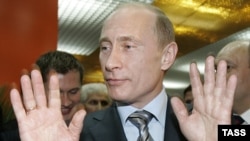
Yesterday's three-hour virtual town hall extravaganza only served to further fuel the speculation. The dominant meme in the Russian print media a day after Putin's performance can be summed up in two words: He's Back! Here's a sampling of a few headlines: "Back in His Old Role" ("Vedomosti"); "The Anticrisis Leader" ("Nezavisimaya gazeta"); and "The Lifeline" ("Gazeta").
Putin said he thought the term extension was a good idea, but appeared to reject the notion that he was preparing to return to the presidency in early elections next year. But he didn't rule out another stint as president after Medvedev's term ends in 2012:
"The next elections in the Russian Federation are in 2012, and I think everyone must do his duty in his current position, and there's no need for fidgeting over what will happen in 2012," he said. "If we live till then, we'll see."
Meanwhile, Putin has been quietly building up and consolidating his real power base -- the Unified Russia party that he leads.
In an excellent post earlier this week, Paul Goble drew our attention to an article in URA.ru by political analyst Dmitry Kolesev that looks at how the ruling party is shoring up its authority in the regions.
For example, at its party congress in November, Unified Russia took over the process of evaluating and selecting gubernatorial candidates -- a task that had, until now, been the responsibility of the president's administration. Soon, Unified Russia will nominate governors and they will be confirmed by regional legislatures where Unified Russia has massive majorities. My colleague Robert Coalson also analyzed the changes here.
Putin also engineered the exclusion of key regional leaders and lobbyists from the party's leadership and tasked his chief of staff, Sergey Sobyanin, and Regional Development Minister Viktor Basargin with centralizing policy toward the regions.
All this seems to point to, at the very least, a major housecleaning among regional elites.
As I have argued here, and elsewhere, what appears to be happening is that Putin is creating a modernized Soviet-style party state where real power rests with Unified Russia and its leader -- just as it did with the general secretary of the Communist Party of the Soviet Union. Under such a system, as long as Putin leads Unified Russia, it doesn't much matter what other state post he also holds.
-- Brian Whitmore
Vladimir Putin is a master of distraction. He excels at throwing up smokescreens and diversions that keep opponents scrambling and pundits busy.
Presently, all eyes are on the shell game that has been all the rage since constitutional amendments extending the presidential term to six years began winding their way through the adoption process.
The conventional wisdom has been that the changes, once they inevitably pass, would be used to facilitate Putin's triumphant return to the Kremlin -- and keep him there for a long, long time. This is supposed to happen either in snap elections next year or after Dmitry Medvedev's term ends in 2012.
Yesterday's three-hour virtual town hall extravaganza only served to further fuel the speculation. The dominant meme in the Russian print media a day after Putin's performance can be summed up in two words: He's Back! Here's a sampling of a few headlines: "Back in His Old Role" ("Vedomosti"); "The Anticrisis Leader" ("Nezavisimaya gazeta"); and "The Lifeline" ("Gazeta").
Putin said he thought the term extension was a good idea, but appeared to reject the notion that he was preparing to return to the presidency in early elections next year. But he didn't rule out another stint as president after Medvedev's term ends in 2012:
"The next elections in the Russian Federation are in 2012, and I think everyone must do his duty in his current position, and there's no need for fidgeting over what will happen in 2012," he said. "If we live till then, we'll see."
Meanwhile, Putin has been quietly building up and consolidating his real power base -- the Unified Russia party that he leads.
In an excellent post earlier this week, Paul Goble drew our attention to an article in URA.ru by political analyst Dmitry Kolesev that looks at how the ruling party is shoring up its authority in the regions.
For example, at its party congress in November, Unified Russia took over the process of evaluating and selecting gubernatorial candidates -- a task that had, until now, been the responsibility of the president's administration. Soon, Unified Russia will nominate governors and they will be confirmed by regional legislatures where Unified Russia has massive majorities. My colleague Robert Coalson also analyzed the changes here.
Putin also engineered the exclusion of key regional leaders and lobbyists from the party's leadership and tasked his chief of staff, Sergey Sobyanin, and Regional Development Minister Viktor Basargin with centralizing policy toward the regions.
All this seems to point to, at the very least, a major housecleaning among regional elites.
As I have argued here, and elsewhere, what appears to be happening is that Putin is creating a modernized Soviet-style party state where real power rests with Unified Russia and its leader -- just as it did with the general secretary of the Communist Party of the Soviet Union. Under such a system, as long as Putin leads Unified Russia, it doesn't much matter what other state post he also holds.
-- Brian Whitmore