

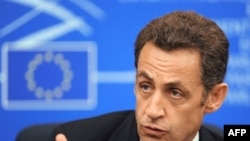
BRUSSELS -- French President Nicolas Sarkozy has told the European Parliament in Strasbourg that the EU cannot admit any new member states before the Lisbon Treaty -- rejected last month by Ireland -- comes into force.
France took over the EU's rotating six-month presidency on July 1 and has made resolving the bloc's constitutional crisis its main priority.
Sarkozy has made that point before, notably in the aftermath of the June 12 Irish referendum.
But at the European Parliament on July 10, he took the argument further. Sarkozy made it clear that, in his view, the door has closed even for Croatia, which is hoping to join the EU in 2010.
"I support enlargement to the Balkans," Sarkozy said. "Our Serbian friends, like our Croatian friends, are unquestionably European. But the greatest supporter of enlargement cannot simultaneously say, 'We don't want Lisbon, but we want enlargement.' It is Lisbon and enlargement."
Sarkozy said accession talks with Croatia must continue. But he stressed that, in his view, the EU's current Nice Treaty limits the bloc's size to 27 member states, which is the present tally.
Others, among them France's own former Europe Minister Pierre Moscovici, who negotiated the Nice Treaty in 2000 when France last held the EU presidency, have argued it can accommodate up to 28 member states.
Pressure Tactic
Sarkozy's more restrictive interpretation has been seen as a tactic to put pressure on Poland and the Czech Republic, both of which reject the Lisbon Treaty but also strongly support enlargement.
In another loaded message, Sarkozy also raised the prospect of a "multispeed Europe," in which countries impatient with the current speed of EU integration could forge ahead in small groups. The Nice Treaty already contains arrangements to this effect.
The EU's borderless Schengen space and its common currency, the euro, both represent existing examples of selective cooperation. However, the concept of a "multispeed" Europe raises the specter of a core group of countries building up permanent structures of closer political cooperation not easily accessible to other member states.
France took over the EU's rotating six-month presidency on July 1 and has made resolving the bloc's constitutional crisis its main priority.
Sarkozy has made that point before, notably in the aftermath of the June 12 Irish referendum.
But at the European Parliament on July 10, he took the argument further. Sarkozy made it clear that, in his view, the door has closed even for Croatia, which is hoping to join the EU in 2010.
"I support enlargement to the Balkans," Sarkozy said. "Our Serbian friends, like our Croatian friends, are unquestionably European. But the greatest supporter of enlargement cannot simultaneously say, 'We don't want Lisbon, but we want enlargement.' It is Lisbon and enlargement."
Sarkozy said accession talks with Croatia must continue. But he stressed that, in his view, the EU's current Nice Treaty limits the bloc's size to 27 member states, which is the present tally.
Others, among them France's own former Europe Minister Pierre Moscovici, who negotiated the Nice Treaty in 2000 when France last held the EU presidency, have argued it can accommodate up to 28 member states.
Pressure Tactic
Sarkozy's more restrictive interpretation has been seen as a tactic to put pressure on Poland and the Czech Republic, both of which reject the Lisbon Treaty but also strongly support enlargement.
In another loaded message, Sarkozy also raised the prospect of a "multispeed Europe," in which countries impatient with the current speed of EU integration could forge ahead in small groups. The Nice Treaty already contains arrangements to this effect.
The EU's borderless Schengen space and its common currency, the euro, both represent existing examples of selective cooperation. However, the concept of a "multispeed" Europe raises the specter of a core group of countries building up permanent structures of closer political cooperation not easily accessible to other member states.