

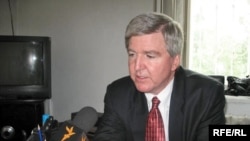
The deputy chief of the U.S. mission to the Organization for Security and Cooperation in Europe (OSCE) has told RFE/RL's Kazakh Service after his arrival in Kazakhstan that there are lingering concerns over that country's implementation of democratic reforms.
Envoy Kyle Scott is in Kazakhstan ahead of the OSCE's Parliamentary Assembly next week in Astana, an event that will mark the first time the assembly has convened in Central Asia.
Kazakhstan was chosen last year to assume the OSCE's rotating chairmanship in 2010 -- a prestige that critics said was inappropriate given the country's rights and democracy record -- after Astana agreed to make democratic reforms.
At the same meeting, in Madrid in November, Kazakhstan was chosen as a venue for this parliamentary session.
Opponents of the chairmanship bid argued that Kazakhstan had not demonstrated that it was ready to fulfill the duties with which an OSCE country is tasked.
Critics noted that Kazakhstan's parliamentary elections in August 2007 resulted in a total victory for the pro-presidential Nur-Otan party, which took every one of the 98 seats available; that independent media in the country continue to be harassed and intimidated; and that restrictive laws have kept opposition political and social groups on a tight leash.
"The commitments that were undertaken by Kazakhstan at that ministerial [conference in Madrid] were very important for the other members of the organization in order to gain the decision for Kazakhstan to become president of the OSCE in 2010," Scott told RFE/RL in Almaty. "We look forward to those commitments being fulfilled, and I will be holding discussions while I am here with members of the government to hear about their progress in this direction."
Scott stressed that there still are concerns about the Kazakh government's commitment to reforms but said he is hopeful that it will make improvements this year.
"Until now I have to say we haven't seen as much progress as we would have liked," Scott said, "but the year is not over and I am optimistic that in the second half of the year we will see further progress by the government of Kazakhstan."
Scott's visit comes just days after Freedom House, the democracy and human rights watchdog, released its annual report with a focus on how governments that have large petroleum reserves are backsliding on democratic reforms.
The three petroleum-rich countries cited were Kazakhstan, Russia, and Azerbaijan. The authors argued that booming economic growth in those countries supported by the current world energy crisis and the dependency of industrial nations on those energy supplies give their governments leverage against international criticism as they tighten their control over their countries.
Scott told RFE/RL that he agrees with the premise of the Freedom House report.
"I agree that countries which are enjoying economic growth find it easier to put off necessary reforms but also that, in the end, these reforms are necessary and will help in the long-term progress of the countries," Scott said. "So we are hopeful that in [the] cases of all the countries you have cited that they will continue on the path toward reform which all of their governments are committed to."
Scott vowed to "take the opportunity to get to know Kazakhstan better" in the days before the OSCE Parliamentary Assembly and meet with government officials and representatives of civil society groups and opposition parties.
RFE/RL's Kazakh Service contributed to this report
Envoy Kyle Scott is in Kazakhstan ahead of the OSCE's Parliamentary Assembly next week in Astana, an event that will mark the first time the assembly has convened in Central Asia.
Kazakhstan was chosen last year to assume the OSCE's rotating chairmanship in 2010 -- a prestige that critics said was inappropriate given the country's rights and democracy record -- after Astana agreed to make democratic reforms.
At the same meeting, in Madrid in November, Kazakhstan was chosen as a venue for this parliamentary session.
Opponents of the chairmanship bid argued that Kazakhstan had not demonstrated that it was ready to fulfill the duties with which an OSCE country is tasked.
Critics noted that Kazakhstan's parliamentary elections in August 2007 resulted in a total victory for the pro-presidential Nur-Otan party, which took every one of the 98 seats available; that independent media in the country continue to be harassed and intimidated; and that restrictive laws have kept opposition political and social groups on a tight leash.
"The commitments that were undertaken by Kazakhstan at that ministerial [conference in Madrid] were very important for the other members of the organization in order to gain the decision for Kazakhstan to become president of the OSCE in 2010," Scott told RFE/RL in Almaty. "We look forward to those commitments being fulfilled, and I will be holding discussions while I am here with members of the government to hear about their progress in this direction."
Scott stressed that there still are concerns about the Kazakh government's commitment to reforms but said he is hopeful that it will make improvements this year.
"Until now I have to say we haven't seen as much progress as we would have liked," Scott said, "but the year is not over and I am optimistic that in the second half of the year we will see further progress by the government of Kazakhstan."
Scott's visit comes just days after Freedom House, the democracy and human rights watchdog, released its annual report with a focus on how governments that have large petroleum reserves are backsliding on democratic reforms.
The three petroleum-rich countries cited were Kazakhstan, Russia, and Azerbaijan. The authors argued that booming economic growth in those countries supported by the current world energy crisis and the dependency of industrial nations on those energy supplies give their governments leverage against international criticism as they tighten their control over their countries.
Scott told RFE/RL that he agrees with the premise of the Freedom House report.
"I agree that countries which are enjoying economic growth find it easier to put off necessary reforms but also that, in the end, these reforms are necessary and will help in the long-term progress of the countries," Scott said. "So we are hopeful that in [the] cases of all the countries you have cited that they will continue on the path toward reform which all of their governments are committed to."
Scott vowed to "take the opportunity to get to know Kazakhstan better" in the days before the OSCE Parliamentary Assembly and meet with government officials and representatives of civil society groups and opposition parties.
RFE/RL's Kazakh Service contributed to this report