


What will happen to the people who have been arrested in the protest rallies in Iran? I can tell you.
I was arrested during the 1999 student demonstrations in Tehran, exactly 10 years ago.
What I did was as trivial in terms of real crime as what the protesters in Iran have done now by expressing rage over the presidential election results.
But the punishment I received was so out of proportion to my actions – and so truly criminal – that I had to flee my homeland and seek political asylum in Europe.
In 1999, Mohammad Khatami was president and reformist hopes were high that the Islamic republic’s oppressive ideological atmosphere was lifting slightly.
I was a university student and we were enjoying an unprecedented amount of freedom to speak our minds in class. That included the compulsory class all students have to take in the roots of the Islamic Revolution.
'Change Was In The Air'
At that time, even the presence of the Basij among the students – 50 percent of all university places are reserved for the members of the militia – did not have its usual chilling effect. Change was in the air.
Then came the sparks that ignited the demonstrations that swept campuses across Tehran and spread to other cities in the summer of 1999.
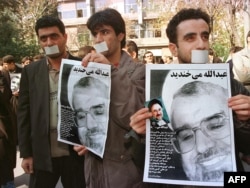 Students, their mouths taped shut, hold up portraits of reformist newspaper editor Abdollah Nuri after Nuri was sentenced to five years in prison for "anti-Islamic propaganda" in December 1999. Some students at Tehran University protested the closure of one of the most popular reformist newspapers. Their small demonstration was attacked by vigilantes armed with clubs who beat at least one student to death as police did nothing.
Our rage boiled over. Tens of thousands of students took to the streets demanding the dismissal of police officials. We also called on Khatami to speed up reforms and give us a more open society.
I was with a group of about 50 students on my campus which tore down a poster of the Supreme Leader Ayatollah Ali Khamenei that hung in one of the buildings. Someone set fire to the picture. The riot police took the simplest course. They locked the campus gates and arrested everyone found inside.
But they did not take us to a police station. Instead, we were blindfolded and taken outside of the legal system to a place where our parents could never find us.
'Stripped Us Naked'
The place was one of the semi-abandoned military camps outside Tehran that date back to the Iran-Iraq war of the 1980s. There we were shoved into metal freight containers – the kind used for shipping. They stripped us naked and gave us two blankets each.
Inside there was nothing to sleep on and no electric light. There was no way to tell the time except by the daylight when it shone through the watchman’s peephole at one end and a ventilation vent at the other.
I was in the container with four other boys. We were all barely 20. And we were inside for two weeks -- naked, powerless, and face-to-face with the fear of being totally at the mercy of our captors.
Food was thrown in once a day. From time to time, we were taken out for questioning. And both those processes helped to destroy whatever shreds of our dignity remained.
The first interrogation sessions were simply beatings. Men who were clearly convinced that we had violated all laws of God and man kicked us until we fell down. Then they kicked our faces. As they did, they shouted “Allahu Akbar,” calling on God to be pleased with them. They were skinheads, but with hair and beards.
Then the real questioning began, and it, too, was to show there was no way out.
'No Correct Answers'
The interrogators wanted to know who pulled down the picture of the Supreme Leader, to what organizations I belonged, and to what organizations my friends and classmates belonged.
It did not matter what I said. There were no correct answers.
“Do you know Masud Rajavi (the spiritual leader of the armed resistance group, the People’s Mujahedin of Iran)?”
“No.”
“You are lying. Everyone knows that bastard. You are lying about everything.”
Sometimes they seemed to want to understand my problem.
“You were one of those who shouted,” the interrogator said.
“No, I wasn’t.”
“You were! Go ahead and shout now. Shout as much as you want.”
And they offered treatment.
“You have extreme tendencies. You just need some balancing.”
And then, turning to one of the strongmen, “Brother X, take him for balancing.” The balancing was more beating.
Nothing To Confess
The interrogations were conducted with a hood over my head. Looking down, I could see only the floor. Once I saw the hands of one of the interrogators after he cuffed my head. His hands were twice the size of mine.
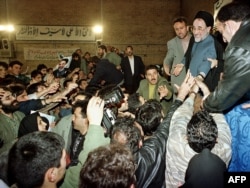 Students try to shake hands with then-President Mohammad Khatami (second from right) after his speech at Tehran's Elm-o-Sanat University in December 1999.After two weeks, I was transferred to a succession of other prison cells, with no idea where I was. Sometimes, the cells were pitch dark. Sometimes, they had four brilliant light bulbs shining 24 hours a day.
I was lucky I had nothing to confess. And I was lucky that made me of no real interest to my captors. After eight months, as inexplicably as the way they had treated me, they let me go.
But now I was a criminal with a history of imprisonment. And that meant all of Iran would be my lifetime prison.
With a prison record, I could not return to university. I could not get a job. My only course was to leave Tehran and return to my small provincial city. And there, where everyone knows everyone, I was an outcast.
My parents had all but given me up for dead. For months they had gone around every prison in Tehran trying to locate me. At every place, they were told there was no record of me being detained. But one official said it was likely I had been made to “disappear.”
The police sent my prison file to an old man in my home town who had lost three sons in the Iran-Iraq war. He owned a men’s shoe store next to the local bank that no one shopped in because the fashions were 10 years old. But he was powerful because he was strongly linked to the Revolutionary Guards.
This man was my parole officer. I had to appear before him each week to show I was still in town. If I wanted to visit friends in another city, I needed his permission.
His only demand of me was to pray. Not just in the mosque but in private prayer meetings as well. And eventually, I complied.
That was how I began my journey out of Iran. As he gained trust in me, I could more easily get permission for longer absences. And on one of these absences, I slipped out of the country.
Dehumanizing
The escape route that people take -- across the Iranian border, across Turkey, by ship to Greece, and overland to France -- is well known. Some of those who are now in jail for protesting the presidential election results – if they are released -- will undoubtedly take it, too. It is horrible, full of dangers, and as dehumanizing as being in prison.
I was tricked by traffickers as one group handed me off to another that claimed it had not been paid. So, I soon ran out of money.
I rode in freight containers. And I rode hanging onto the bottom of a speeding truck. That means sitting on a small metal bar a half-meter above the asphalt and hanging on with arms that become so paralyzed the muscles no longer contract. I was numb with fear.
Was it worth this to escape my home country and to leave my parents and dearest friends? Of course not.
But for me it was a question I never had to ask. The government of my country took my country away from me. And my crime was nothing more than taking part in a political demonstration.


I was arrested during the 1999 student demonstrations in Tehran, exactly 10 years ago.
What I did was as trivial in terms of real crime as what the protesters in Iran have done now by expressing rage over the presidential election results.
But the punishment I received was so out of proportion to my actions – and so truly criminal – that I had to flee my homeland and seek political asylum in Europe.
In 1999, Mohammad Khatami was president and reformist hopes were high that the Islamic republic’s oppressive ideological atmosphere was lifting slightly.
I was a university student and we were enjoying an unprecedented amount of freedom to speak our minds in class. That included the compulsory class all students have to take in the roots of the Islamic Revolution.
'Change Was In The Air'
At that time, even the presence of the Basij among the students – 50 percent of all university places are reserved for the members of the militia – did not have its usual chilling effect. Change was in the air.
Then came the sparks that ignited the demonstrations that swept campuses across Tehran and spread to other cities in the summer of 1999.

Our rage boiled over. Tens of thousands of students took to the streets demanding the dismissal of police officials. We also called on Khatami to speed up reforms and give us a more open society.
I was with a group of about 50 students on my campus which tore down a poster of the Supreme Leader Ayatollah Ali Khamenei that hung in one of the buildings. Someone set fire to the picture. The riot police took the simplest course. They locked the campus gates and arrested everyone found inside.
But they did not take us to a police station. Instead, we were blindfolded and taken outside of the legal system to a place where our parents could never find us.
'Stripped Us Naked'
The place was one of the semi-abandoned military camps outside Tehran that date back to the Iran-Iraq war of the 1980s. There we were shoved into metal freight containers – the kind used for shipping. They stripped us naked and gave us two blankets each.
Inside there was nothing to sleep on and no electric light. There was no way to tell the time except by the daylight when it shone through the watchman’s peephole at one end and a ventilation vent at the other.
I was in the container with four other boys. We were all barely 20. And we were inside for two weeks -- naked, powerless, and face-to-face with the fear of being totally at the mercy of our captors.
Food was thrown in once a day. From time to time, we were taken out for questioning. And both those processes helped to destroy whatever shreds of our dignity remained.
The first interrogation sessions were simply beatings. Men who were clearly convinced that we had violated all laws of God and man kicked us until we fell down. Then they kicked our faces. As they did, they shouted “Allahu Akbar,” calling on God to be pleased with them. They were skinheads, but with hair and beards.
Then the real questioning began, and it, too, was to show there was no way out.
'No Correct Answers'
The interrogators wanted to know who pulled down the picture of the Supreme Leader, to what organizations I belonged, and to what organizations my friends and classmates belonged.
It did not matter what I said. There were no correct answers.
“Do you know Masud Rajavi (the spiritual leader of the armed resistance group, the People’s Mujahedin of Iran)?”
“No.”
“You are lying. Everyone knows that bastard. You are lying about everything.”
Sometimes they seemed to want to understand my problem.
“You were one of those who shouted,” the interrogator said.
“No, I wasn’t.”
“You were! Go ahead and shout now. Shout as much as you want.”
And they offered treatment.
“You have extreme tendencies. You just need some balancing.”
And then, turning to one of the strongmen, “Brother X, take him for balancing.” The balancing was more beating.
Nothing To Confess
The interrogations were conducted with a hood over my head. Looking down, I could see only the floor. Once I saw the hands of one of the interrogators after he cuffed my head. His hands were twice the size of mine.

I was lucky I had nothing to confess. And I was lucky that made me of no real interest to my captors. After eight months, as inexplicably as the way they had treated me, they let me go.
But now I was a criminal with a history of imprisonment. And that meant all of Iran would be my lifetime prison.
With a prison record, I could not return to university. I could not get a job. My only course was to leave Tehran and return to my small provincial city. And there, where everyone knows everyone, I was an outcast.
My parents had all but given me up for dead. For months they had gone around every prison in Tehran trying to locate me. At every place, they were told there was no record of me being detained. But one official said it was likely I had been made to “disappear.”
The police sent my prison file to an old man in my home town who had lost three sons in the Iran-Iraq war. He owned a men’s shoe store next to the local bank that no one shopped in because the fashions were 10 years old. But he was powerful because he was strongly linked to the Revolutionary Guards.
This man was my parole officer. I had to appear before him each week to show I was still in town. If I wanted to visit friends in another city, I needed his permission.
His only demand of me was to pray. Not just in the mosque but in private prayer meetings as well. And eventually, I complied.
That was how I began my journey out of Iran. As he gained trust in me, I could more easily get permission for longer absences. And on one of these absences, I slipped out of the country.
Dehumanizing
The escape route that people take -- across the Iranian border, across Turkey, by ship to Greece, and overland to France -- is well known. Some of those who are now in jail for protesting the presidential election results – if they are released -- will undoubtedly take it, too. It is horrible, full of dangers, and as dehumanizing as being in prison.
I was tricked by traffickers as one group handed me off to another that claimed it had not been paid. So, I soon ran out of money.
I rode in freight containers. And I rode hanging onto the bottom of a speeding truck. That means sitting on a small metal bar a half-meter above the asphalt and hanging on with arms that become so paralyzed the muscles no longer contract. I was numb with fear.
Was it worth this to escape my home country and to leave my parents and dearest friends? Of course not.
But for me it was a question I never had to ask. The government of my country took my country away from me. And my crime was nothing more than taking part in a political demonstration.
Iran Election Special
Iran Election Special
RFE/RL's Full Coverage
Following the disputed reelection of Iranian President Mahmud Ahmadinejad, supporters of Mir Hossein Musavi have taken to the streets to protest. Click here for news, blogs, and analysis of the presidential election and aftermath.Iran Election Diary
Iran Election Diary