



Prague, 15 June 2005 (RFE/RL) -- They are, indisputably, one of the more bizarre consequences of a war that ended fully sixty years ago. Four cold, rocky, disconsolate islands almost constantly wreathed in mist.
Yet Etorofu, Kunashiri, Shikotan, and Habomai are the reason why, at the start of the 21st century, Russia and Japan are still technically in a state of war with each other.
For nationalists in both countries, there can be no compromise. In Japan, in particular, there has been a cross-party political consensus on the issue: the islands are Japanese and must be returned. But there are growing signs that both Moscow and Tokyo might be ready to make concessions to put the past behind them.
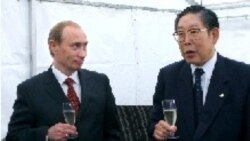
Russian President Vladimir Putin told former Japanese Prime Minister Yoshiro Mori in St. Petersburg yesterday that he would like to visit Japan in November. According to the Japanese newspaper "Asahi," Putin also said Russia supports Japan's efforts to acquire a permanent seat on the UN Security Council.
The two men were in St. Petersburg to attend the opening of a giant new Toyota assembly plant, a high point in Japanese investment in Russia. By being there, Putin indicated the importance he attaches to Russo-Japanese ties.
"Today, together with our Japanese partners we are launching the construction of the first auto enterprise of Toyota in Russia," Putin said. "First of all, I'd like to wish success to all those who are going to implement this promising project. The make of this largest Japanese car producer is well known all over the world. It's very popular in Russia as well. I'm sure the output of Toyota's St. Petersburg plant will be in great demand."
Russia has long been keen to persuade Japan to invest in its economy but Tokyo has been reluctant to do so while the islands remain an issue of dispute. Russian political analyst Aleksandr Konovalov said he believes the St. Petersburg deal is a sign attitudes are shifting.
"I don't think the Japanese will change their position dramatically but, at the same time, my feeling is that they are gradually moving to understanding that it will be necessary to develop economic relations first and to postpone political, juridical settlement of the territorial problem for substantial time," Konovalov said.
Both sides have much to gain from a settlement of their differences. Russia needs Japanese investment in its impoverished far eastern regions and Moscow and Tokyo share a wariness of China's wakening power.
A starting point for compromise might be the 1956 Japanese-Soviet communique, subsequently unilaterally abrogated by Moscow, for the return of the smallest two of the four territories. Putin seemed to be moving in this direction when he raised the possibility of their return in November. But the Japanese clearly want more. The two islands referred to in the communique make up just 7 percent of the disputed area.
One approach currently doing the rounds in Japan is for a 37-63 per cent split of the territories, with the smaller part going to Japan. Under this solution, three islands would revert to Japanese territory, while the largest, Etorofu, would remain part of Russia.
No solution is possible, however, without a major demonstration of political will. Compromise might be the only way to resolve the dispute but both governments know that they will face fierce domestic criticism if they give any ground.
Yet Etorofu, Kunashiri, Shikotan, and Habomai are the reason why, at the start of the 21st century, Russia and Japan are still technically in a state of war with each other.
For nationalists in both countries, there can be no compromise. In Japan, in particular, there has been a cross-party political consensus on the issue: the islands are Japanese and must be returned. But there are growing signs that both Moscow and Tokyo might be ready to make concessions to put the past behind them.
Russian President Vladimir Putin told former Japanese Prime Minister Yoshiro Mori in St. Petersburg yesterday that he would like to visit Japan in November. According to the Japanese newspaper "Asahi," Putin also said Russia supports Japan's efforts to acquire a permanent seat on the UN Security Council.
The two men were in St. Petersburg to attend the opening of a giant new Toyota assembly plant, a high point in Japanese investment in Russia. By being there, Putin indicated the importance he attaches to Russo-Japanese ties.
Russia has long been keen to persuade Japan to invest in its economy but Tokyo has been reluctant to do so while the Kurile islands remain an issue of dispute.
"Today, together with our Japanese partners we are launching the construction of the first auto enterprise of Toyota in Russia," Putin said. "First of all, I'd like to wish success to all those who are going to implement this promising project. The make of this largest Japanese car producer is well known all over the world. It's very popular in Russia as well. I'm sure the output of Toyota's St. Petersburg plant will be in great demand."
Russia has long been keen to persuade Japan to invest in its economy but Tokyo has been reluctant to do so while the islands remain an issue of dispute. Russian political analyst Aleksandr Konovalov said he believes the St. Petersburg deal is a sign attitudes are shifting.
"I don't think the Japanese will change their position dramatically but, at the same time, my feeling is that they are gradually moving to understanding that it will be necessary to develop economic relations first and to postpone political, juridical settlement of the territorial problem for substantial time," Konovalov said.
Both sides have much to gain from a settlement of their differences. Russia needs Japanese investment in its impoverished far eastern regions and Moscow and Tokyo share a wariness of China's wakening power.
A starting point for compromise might be the 1956 Japanese-Soviet communique, subsequently unilaterally abrogated by Moscow, for the return of the smallest two of the four territories. Putin seemed to be moving in this direction when he raised the possibility of their return in November. But the Japanese clearly want more. The two islands referred to in the communique make up just 7 percent of the disputed area.
One approach currently doing the rounds in Japan is for a 37-63 per cent split of the territories, with the smaller part going to Japan. Under this solution, three islands would revert to Japanese territory, while the largest, Etorofu, would remain part of Russia.
No solution is possible, however, without a major demonstration of political will. Compromise might be the only way to resolve the dispute but both governments know that they will face fierce domestic criticism if they give any ground.