



Pripyat, Ukraine; 20 June 2005 (RFE/RL) -- We are in Pripyat -- once a flourishing Soviet town, but now a silent, empty place haunted by Chornobyl's nuclear legacy.
It is raining heavily as our driver parks his old Zhiguli in what used to be a children's amusement park. "It's good," he says, looking at the rain. "It will wash away some of the radioactivity."
Our guide is Serhiy Chernov, a local journalist. He lived in Pripyat as a student, and says he had hoped to make it his permanent home.
"There were flowers everywhere. Of all the cities I've seen in Ukraine -- of course, I haven't seen all of them -- it was the best. My wife and I celebrated our wedding here, and I wanted very much to be sent to work here after I graduated from Kyiv University. But half a year before I graduated, the catastrophe took place," Serhiy says.
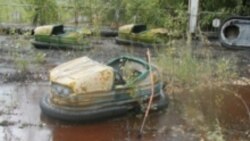
Nearly two decades later, Pripyat is a ghost town. A gloomy atmosphere hangs over the abandoned amusement park. Grass grows through cracks in the asphalt. Raindrops splash on empty park rides.
A large Ferris wheel remains a vivid shade of yellow, as though it had been painted yesterday. Erected just days before the 26 April 1986 disaster, it has never carried a single passenger.
We get back in the car and drive through the rain to what Serhiy says was once the heart of Pripyat.
"This is the main square of the city. The regional headquarters of the [Communist] Party was based here. Look at the building over there. There was a restaurant and a hotel. It was the center of town. In the past, roses were growing everywhere. Now you see only bushes. On the top of some houses you can see birch trees growing," Serhiy says.
We walk into the Communist Party building. Portraits of once-prominent Politburo members lie scattered on the floor. There are empty chairs, books by Lenin, and posters bearing Communist slogans.
"No souvenirs," Serhiy warns -- everything is radioactive. He says contamination levels vary from place to place. But it will be hundreds of years before Pripyat is safe to live in.
In the rush to evacuate the city, few residents had time to take more than a few small possessions with them. But over the years, the town has been picked clean by thieves who took whatever they could and sold it.
Oleksiy Dolia, an ethnographer, says people throughout Ukraine may be unwittingly living with contaminated furniture and other property stolen from Pripyat.
"There's nothing left there. The houses are empty. Nearly everything was left in these houses -- furniture, [audio and video] equipment. Everything was there. But now there's nothing left," Dolia says.
Once a year, on 26 April, onetime Pripyat residents return to the town. Serhiy says it is a chance for many to remember what their lives were like before the accident.
"Some of them haven't been here for 10 or 15 years. Some more, some less. They meet here. Sometimes they set up a table with food, they kiss one another, they take pictures, remembering what their lives were like in this town. They think back on the times they went to a certain restaurant, or to the swimming pool. There was a wonderful pool here, a wonderful stadium," Serhiy says.
As we leave Pripyat, we stop and say goodbye to a sole policeman manning the checkpoint on the road leading in and out of the town. But after a wrong turn, we find ourselves once again in the main square, with no police to stop us. It seems anyone can enter the radioactive zone and not be detected.
(Photos by Valentinas Mite)
It is raining heavily as our driver parks his old Zhiguli in what used to be a children's amusement park. "It's good," he says, looking at the rain. "It will wash away some of the radioactivity."
Our guide is Serhiy Chernov, a local journalist. He lived in Pripyat as a student, and says he had hoped to make it his permanent home.
"There were flowers everywhere. Of all the cities I've seen in Ukraine -- of course, I haven't seen all of them -- it was the best. My wife and I celebrated our wedding here, and I wanted very much to be sent to work here after I graduated from Kyiv University. But half a year before I graduated, the catastrophe took place," Serhiy says.
Nearly two decades later, Pripyat is a ghost town. A gloomy atmosphere hangs over the abandoned amusement park. Grass grows through cracks in the asphalt. Raindrops splash on empty park rides.
A large Ferris wheel remains a vivid shade of yellow, as though it had been painted yesterday. Erected just days before the 26 April 1986 disaster, it has never carried a single passenger.
We get back in the car and drive through the rain to what Serhiy says was once the heart of Pripyat.
"This is the main square of the city. The regional headquarters of the [Communist] Party was based here. Look at the building over there. There was a restaurant and a hotel. It was the center of town. In the past, roses were growing everywhere. Now you see only bushes. On the top of some houses you can see birch trees growing," Serhiy says.
Over the years, the town has been picked clean by thieves who took whatever they could and sold it.
We walk into the Communist Party building. Portraits of once-prominent Politburo members lie scattered on the floor. There are empty chairs, books by Lenin, and posters bearing Communist slogans.
"No souvenirs," Serhiy warns -- everything is radioactive. He says contamination levels vary from place to place. But it will be hundreds of years before Pripyat is safe to live in.
In the rush to evacuate the city, few residents had time to take more than a few small possessions with them. But over the years, the town has been picked clean by thieves who took whatever they could and sold it.
Oleksiy Dolia, an ethnographer, says people throughout Ukraine may be unwittingly living with contaminated furniture and other property stolen from Pripyat.
"There's nothing left there. The houses are empty. Nearly everything was left in these houses -- furniture, [audio and video] equipment. Everything was there. But now there's nothing left," Dolia says.
Once a year, on 26 April, onetime Pripyat residents return to the town. Serhiy says it is a chance for many to remember what their lives were like before the accident.
"Some of them haven't been here for 10 or 15 years. Some more, some less. They meet here. Sometimes they set up a table with food, they kiss one another, they take pictures, remembering what their lives were like in this town. They think back on the times they went to a certain restaurant, or to the swimming pool. There was a wonderful pool here, a wonderful stadium," Serhiy says.
As we leave Pripyat, we stop and say goodbye to a sole policeman manning the checkpoint on the road leading in and out of the town. But after a wrong turn, we find ourselves once again in the main square, with no police to stop us. It seems anyone can enter the radioactive zone and not be detected.
(Photos by Valentinas Mite)