



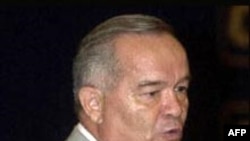
The accord illustrates Russia's growing support for the authoritarian Uzbek leader, who has come under heavy fire in the West for the bloodshed in Andijon in May.
The talks will reportedly focus on ways to boost bilateral military and economic cooperation, and on the activities of the Shanghai Cooperation Organization, a regional security group including Russia, China, Uzbekistan, and three other Central Asian countries.
Putin and Karimov are also due to discuss Uzbekistan's possible admittance to the Eurasian Economic Community (Eurasec), a body seeking to establish a single economic zone comprising Russia, Kazakhstan, Kyrgyzstan, Tajikistan, and Belarus.
Sergei Luzyanin, the president of the Foundation for Eastern Studies at the Moscow State Institute for International Relations, tells RFE/RL's Russian Service that the growing rapprochement between both countries illustrates Russia's drive to strengthen its presence in Central Asia.
"All this is linked to the strengthening of Russia's position in Central Asia through a rapprochement with its main player, Uzbekistan," Luzyanin says. "I do not exclude that the opening of a Russian military base in Uzbekistan in the near future may even be discussed."
New Accord
The highlight of today's talks will be the planned signing of a treaty between Russia and Uzbekistan.
The Russian Foreign Ministry said in a statement today that the treaty -- which builds on the previous Strategic Partnership Treaty signed by both countries in June 2004 -- seeks to establish a "long-term foundation" for closer bilateral ties.
According to media reports, in this new treaty, Russia pledges to support Uzbekistan in the event of unrest such as the 13 May violence in the Uzbek city of Andijon.
Speaking to reporters ahead of talks, Karimov thanked Moscow for its support and said that "Russia will not regret signing this treaty today."
Putin, in turn, called the treaty a "serious new step in the development of bilateral cooperation."
The Uzbek authorities blame Islamic militants for staging the uprising and say that 187 people were killed in the violence, mainly militants and government troops. Rights watchdogs, however, say over 700 unarmed civilians were killed by government forces.
Karimov's alleged heavy-handed response to the unrest and his subsequent refusal to allow an international probe into the violence has severely soured Uzbekistan's relations with the West.
Moscow has displayed growing support for the Uzbek leader since the Andijon events. China has also thrown its weight behind Karimov.
But Luzyanin says Russia's support for the authoritarian Uzbek president is unlikely to strain its ties with the West.
"On the whole, if Russia will support Uzbekistan on the [question of] European sanctions], its position will not be significantly affected all the same. Of course, [such a position] will generate some additional criticism but it will not radically worsen Europe's relations with Russia because of Tashkent," Luzyanin says.
In early October, the European Union announced that it will ban weapons exports to Uzbekistan. It will also refuse visas to certain officials.
In July, the SCO urged the United States to set a timetable for pulling out its troops from bases in Uzbekistan. This call was swiftly followed by Uzbekistan's request that the United States withdraw its troops within six months.
As a further sign of growing military ties, Russia and Uzbekistan held their first joint military exercises in September.
Aftermath Of Andijon

A dedicated webpage bringing together all of RFE/RL's coverage of the events in Andijon, Uzbekistan, in May 2005 and their continuing repercussions.

