



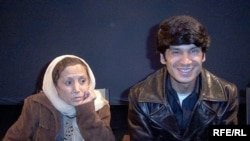
New York, 6 December 2005 (RFE/RL) -- The idea for "Beyond the Mirror" first took root in northern Pakistan in the spring of 2002. Members of Manhattan's Bond Street Theatre -- performing for Afghan refugee children -- met a group of Afghan actors and a friendship was formed.
Joanna Sherman is the artistic director of the Bond Street Theatre and codirector of "Beyond the Mirror." She tells RFE/RL the two groups of actors were drawn to each other by their common mission. A grant from the U.S. National Endowment for the Arts has allowed the troupes to perform "Beyond the Mirror" throughout Afghanistan, as well as in Japan and the United States.
"People are fascinated," she said. "We follow every performance with a kind of question-and-answer talk back with the audience, in which we found that people are really intrigued by Afghanistan. They remember that it was an issue. The issue has sort of been overtaken by the Iraq situation, and people remember that it was the unended story. 'Whatever happened to Afghanistan? What happened to the people there?' Which is one of the reasons why we are bringing this production here, because we want to clear up some of the misconceptions about Afghanistan and how the conflict occurred."
A separate grant from the U.S. State Department has allowed both groups to pursue educational programs aimed at Afghan
students.
"Beyond The Mirror" is built on the personal stories of real Afghans. The productions starts with the invasion by the Soviet Union in 1979, continues through the reign of the Taliban regime, and ends with the current situation.
"[Mahmoud] Salimi and I decided that we wanted to talk about conflict, the chronological order of events," she said. "And it's all drawn on true stories, so it's more of an episodic show. And all of these different stories of normal people that we've interviewed -- all true stories, starting with the actors themselves -- and then going to different provinces and interviewing women and children and old men, all different phases of life."
The Bond Street Theatre was founded in 1976. The history of Afghan's Exile Theater is shorter, but more turbulent. Salimi is the company's 30-year old founder: "We were in Pakistan, living there illegally as refugees when the Taliban were in Afghanistan, [when] they had power there. On March 18, 2000, we established Exile Theater. We were 12 [members]. At that time, people from TV, movie, theater, and also some other people that were not involved with the arts, we got together and established the theater. The aim was to rehabilitate Afghanistan's theater because it was stopped by the Taliban at that time."
Two years later, Salimi says, a group of armed men visited their refugee camp and, after tense questioning, warned them to stop their performances. In 2003, Exile Theatre moved to Kabul.
Exile Theatre's Anisa Wahab is an ethnic Tajik and one of the few women in Afghan theater who has enjoyed a long and successful career -- first as a child TV star, then on the stage, and in the movies. Wahab says that, while the arts climate in Afghanistan has improved considerably since the ouster of the Taliban, there is still a long way to go. But at least female performers, she says, have the opportunity to work undisturbed: "The conditions for women in Afghanistan are now better. They go to their jobs. I appear on TV and on stage. There is no problem from my family. There is no pressure from the government on actors not to perform. The government now supports artists. They can go and perform."
Wahabi first gained prominence on Afghan TV in the 1960s, where she sometimes played the roles of boys. Later, she switched to performing in comic shows. She says she is still recognized on the streets of Kabul.
Salimi says the time he has spent in New York has been intense. He and his friends have been to some Broadway shows and are enjoying the sights and sounds of the city. But he says he has also been struck by the individualism and loneliness he has witnessed.
"Family structure is a much more secure place or environment for me, that's more strong [in Afghanistan]," he said. "Especially when I see old men and women here [in New York], I don't feel secure about them. Because more than food and clothes and home, they need support from humans, to talk to them, to have kind behavior, to have love."
U.S. media reviews of "Beyond The Mirror" were generally sympathetic. "The New York Times" called the actors "ambassadors for peace, armed with slapstick." There are plans to continue the tour of "Beyond the Mirror" in Europe in the near future.
Joanna Sherman is the artistic director of the Bond Street Theatre and codirector of "Beyond the Mirror." She tells RFE/RL the two groups of actors were drawn to each other by their common mission. A grant from the U.S. National Endowment for the Arts has allowed the troupes to perform "Beyond the Mirror" throughout Afghanistan, as well as in Japan and the United States.
"People are fascinated," she said. "We follow every performance with a kind of question-and-answer talk back with the audience, in which we found that people are really intrigued by Afghanistan. They remember that it was an issue. The issue has sort of been overtaken by the Iraq situation, and people remember that it was the unended story. 'Whatever happened to Afghanistan? What happened to the people there?' Which is one of the reasons why we are bringing this production here, because we want to clear up some of the misconceptions about Afghanistan and how the conflict occurred."
A separate grant from the U.S. State Department has allowed both groups to pursue educational programs aimed at Afghan
students.
"Beyond The Mirror" is built on the personal stories of real Afghans. The productions starts with the invasion by the Soviet Union in 1979, continues through the reign of the Taliban regime, and ends with the current situation.
"[Mahmoud] Salimi and I decided that we wanted to talk about conflict, the chronological order of events," she said. "And it's all drawn on true stories, so it's more of an episodic show. And all of these different stories of normal people that we've interviewed -- all true stories, starting with the actors themselves -- and then going to different provinces and interviewing women and children and old men, all different phases of life."
The Bond Street Theatre was founded in 1976. The history of Afghan's Exile Theater is shorter, but more turbulent. Salimi is the company's 30-year old founder: "We were in Pakistan, living there illegally as refugees when the Taliban were in Afghanistan, [when] they had power there. On March 18, 2000, we established Exile Theater. We were 12 [members]. At that time, people from TV, movie, theater, and also some other people that were not involved with the arts, we got together and established the theater. The aim was to rehabilitate Afghanistan's theater because it was stopped by the Taliban at that time."
Two years later, Salimi says, a group of armed men visited their refugee camp and, after tense questioning, warned them to stop their performances. In 2003, Exile Theatre moved to Kabul.
Exile Theatre's Anisa Wahab is an ethnic Tajik and one of the few women in Afghan theater who has enjoyed a long and successful career -- first as a child TV star, then on the stage, and in the movies. Wahab says that, while the arts climate in Afghanistan has improved considerably since the ouster of the Taliban, there is still a long way to go. But at least female performers, she says, have the opportunity to work undisturbed: "The conditions for women in Afghanistan are now better. They go to their jobs. I appear on TV and on stage. There is no problem from my family. There is no pressure from the government on actors not to perform. The government now supports artists. They can go and perform."
Wahabi first gained prominence on Afghan TV in the 1960s, where she sometimes played the roles of boys. Later, she switched to performing in comic shows. She says she is still recognized on the streets of Kabul.
Salimi says the time he has spent in New York has been intense. He and his friends have been to some Broadway shows and are enjoying the sights and sounds of the city. But he says he has also been struck by the individualism and loneliness he has witnessed.
"Family structure is a much more secure place or environment for me, that's more strong [in Afghanistan]," he said. "Especially when I see old men and women here [in New York], I don't feel secure about them. Because more than food and clothes and home, they need support from humans, to talk to them, to have kind behavior, to have love."
U.S. media reviews of "Beyond The Mirror" were generally sympathetic. "The New York Times" called the actors "ambassadors for peace, armed with slapstick." There are plans to continue the tour of "Beyond the Mirror" in Europe in the near future.
Afghanistan's Musical Revival
Afghanistan's Musical Revival
BACK IN THE GROOVE Decades of war and the Taliban's five-year ban on music took their toll on Afghan classical music. Musicians have been trying to resuscitate the art since the end of Taliban rule. But they face serious economic and artistic challenges -- including the threat of possible attack by Taliban fighters if they perform in provincial areas...(more)