



Washington, 7 December 2005 (RFE/RL) -- Romanian President Traian Basescu seemed as pleased to be hosting the bases as the Americans are to have them.
Speaking on 6 December at a Bucharest news conference with visiting U.S. Secretary of State Condoleezza Rice, Basescu welcomed Romania's opportunity to play a prominent role in international security.
"This agreement [on opening U.S. military bases] places Romania within the global security system -- with an important contribution. After the signing of this agreement and its validation by the [Romanian] parliament, Romania will become a pillar of stability in the region," Basescu said.
Easier Access
The U.S. bases in Romania -- and those expected to be set up in neighboring Bulgaria -- are intended to give the United States easier access to the Middle East in what U.S. President George W. Bush calls the war on terrorism. Sofia says it expects to finalize talks with the United States by March on setting up U.S. military facilities on its territory.
The deployments are part of a broader U.S. troop realignment outlined by Bush last year. As part of the plan, tens of thousands of U.S. troops based in Germany and elsewhere in Europe will be shifted further east into smaller, more flexible bases, or redeployed back to the United States.
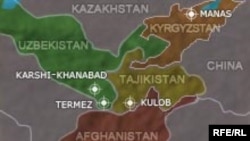
Meanwhile, the United States will still have access to the Kyrgyz base, at least for the foreseeable future. A U.S. presence there has an obvious motivation, and perhaps one that might not be so obvious.
"With regard to Central Asia, I think we have a dual purpose, maybe a triple purpose, with those bases," Ted Galen Carpenter, the vice president for defense and foreign-policy studies at the Cato Institute, a private Washington think tank, told RFE/RL. "Certainly, we want bases in Central Asia for operations against the remaining Taliban and Al-Qaeda operatives in that region. But having bases in Central Asia also sends a message to China and to Russia that this is now a significant U.S. sphere of influence."
Carpenter said the U.S. presence in Kyrgyzstan annoys Russia. But he believes President Vladimir Putin is less annoyed than are the country's "political elite," many of them left over from the days of Soviet rule. These elites still view the United States almost as warily as they did during the Cold War, he said.
Encirclement Strategy
"For many Russians, this looks like an encirclement strategy to intimidate Russia. And Russia has a lot of issues with many of these countries [that were once in the Soviet sphere], including the treatment of Russian-speaking inhabitants, both in the Baltics and in Ukraine. So this could become a source of very serious friction between the West -- and especially the United States -- and Russia in the future," Carpenter said.
Carpenter said this Russian perception is not entirely inaccurate. He believes part of U.S. strategy is to encircle Russia, which he calls a recent enemy that must still prove itself as a democracy and a friend of the West.
James Goodby agrees that Putin and other Russian officials are concerned about Western influence on its neighbors. Goodby studies East-West security issues at the Brookings Institution, another Washington policy research center. He told RFE/RL that he believes Putin is prepared to respond to the Western "encirclement strategy" -- real or perceived -- by strengthening relations with China and former Soviet states in Central Asia and the Caucasus.
"Putin's main concern is with what they used to call the 'near abroad.' As Putin sees it, he's trying to stabilize the region, like Moldova, Georgia, Azerbaijan. I think you're going to find much less cooperation with, for example, the [Organization for Security and Cooperation in Europe] in those regions. And I think Russia will be a bit more assertive, partly because that's one of their main strategic interests and partly in a kind of a response to American activism elsewhere near their frontiers," Goodby said.
Already, Goodby said, Putin and China have managed to use the Shanghai Cooperation Organization to exert their influence in Central Asia. But he expects Putin not to go beyond this sort of reaction.
"Of course, there are things [the Russians] could do to make things a little bit more unpleasant, but they have a lot of other interests, for example, membership in the World Trade Organization. They're having a meeting of the Group of Eight in St. Petersburg [in the spring]. So they have a lot at stake in their relations with the West," Goodby said.
Goodby said a stronger reaction might jeopardize Russia's economy and its prestige.