



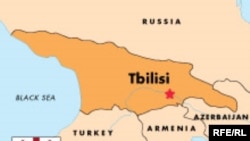
Washington, 17 December 2005 (RFE/RL) -- Russia's Gazprom announced earlier this month that it wants to almost double the price of natural gas to Georgia, raising tariffs from around $60 to $110 per 1,000 cubic meters. The new price would take effect on 1 January.
Russia insists that the reason for the price increase is not political. After all, Gazprom wants to charge Armenia, a close Russia ally, the same price as Georgia. The Georgian government, however, remains skeptical.
Sending A Message
Kakha Bendukidze, the Georgian state minister of in charge of economic reforms, has asked what suddenly happened to Russia’s economy that requires such a dramatic price rise. In an interview with "Kommersant-Daily" on 16 December, he wondered if there was such economic necessity before 1 January, then that must mean politics prevented the prices from being increased earlier.
On 16 December, Georgian Foreign Minister Bezhuashvili told an audience at Washington’s Carnegie Endowment for International Peace that Russia wants to "send a message" to the new democracies, Ukraine and Georgia, with the price hikes. And together, the two strategic allies are ready to form a common front.
"We need to confront these issues. And, we are saying and this is a common voice -- we had consultations with Ukrainians -- if this is the price for independence, we are going to pay this price. But we need to stay together. My message here in Washington -- speaking in the White House, in the State Department and other institutions -- will be to elaborate a very clear strategy, short-term, mid-term and long-term strategy how we will altogether face this problem, because this is not a problem and issue only for Georgia," Bezhuashvili said.
Diversification Of Energy Sources
Bezhuashvili is seeking not only U.S. support for a common Georgian-Ukrainian energy policy but also European. He stopped in Brussels on his way to Washington. There, he said he found support for diversifying sources of energy supply.
"The understanding in Europe is growing that there is a need for a trans-Atlantic energy-security strategy. One that will secure Europe from energy dependence that is taking place in the Eurasia and Europe in particular. Here we are facing a very tough policy of Russia, playing on the energy dependence of Europe and its neighbors," Bezhuashvili said.
The response from the Washington audience was not entirely sympathetic. Nikolai Zlobin, the director of Russian and Asian programs at the Center for Defense Information, said he was sympathetic to Georgia, but he wondered whether its current foreign-policy strategy was too focused on the West.
"What strike[s] me about your presentation [is that] you address your relations with the West and the United States and European Union, and I think Georgia really needs to improve drastically its relations with the near abroad. Your relations with Russia [are] going very bad[ly]. Your relations in the region with your neighbors [are] not so good and I would like to know what [is] your strategy -- not to blame Russia, not to blame anyone else -- but what is your strategy to improve these relations. Because I doubt the West or United States or European Union will want to fight or confront Russia over Georgia," Zlobin said.
However, Bezhuashvili insisted that energy dependence on Russian gas supplies is a problem facing not just Georgia and Ukraine but also "stable democracies" in Western Europe.
In the meantime, Georgian economists estimate that the doubling of gas prices in January could chop off an estimated 1.5 percent of Georgia's annual gross domestic product next year.
RFE/RL's World: 2005 In Pictures

A slideshow of images related to the top news stories of 2005 from throughout RFE/RL's broadcast region with links to RFE/RL's reporting.
See also:
2005 In Review: Central Asia Witnesses Revolution, Continued Crackdown
2005 In Review: Does The Presence Of Western Election Observers Make A Difference?
2005 In Review: The Geopolitical Game In Central Asia
2005 In Review: Migrants, Refugees Victims Of Incoherent Laws In Post-Soviet States
2005 In Review: The Transformation Of Television In Russia
2005 In Review: Russia's Centralization Gathers Pace
2005 In Review: A Year Of Hopes, Disappointments For Afghans And Iraqis