



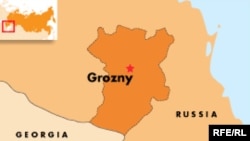
Prague, 22 December 2005 (RFE/RL) -- Azhan Askhabova says her daughter was standing in line at school when she suddenly smelled something strange -- something similar to motor fuel.
Overcome with nausea, she vomited and fainted. And one by one, the girls in line with her were doing just the same.
More Than 70 Stricken
It has been a week since the first outbreak of the mystery ailment that by now has affected more than 70 people, the vast majority of them teenage girls.
Since then, more than 20 patients have been brought to the Republican Pediatric Hospital in the Chechen capital, Grozny.
Jaradat Dotueva brought her son there after he fell ill. She spoke to RFE/RL's North Caucasus Service:
"My son came back, and said: 'Mama, today I couldn't stay at school, everyone had headaches and their stomachs hurt.'"
He also said that he was cold, so I bundled him up in warm clothes," Dotueva said. "His hands and feet were cold. After some time they all seemed to get better. For a while it was as if nothing had happened at all. But then everything started all over again. While they were feeling better we took some of them home. But at home everything started again. So we gathered everyone up and brought them here. The vast majority of them are girls. The only boy is my son. But now at home the boys are also complaining about headaches -- my other son, who's still at home, my neighbor's son."
The majority of the patients are from the village of Starogladovskaya in the eastern part of the North Caucasus republic.
But the illness is apparently not limited to a single site. Children and adult employees from several schools in different villages have all come down with the same symptoms.
Not Food Poisoning Or Radiation Sickness
Doctors and toxicologists, some brought in from Moscow, have ruled out food poisoning as a possible cause. The grounds of the schools have also reportedly been screened for radioactivity and found to be normal.
Authorities have described as premature speculation about a possible terrorist plot. But Huseyn Nutaev, the head of Shelkovskaya Oblast, where the schools are located, has suggested that nerve gas could be responsible for the poisoning.
Sultan Alimkhadzhiev, Chechnya's deputy health minister and the head doctor at the pediatric hospital in Grozny, told RFE/RL there is no firm evidence the illness is the result of toxic agent poisoning.
Psychosomatic?
"We can't establish with any certainty that it was poisoning. This kind of situation has been described by an American toxicology institution. We found a description of it in an article," Alimkhadzhiev said. "It confirmed that similar incidents have been known to take place. In our republic there was a war. And children, in a psychological sense, have been traumatized by this war. They are very weak, both physically and psychologically. People -- especially woman and girls -- are affected by the anticipation of new traumas. After all, out of all the sick children, there is only one boy. The girls are between 12 and 15 years old -- more susceptible to pressure. This is mentioned in the American article we read."
But one Western doctor dismissed the theory that the illness could be a result of psychological trauma. Marc Siegel, an associate professor of medicine at New York University's School of Medicine in New York City, says the symptoms point to environmental poisoning:
"These symptoms are classic for severe mercury intoxication. There's a disease called Minamata disease, which is very consistent with this exact constellation of symptoms, the neurological findings," Siegel said. "The blackouts, the tingling, the nausea -- all of this is consistent with severe mercury poisoning. And it can be due to environmental exposure, such as a soda plant, some kind of chemical plant nearby. I would find it conceivable to believe that this could occur in Chechnya without it being a terrorist event."
Siegel, the author of "False Alarm, The Truth About The Epidemic Of Fear" and the soon to be published "Bird Flu," said most cases of Minamata disease have been linked to regional environmental exposure -- and could explain why different school buildings in neighboring villages are each experiencing similar outbreaks.
He also said toxicology experts examining the schools should pay particular attention to what activities the female teenage students may have had in common.
Some of those struck by the mystery ailment have already begun to be released from hospital -- suggesting that if a toxic agent was to blame, their exposure was relatively mild. But Siegel said severe mercury poisoning can have devastating long-term effects:
"The problem with mercury is that it's hard to get it out of the system. You have to do some kind of chelation therapy and treatment," Siegel said. "But unfortunately if it's mercury, it could have some long-term effects in terms of neurological damage to the peripheral nervous system and to the nerves and to the brain as well. If it's nerve gas or some other agent besides mercury, the risks are less, because it would be a more evanescent effect. But I'm concerned about long-term neurological damage to people that are having an acute severe mercury exposure."
Blood samples from the patients have been sent to a toxicology centers in Moscow and Makhachkala, the provincial capital of neighboring Daghestan. The first results are expected only on 26 December.
In Moscow, Russian President Vladimir Putin has offered financial assistance to help the Chechen authorities cope with the sudden outbreak.
All the schools in Shelkovskaya Oblast have been closed until 25 December.
Crisis In Chechnya

RFE/RL's complete coverage of Russia's war-torn Republic of Chechnya.