




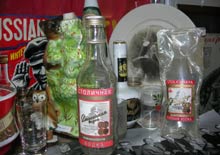
Nikishin says he quickly fell in love with the old vodka bottles that he bought to illustrate his book. Since then, his collection has grown to about 40,000 items -- the biggest in the world, he likes to point out.
But Nikishin insists that his love affair with vodka is nothing unhealthy. His aim, he says, is to restore the status of the drink he describes as "an invention of genius."
"We have a two-faced policy towards vodka. Everyone seems to drink it, but one shouldn't talk about it, it's better to keep quiet. I've never liked this attitude. The French know and respect the history of cognac, the Scots of whisky -- but for some reason, the Russians have an incomprehensible relation to their own invention," Nikishin says. "And our entire history, the fact that Russian vodka has conquered the whole world, that everybody knows it and drinks it, proves it is an invention of genius."
A few hundred items of Nikishin's itemsare temporarily displayed in a rented corner of Moscow's Decorative, Applied, and Folk Art Museum -- bottles in all shapes and sizes, glasses, elaborate cork toppers, old snapshots, posters, and ads.
Vodka Paraphernalia
The collection on display also includes an electric corking machine seized from an illegal distillery and the sofa on which Pyotr Smirnov died.
Nikishin's dream is to open a permanent museum in Moscow. A few Russian cities have vodka museums, but despite Nikishin's repeated requests for an exhibition space, the idea so far has not gained ground with the Moscow authorities.
Alcoholism is cited as one of the main causes for Russia's shrinking population and Russians' short lifespan. While Russian women can hope to live to 72 years, male life expectancy is only 58 years -- 16 years less than in Western Europe.
Health officials say alcohol is linked to 30 percent of all deaths in Russia, with alcohol poisoning alone killing about 40,000 people a year.
Nikishin does not deny vodka is dangerous to one's health, and calls it a "devil" that can kill if one doesn't tame it.
But he says vodka bans and taboos only contribute to fuelling alcoholism in Russia. He is convinced that his collection, which includes rare tsarist anti-drinking ads, can help fight alcoholism by teaching people about how to drink vodka -- moderately and in a civilized manner.
Nikishin says bottles shaped into busts of military and literary luminaries testify to the respect vodka enjoyed in tsarist times.
Tsarist military cadets even received special instruction on how to drink vodka so they would not disgrace their army during celebrations.
Fall From Grace
Today, however, this golden age of vodka is long gone.
Nikolai Zhuravlev, a 56-year-old scholar and a self-professed vodka fan who says he drinks at least half a bottle when celebrating with friends, admits that he is in the dark about how the drink was actually born and consumed in the past.
"Ahh, I've heard it somewhere, but...well, Mendeleev invented something or other.... Vodka hasn't always existed in Russia, I'm sure of that. Actually, I don't really need to know it. The important thing is that I like vodka, that's all. With cucumbers or sprats, it's wonderful," Zhuravlev says.
Dmitrii Mendeleev, the Russian chemist famous for creating the first version of the periodic table of elements in 1869, also determined that the optimal ratio of alcohol used in vodka was 40 percent.
According to Nikishin, vodka's fall from respectability began with Tsar Peter the Great, who brought from Europe the tradition of repeated toasting.
The tsar further contributed to vodka's bad reputation by using it as a punishment. To discourage unpunctuality, for instance, he supposedly forced latecomers to drink 10 liters of vodka from a huge glass container until they collapsed --and, often, died.
Despite its dangers and its negative associations, attempts to curb vodka consumption have failed spectacularly in Russia -- they largely served to infuriate Russians and generate a booming black market.
Vodka was first banned in 1914; then, in 1985, Mikhail Gorbachev launched an anti-alcohol campaign, scaling back production and slashing hours when the drink could be sold. Sharp-tongued vodka enthusiasts claim both campaigns triggered the fall of the Russian empire in 1917 and the collapse of the Soviet Union in 1991.
Russians' enduring love for vodka is illustrated in the following joke, which takes place during Gorbachev's anti-alcohol campaign: a man standing in line for vodka becomes tired of waiting and goes to the Kremlin to shoot Gorbachev. He returns after a few minutes, because the line to shoot Gorbachev is even longer.

