




The group co-chairmen said during a visit to the South Caucasus last month that some progress was achieved during the course of 2005 toward resolving the Karabakh conflict, and they expressed cautious optimism that 2006 could prove to be a window of opportunity in which the two sides reach agreement at least on the basic parameters for a settlement.
Armenian Foreign Minister Vartan Oskanian echoed that cautious optimism, telling journalists in Yerevan on 15 December that "there has been positive movement this year. If that trend continues, it will be possible to expect some document to be born at the beginning of 2006."
Oskanian gave no hint of what that "document" might be, but Russian Minsk Group co-chairman Yury Merzlyakov told Azerbaijan's Trend news agency on 21 December that the co-chairs are currently drafting a two-page document that would enumerate the "basic principles" for resolving the conflict, and to which the two sides must give their agreement.
On 29 December, day.az quoted Merzlyakov as having told APA news agency that during their meetings in Warsaw in May 2005 and Kazan in August, Armenian President Robert Kocharian and his Azerbaijani counterpart Ilham Aliyev discussed the basic principles for resolving the conflict.
Merzlyakov said he hopes that at their upcoming summit the two presidents will give the green light for finalizing a document enumerating those principles, which it would be appropriate to describe as a "framework document" rather than a full-fledged peace agreement. That document would then enable the foreign ministers to focus more closely and in greater detail on individual issues that must be addressed.
Azerbaijani Foreign Minister Elmar Mammadyarov for his part told journalists in Baku on 22 December that there are nine "basic principles" for a settlement, one of which is the deployment of an international peacekeeping force parallel with the gradual withdrawal of Armenian forces from occupied Azerbaijani territory. Merzlyakov said that force would number some 10,000 men, and that in the interests of impartiality it should not include contingents from Russia, the U.S., France, or Turkey.
Merzlyakov gave no hint of whether and how the proposed framework document might reconcile the conflicting approaches of the two sides to resolving the conflict.
Azerbaijani officials continue to insist on the so-called "phased" approach, under which no decision would be made on the final status of the disputed Nagorno-Karabakh Republic until Armenian troops have been withdrawn from territory they currently occupy contiguous to the enclave and the Azerbaijani community that fled in 1988 has returned.
Azerbaijan also continues to reject any status other than "the highest degree of autonomy" within Azerbaijan for Karabakh. Armenia, by contrast, rules out any vertical subordination of the unrecognized Nagorno-Karabakh Republic to the Azerbaijani central government, and wants all aspects of the peace agreement, and the timetable for implementing them, specified in the final peace agreement (the so-called "package" approach).
One seeming synthesis of those approaches is a plan first floated in October by the International Crisis Group that envisaged the gradual withdrawal of Armenian forces from occupied Azerbaijani territory, the deployment of international peacekeepers, and the holding after a minimum of five years of a referendum on the enclave's final status in which its population would have a variety of options from which to choose, including self-determination, secession from the Azerbaijan Republic, and unity with it.
Nagorno-Karabakh
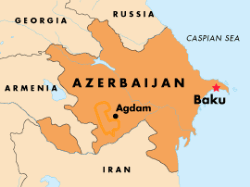 Click on the map to see an enlarged map of the Nagorno-Karabakh conflict area.
In February 1988, the local assembly in Stepanakert, the local capital of the Azerbaijani region of NAGORNO-KARABAKH, passed a resolution calling for unification of the predominantly ethnic-Armenian region with Armenia. There were reports of violence against local Azeris, followed by attacks against Armenians in the Azerbaijani city of Sumgait. In 1991-92, Azerbaijani forces occupied most of Nagorno-Karabakh, but the Armenians counterattacked and by 1993-94 had seized almost all of the region, as well as vast areas around it. About 600,000 Azeris were displaced and as many as 25,000 people were killed before a Russian-brokered cease-fire was imposed in May 1994.
For a complete archive of RFE/RL's coverage of the Nagorno-Karabakh conflict,click here.
Of particular interest:
2005 In Review: Conflicts In Caucasus Still Characterized By Gridlock