


But what is Rugova's legacy? Basri Qaprici, who is president of Kosova's PEN Club and a longtime associate of Rugova, and Momcilo Trajkovic, who heads the Serbian Resistance Movement of Kosovo and is a veteran Serbian political leader, recently gave their views to RFE/RL's South Slavic and Albanian Languages Service.
Both men agree that Rugova was someone special, albeit for different reasons. Qaprici noted that he was "a symbol of peace in the Balkans...[who sought] a peaceful resolution of the Kosova question and the dissolution of Yugoslavia in a peaceful way."
First To Declare Openly For Independence
Trajkovic argues that the Kosovar leaders who came before Rugova were communists who were not honest about their ultimate political goals, whereas Rugova was the first ethnic Albanian politician to declare openly that he wanted independence.
On the down side, Rugova said that he favored peaceful means but was unwilling to take into account the opinion of those minorities that did not want independence. Rugova should have realized that one must talk to people who have different views and not only to those who share one's ideas, Trajkovic maintains.
Which Tactics?
And what about Rugova's tactics? Qaprici notes that Rugova realized in the late 1980s that independence was a viable option only if Yugoslavia began to dissolve into separate, internationally recognized states. Until that happened, he had to put forward the idea of making Kosova the seventh republic in the Yugoslav federation, which was, in any event, totally unacceptable to the Serbian leadership. Rugova later resisted overtures from Ljubljana and Zagreb to open a "joint front" against Belgrade when they began their moves toward independence. Finally, when Serbian repression increased in Kosova in the second half of the 1990s, Rugova resisted calls from the UCK to join their cause, Qaprici maintains.

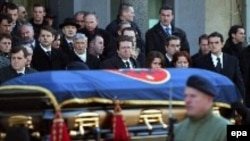
Rugova in 2004 (epa)
Qaprici says that this assessment is not quite fair, noting that nobody in the Serbian political establishment was willing to talk to Rugova during the 1990s, and that Trajkovic himself was a political outsider during the rule of former Serbian and Yugoslav President Slobodan Milosevic.
The two speakers differed sharply about the controversial visit of Rugova to Milosevic in the spring of 1999, when Serbian repression in Kosova was in full swing. Qaprici maintains that Rugova was kidnapped in an effort to compromise him, adding that he knew full well that the "only language Milosevic understood was that of force." Trajkovic, however, argues that Rugova was "brave" in going to the Serbian capital to "try to find a [political] solution." In the end, Rugova "outsmarted" Milosevic, Trajkovic maintains.
The Genuine Article
Rugova's own people subsequently elected him twice to the presidency in recognition of his democratic credentials. Trajkovic adds that Hashim Thaci and other former guerrillas sought after the war to present themselves as democratic politicians to win credibility, but the voters understood that Rugova was the genuine article.
Looking toward the upcoming status talks, Qaprici argues that Kosova's elected institutions now carry more weight than do individual leaders. Trajkovic agrees that the institutions occupy center stage politically, so Rugova's death will not substantially affect the talks. The key players in the negotiations are, however, in the international community, and Rugova's successor will be somebody who will listen to them. Trajkovic concludes that what Kosova truly needs is a leader who understands something about economics and "not just politics alone."
Rugova Visits RFE/RL
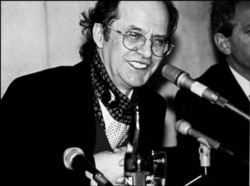 Rugova at RFE/RL's Prague headquarters in 1998
IBRAHIM RUGOVA visited RFE/RL headquarters in Prague on December 18, 1998, in order to highlight the oppression of Albanian-language media in Kosovo by the government of then Yugoslav President Slobodan Milosevic.
The Serbian Information Ministry on December 18, 1998 threatened two newspapers in Kosovo with prosecution for allegedly "stirring up terrorism and calling for the violent overthrow of the constitutional order." Serbia passed an information law two months earlier, setting fines for articles perceived to threaten the constitutional order.
Rugova said Serbian authorities have subjected Albanian-language media in the province to years of repression, shutting down some 90 periodicals, barring Albanian-language television programs and banning or jailing local journalists. He said there were two Albanian-language dailies left - "Bujku" and "Koha Ditore" - which continue to function. Rugova also said Serbian forces could, in his words "exterminate Kosovars next spring in a couple of days if they wanted to." He said this is why it is his goal to achieve a negotiated interim political settlement with the help of the international community.
For a complete archive of RFE/RL's coverage of events in Kosovo, click here.