



PRAGUE, 1 February 2006 (RFE/RL) -- One day in October, Croatians opened their morning newspapers to find a list of names. -- more than a thousand of them -- under the headline, "I don't want to hide any longer!"
The advert was the initiative of the gay rights group Iskorak, or Step Forward.
"We wanted, with a symbolic 'coming out,' to show that homosexual people are in the society and that we do have the same rights as everyone else," Iskorak head Kristijan Grdan says. "Coming out with only first names, without second names, is just a first step because coming out with last names is still a very big step to take in the public eye."
Croatia has one of the most liberal approaches in the region to homosexuality. Since 2003, it's allowed same-sex unions and it has laws forbidding discrimination on the basis of sexual orientation.
'System Of Protection'
But Grdan says homosexuals still face much prejudice.
"There is a certain system of protection, but when you find your self on the street with your partner, and someone beats you up, you know that it's still not safe," Grdan tells RFE/RL. "Often, this violence is in the sense of threats, scaring, or something similar."
The status of homosexuality in the law varies across the world.
It's punishable by death in some places, while other countries allow same-sex unions with many of the same rights as married couples.
Tougher Climates
The situation's as diverse in the RFE/RL broadcast region RFE/RL, from Eastern Europe to the former Soviet Union and parts of the Middle East.
In some countries, like Croatia, gays are increasingly "coming out of the closet," organizing themselves and demanding greater rights.
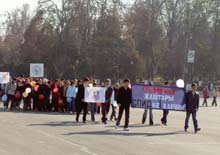
An AIDS awareness rally in the Kyrgyz city of Osh in December 2005 (RFE/RL)
"The Kazakh Constitution very clearly bans any kind of discrimination, including discrimination on the basis of sexuality, which applies to sexual minorities as it does to any other citizen," says Yevgeniy Zhovits, head of Kazakhstan's Bureau on Human Rights and the Rule of Law. "That's the legal basis. But practice is a different question, attitudes in society are a different question. These are still, mostly, very negative towards sexual minorities."
Some Kazakh gays claim there have been cases where an employer has sacked someone because they were gay.
Yet some things appear to be changing, at least in the bigger cities.
'It'll Take 20 Years'
There's a small gay scene in Almaty, complete with clubs, and there's a gay website, gay.kz
Still, issues such as same-sex unions, or the right to adopt children, remain firmly off the agenda.
Nayil, a gay man from Almaty who asked to be identified only by his first name, says change is coming slowly.
"The way gays live in, say, Europe or other countries abroad, it's totally different from here," Nayil says. "They're in a stronger position, they feel more stable in society than here. Here, in the east, in Asia, we're more constricted, because people are just beginning to understand, accept us as we are. It'll probably take society 20 years or so for gays here to be able to feel like fully-fledged people."
Homosexuality is prohibited by Islam, so where Islamic law holds sway, laws on homosexuality can be harsh.
In Iran, it can be punishable by death, a sentence that is still carried out. In November, two men were executed for homosexual sex, a move that prompted widespread condemnation. Human Rights Watch said Iran's persecution of gay men flouted international human-rights standards.
Not Openly Discussed
In Afghanistan, homosexuality is still a crime, though no one these days faces having a wall toppled on them -- as was the punishment under the Taliban. And correspondents say sex between men -- especially an older and younger man -- is fairly common, though frowned on and not openly discussed.
Most countries of the former Soviet Union have scrapped laws that made homosexual acts between men a punishable offense.
Notable exceptions are Turkmenistan and Uzbekistan, where gay men face up to two or three years in jail, respectively.
In Russia, the old laws are gone, but there's still a stigma attached to being gay, and plans for a gay pride march in Moscow have encountered hostility from authorities and ordinary people alike.
Some Improvements
As far as legal attitudes to homosexuals, Croatia, with its same-sex unions, remains a liberal outpost in the RFE/RL region. But there are tentative efforts elsewhere to bring in laws that would promote gay rights.
One such place is Moldova, where an NGO has lobbied authorities to bring in an antidiscrimination law.
Opinions among ordinary Moldovans are split.
"[These are] persons who have deviated from the normal social moral, and I think they should not enjoy support," one man told RFE/RL's Romanian and Moldovan Service. "This issue should not be legalized. [It should be] the way it was, they should hide. If we are Christians, Orthodox, the Bible also forbids this [practice]."
"I've heard that they want to have some kind of association, to be recognized, to have their rights, and their own [kind of] sexual life," another man says. "But I think that here, in Moldova, these will not be admitted, because the [people's] mentality remains post-Soviet. Maybe in 20-30 years, people's mentality will change."
Across the region -- as elsewhere in the world, gays still have a long way to go before full acceptance.
"I think it's hard to be different in every country, not just Croatia," says one woman in Zagreb.
(compiled from material by RFE/RL's South Slav, Afghan, Romanian/Moldovan, Kazakh, Tatar-Bashkir and Azerbaijan)

