




PRAGUE, 17 February 2006 (RFE/RL) -- In the scramble to contain bird flu, some countries, at least, appear to be getting it right.
Take Italy, for example. When the virulent H5N1 strain was found in dead swans on 11 February, the response from authorities won praise from the UN's Food and Agriculture Organization.
Swift Reaction, No Panic
"They cordoned off the area and increased a surveillance zone to about 10 kilometers," says FAO official Juan Lubroth. "Because some of the poultry were inside the 10-kilometer area, they were sequestered -- no movement in, no movement out. There was rapid sending of the samples [for testing], confirmatory diagnosis, quick action on part of the Ministry of Agriculture to hold a press conference and take measures at the local level, and good coordination between the central and provincial governments."
Good advance planning, good organization, rapid diffusion of information -- on the surface, that would seem to contrast sharply with the picture further east, where the main tool in the armory of the authorities appears to be mass culling of domestic poultry, followed up by quarantine and disinfection.
Mass Culling In Turkey, Daghestan
When 12 people fell ill with the H5N1 virus in Turkey this year and four died, the government slaughtered nearly 2 million birds nationwide. Fifty suspected cases of the virus had been found in domestic birds and four in wild birds.
In Russia, they have taken the same approach – first in Siberia last July and August and this month in the north Caucasian republic of Daghestan, which borders the Caspian Sea. There, they've slaughtered 270,000 birds in the last week, following confirmation of the presence of the H5N1 virus in two poultry farms. The plan is to follow that up with selective vaccination.
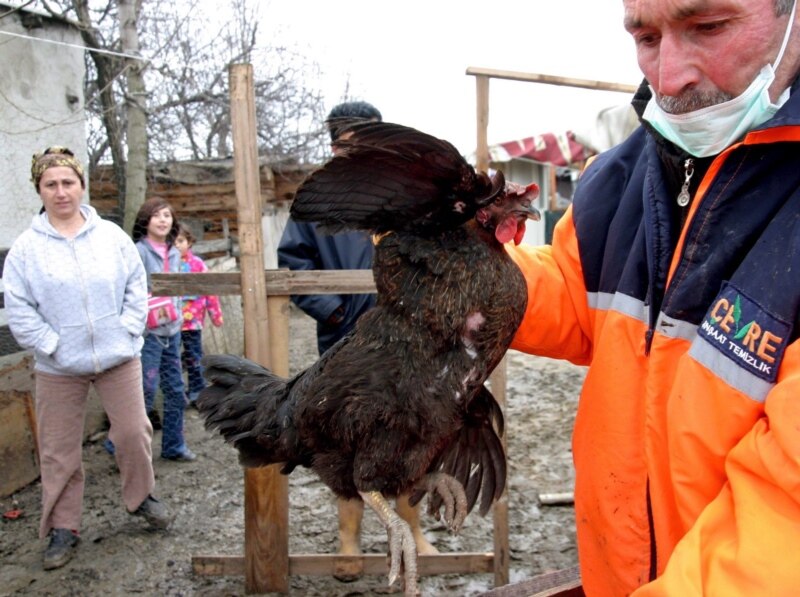
Officials collecting poultry near Istanbul on 13 January (epa)
"In the first poultry farm, all the birds were destroyed by 4 or 5 February," Djambulatov said. "The farm is shut and in three weeks, we'll test it again for the virus and we'll keep observing its behavior for a further month after that. We've destroyed 50,000 dead birds at the Shamkhal poultry farm and will kill another 100,000 even if they're alive and healthy."
The difference in response between East and West appears striking. But the picture, experts say, is actually more complex.
Wild Birds Or Poultry?
European Union countries have only had to deal with bird-flu outbreaks in wild birds. That means there's been no need for the mass culling of poultry. The emphasis instead is on containment to prevent the spread of the virus from wild birds to domestic poultry.
"There is little you can do about the wild birds, especially the migratory ones, it's very difficult to do anything there and probably it's not possible or even desirable," says Dutch virologist Albert Osterhaus. "The most important thing is to now, as much as possible, to have the poultry flocks indoors."
But that's easier to do in countries like Germany or Italy, where poultry farming tends to be large-scale and often indoors anyway.
Different Situation In The East
Further east, in countries like Russia or Turkey, "backyard chickens" are much more an integral part of rural life. So preventing the spread of the virus to domestic poultry is nearly impossible.
And many of the measures being taken in the EU states are also being taken in countries further east.
Take Azerbaijan, for instance, which has also been coping with an outbreak in wild birds.
There authorities say they have set up 3-kilometer quarantine zones round infected areas and put poultry farms under stricter supervision -- just like in the EU.
The FAO also recommends countries cull susceptible birds if they find the virus in poultry --- like they're doing in Daghestan this week.
The EU Would Do The Same Thing
Would this recommendation also apply to the European Union, if the virus were to be discovered in domestic birds?
"Most certainly" the FAO's Lubroth says. "If the disease would have spilled over from let's say the dead swans to poultry in Italy -- we do not have any evidence that that has happened yet, but if it were to happen tomorrow -- the Italian authorities would depopulate that particular premises or village of all susceptible animals. The virus is multiplying in poultry at very high levels, and it's through poultry that people get infected, not wild life. So we want to limit that possibility."
In that event, the response by East and West might not look very different after all.
Affected Areas
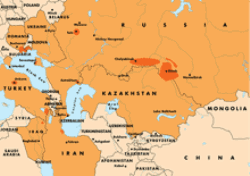
Click on the map for a closer view of the areas within RFE/RL's broadcast region where cases of diseased fowl have been confirmed. Last updated on February 20.
BIRD FLU, or avian influenza, continues to menace scattered areas from East Asia, where the disease first appeared, to Southeastern and Eastern Europe and beyond. Authorities around the world are bracing themselves -- and, more importantly, planning and taking measures to fight the disease wherever it appears.
Stories Of Particular Interest:
Bird-Flu Expert Discusses Issue Of Migratory Birds
Bird Flu: As European Worries Grow, Some See Benefits In Alarm