



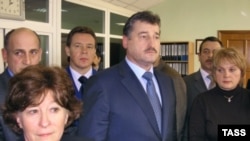
She made the comment in the Chechen capital, Grozny, after a meeting with the public prosecutor for the region, Valery Kuznetzov.
Today's visit to Chechnya was part of a tour of the North Caucasus. On 23 February, she is expected to meet with President Vladimir Putin in Moscow.
(ITAR-TASS, Interfax)
Lyudmila Alekseyeva
 Lyudmila Alekseyeva (TASS)
THE END OF THE 'GOLDEN AGE' Moscow Helsinki Group founder and Chairwoman LYUDMILA ALEKSEYEVA spoke at an RFE/RL briefing in Washington, D.C., on October 26, discussing the difficulties facing Russian nongovernmental organizations. Tanya Lokshina, chairwoman of the DEMOS Center for Information and Research, also participated in the briefing.
According to Alekseyeva, who is a regular contributor to RFE/RL's Russian Service, the time in office of former Russian President Boris Yeltsin is considered a "golden age" for Russian NGOs -- even though this is "not [because] Yeltsin was a strong democrat," but rather because "society was left to its own devices and we managed to build civil society" while the "power elites" struggled among themselves and ignored the lower strata. Alekseyeva said Russia has emerged from its economic crises under President Vladimir Putin, but there is "no division of power in Russia under the model of executive vertical controls," where regional governors, a "puppet parliament," and a judiciary "stripped" of independence are under the Kremlin's control. Nonetheless, according to Alekseyeva, Russia is "not returning to Soviet times," because "today the attacks are selective" and "there is now a civil society" to resist the pressure.
Alekseyeva expressed concern that "Western democratic states don't react to attacks on human rights." She said that "in Soviet times, we few dissidents felt enormous Western support." She called that support "our shield," which she said is now missing. The supporters of civil society feel "now abandoned by Western allies," Alekseyeva said.
LISTEN
Listen to the complete panel discussion (about 90 minutes):Real Audio Windows Media
More stories featuring Alekseyeva and the Moscow Helsinki Group:
Human Rights Groups Spurn Chechen Poll
What Is The Biggest Threat To Stability In Kabardino-Balkaria?
Geologist Takes Law Abolishing Election Of Regional Leaders To Court