



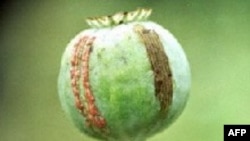
The country's government has made reducing poppy production a top priority.
The survey, by the Afghan government and the United Nations, indicates that more poppies are being grown in 13 of Afghanistan's provinces. The survey says cultivation levels are stable in 16 provinces and have dropped in only three provinces.
Poppies are the main ingredient used to make heroin.
Doris Buddenberg, of the UN Office on Drugs and Crime, said her organization is concerned about the trends.
(AP)
Helmand Province Governor Comments
 U.S. Marines operating in Helmand Province in 2002 (epa)
RULING A RESTIVE LAND: On February 12, RFE/RL Radio Free Afghanistan correspondent Jawaid Wafa spoke briefly with Helmand Province Governor MOHAMMAD DAOUD about the ongoing violence in his restive region on the border with Pakistan.
RFE/RL: Recently, there have been many clashes and attacks by insurgents in Helmand Province. What in your view facilitates these attacks, especially in Helmand?
Mohammad Daoud: This province has a 160-kilometer border with Pakistan's Baluchistan Province. In reality, armed people, armed terrorists, from the other side of the border cross the border into Helmand. They carry out attacks and return back. It is a serious problem in Helmand that within our borders there is neither tribal good will, nor are there are special military or security measures to prevent enemies from crossing back and forth.
RFE/RL: The attacks and clashes have not only been between government forces and insurgents. There have been various clashes in different parts of Helmand between police and purported drug smugglers. How do you explain this?
Daoud: Drug smugglers also use the border for their own purposes. They have opened markets on the border and process opium there. This is a serious problem along our border. We are in touch with our authorities on this problem.
RFE/RL: There are government border police patrol your border. What is their role in preventing illegal crossings?
Daoud: Along this 160-kilometer border, there are car routes, walking routes. We have border police, but unfortunately, either because of their own problems or because of weak administration, they have not been able to stop the crossing.
RELATED ARTICLES