

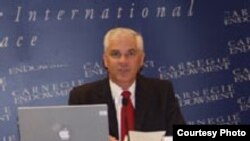
RFE/RL: Some people argue that the Russian proposal plus a small-scale enrichment capacity could have ended the crisis. Iran is said to have nearly accepted the deal; it appeared that Russia also agreed with the deal. But after meeting with [U.S.] Secretary [of State Condoleezza] Rice, [Russian Foreign Minister Sergei] Lavrov said there was not going to be a combination of the Russian proposal and small-scale enrichment. What is wrong with small-scale enrichment...if it could solve the problem?
Joseph Cirincione: Well, clearly the United States and many other countries, including France and other members of the European Union, are concerned that, number one, Iran has to be held accountable for its past violations; it shouldn't be rewarded for violating the treaty. And number two, the concern is that if Iran begins with a little bit of enrichment, that will soon lead to a lot of enrichment. They see this as a slippery slope and see no reason to give in to this Iranian demand at this stage. I think there's room for a compromise, but I think it's too early to compromise. First, let's bring this to the United Nations Security Council, get the Security Council to speak on it, see if that won't convince Iran that it has to back down. There's no reason to be looking for a compromise position at this point. I would say in April or May, if this is still unresolved, then and only then would you start considering this kind of limited research. But it would have to be very limited indeed -- not thousands of centrifuges, not hundreds of centrifuges [but] a real small-scale research project.
Tehran's Bluff?
RFE/RL: [Expediency Council Chairman and former President Ali-Akbar Hashemi-] Rafsanjani said [on March 8] that "whether we remain a member of the [International Atomic Energy Agency, or IAEA] or not, we should try to keep what we have and we should try to strengthen our national unity." Similar statements about leaving the IAEA or the NPT [Nuclear Non-Proliferation Treaty] were made by Iranian officials. Do you think Iran's referral to the UN, could make Iran leave the NPT or the IAEA?
Cirincione: I think it's very unlikely that Iran is going to leave the NPT at this point. They would lose all assistance if they did so. For example, Russia would have to stop work immediately on the Bushehr reactor. You cannot aide another country if they've pulled out of the treaty or are in violation of the treaty. So I think this is a bluff at this point. I don't think we need to be too concerned about these kinds of Iranian threats.
U.S. Credibility
RFE/RL: You've said in the past that Secretary Rice has been successful in uniting the international community against Iran's stance. Now we hear statements by [U.S.] Vice President [Dick] Cheney or others implying possible military actions against Iran. Could that harm the unity?
Cirincione: Yes. What's disturbing about the vice president's remarks is, number one, that he's getting involved in this discussion at all -- because people remember the role he played in Iraq, where he basically misled the world, misled the American people, gave a lot of false information, and was the prime architect of the war against Iraq. Number two, to have the vice president intervening at this point could lead other countries to conclude that all this talk about a peaceful settlement is not true. Countries may start to believe the U.S.'s true agenda is regime change and that they're just using this nuclear issue as a way to get it. If that becomes the widespread view, then support for the U.S. and European position will collapse.
These countries don't want any part of renewed military actions against another country in the Middle East. I have said over the past few months that no senior American official was seriously considering military options against Iran. I now have to change that view. I do believe, from what the vice president [Cheney] said and from other reports that I've heard, that the vice president's office is seriously considering a military option against Iran. I don't think that's a viable option -- I think it would be a disaster for the United States if they did it -- but I do believe that some of the same officials who launched the war in Iraq are, in fact, considering launching a war against Iran, and I'm greatly disturbed by that.
Why Enrichment?
RFE/RL: Iran's justification for producing its nuclear fuel is concern that Russia might stop delivering the fuel one day. Without an international agreement that guarantees fuel delivery, is it fair to say that Iran's concern is legitimate?
Cirincione: It doesn't make any sense for any nation to build its own fuel-fabrication facility unless they've got at least 20 reactors. The cost of building it is so expensive, and there's an ample supply of fuel on the world market, and it's relatively cheap currently because of an oversupply, actually. So when Iran says that it wants to build a fuel facility and it doesn't even have one reactor operating, it raises questions about what their true intentions are. That's why the Russian deal makes such sense. Russia is willing to sell the fuel to Iran at market rates and to take the fuel back so Iran doesn't have to worry about reprocessing. I think that's a deal Iran should take.
But we also could consider a true international agreement, where a number of nations pledge together to provide fuel to Iran -- perhaps under IAEA organization -- so that Iran can be assured that Russia or any other country could never cut off its supply of fuel. Iran could become a prototype of a new kind of fuel-supply mechanism that could be applied not just to Iran but to other countries, giving them a guaranteed international supply of fuel.
Indian Parallels
RFE/RL: Some people say the nuclear deal between the United States and non-NPT-member India, while NPT member Iran is going to be punished, could weaken the NPT. Do you agree?
Cirincione: Yes. The U.S. deal, brokered by President Bush and [Indian] Prime Minister [Manmohan] Singh, is a real blow to the Non-Proliferation Treaty. If this deal stands, the treaty could fall. Here's why: The president is basically violating Article 1 of the treaty. Article 1 says that no state with nuclear technology will sell that technology to another country if it assists or encourages that country's nuclear-weapons program. This sale does help India build more nuclear weapons; it does encourage India's nuclear-weapons program.
This deal is going to come back to haunt us. If we're making an exception for India, selling nuclear technology even though they're not a part of the [NPT], then why can't Russia decide that it's going to make an exception for Iran -- to sell nuclear technology to Iran even if Iran were to pull out of the treaty? Once you start playing this nuclear exceptionalism theme, once you start breaking the rules for favorite states, it becomes impossible to stop. That's why the India deal actually greatly weakens our efforts to enforce the NPT against Iran.
Iran's Nuclear Program

THE COMPLETE PICTURE: RFE/RL's complete coverage of controversy surrounding Iran's nuclear program.