




Freed today met with rights campaigners and representatives of Azerbaijan's civil society at the U.S. ambassador's residence in Baku.
After the meeting, rights campaigner Rena Sadaddinova told Azerbaijan's Turan news agency that the discussion focused on last November's disputed parliamentary polls, human rights violations, the issue of political prisoners, and the Nagorno-Karabakh conflict.
Freed was scheduled to meet later today with President Ilham Aliyev and Azerbaijani businessmen.
Freed will later fly to neighboring Armenia. From there he will proceed to Istanbul to attend a meeting of the Minsk Group of nations that have been mandated by the Organization for Security and Cooperation in Europe to help Armenia and Azerbaijan settle the 18-year-old Karabakh dispute.
(Turan, APA)
The Nagorno-Karabakh Conflict
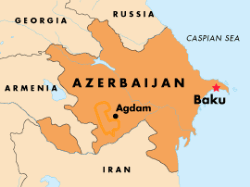 Click on the image to view an enlarged map of the Nagorno-Karabakh conflict zone
In February 1988, the local assembly in Stepanakert, the local capital of the Azerbaijani region of NAGORNO-KARABAKH, passed a resolution calling for unification of the predominantly ethnic-Armenian region with Armenia. There were reports of violence against local Azeris, followed by attacks against Armenians in the Azerbaijani city of Sumgait. In 1991-92, Azerbaijani forces launched an offensive against separatist forces in Nagorno-Karabakh, but the Armenians counterattacked and by 1993-94 had seized almost all of the region, as well as vast areas around it. About 600,000 Azeris were displaced and as many as 25,000 people were killed before a Russian-brokered cease-fire was imposed in May 1994.
CHRONOLOGY: For an annotated timeline of the fighting around Nagorno-Karabakh in 1988-94 and the long search for a permanent settlement to the conflict, click here.
 Click on the icon to view images of the Nagorno-Karabakh conflict (Flash required)
To view an archive of all of RFE/RL's coverage of Nagorno-Karabakh, click here.