




Bush urged the American people to have patience. He suggested the decision to withdraw U.S. troops probably would not come until after he leaves the White House in early 2009. He acknowledged polls showing dwindling support for the war, but said he won't change course because he believes the effort will lead to a stable, democratic Iraq.
"I am confident, I believe, I am optimistic, we will succeed [in Iraq]. If not, I'd pull our troops out. If I didn't believe we had a plan for victory, I wouldn't leave our people in harm's way."
‘A Clash About Civilization’
The news conference was one of several opportunities for the Bush administration to try to encourage public support for the war. Bush already has made two speeches in the past week, as have Vice President Dick Cheney and other senior White House officials.
Bush even has enlisted foreign support. Yesterday, NATO Secretary General Jaap de Hoop Scheffer spoke with Bush in Washington about the alliance's success in training indigenous Iraqi security forces. Today in London, Blair gave a speech framing the conflict over terrorism from a cultural standpoint.
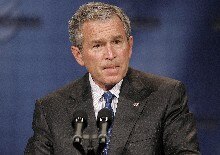
U.S. President George W. Bush (file photo, epa)
Blair said that his government sees the war as being not about what he called a "clash between civilizations, it is a clash about civilization." He said he wants people in Muslim societies to understand the benefits of a modern culture that is open, diverse, and secular.
"‘We' is not the West. ‘We’ are as much Muslim, as Christian, or Jew, or Hindu. We are those who believe in religious tolerance, openness to others, in democracy, liberty and human rights administered by secular courts."
He said if intolerant terrorists succeed in Iraq or Afghanistan, they will deal a death blow for a modern future in the Arab and Muslim world. But he said a victory for democracy would mean security and stability not only for Afghanistan and Iraq, but also for the West.
"What happens in Iraq or Afghanistan today is not just crucial for the people in those countries or even in those regions but for our security here and around the world,” Blair said. “It is a cause that has none of the debatable nature of the original decisions to go for a regime change. It is an entirely noble one to help people, in need of our help, in pursuit of liberty and the self-interested one, since in their salvation lies our own security."
An Activist Foreign Policy
Blair said Europe and the United States are taking what he called an "activist" approach to foreign policy. That includes the current NATO military involvement in Afghanistan, and the U.S. and British military presence in Iraq.
This "activist" policy, Blair said, also is the basis of the effort led by Britain, France and Germany -- known as the EU-3 -- to try to keep Iran from developing nuclear weapons. He called it an "interventionist" policy, but one so far limited to diplomacy.
In Washington, Bush said his administration is and the EU-3 are united in their opposition to a nuclear-armed Iran.
"If the Iranians were to have a nuclear weapon, they could blackmail the world. If the Iranians were to have a nuclear weapon, they could proliferate. This is a country that is walking away from international accords."
Bush was asked if Iran's nuclear program would a topic in direct U.S. talks with Iran that were announced last week. He said, as he has before, that these meetings would be limited to Tehran's suspected involvement in some of the sectarian violence in neighboring Iraq. Bush said the nuclear issue would be handled jointly with the EU-3.
