

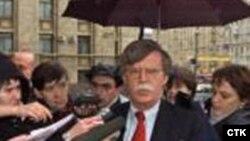
U.S. Ambassador John Bolton spoke after consultations on March 28 in New York among representatives of the five permanent, veto-holding Security Council members -- the United States, Russia, France, Britain, and China.
Diplomats say Britain and France, backed by the United States, have distributed a new proposal for a Security Council statement demanding that Iran stop uranium enrichment, a process necessary to produce nuclear weapons.
The proposal is reported to have eliminated some language that was opposed by Russia and China in earlier versions of the document.
The five permanent Security Council countries are trying to reach agreement ahead of a meeting of their foreign ministers, plus Germany, in Berlin on March 30.
Bolton said it is important for the council "to speak soon" and "to speak clearly."
"The council itself understands how important this is not just with respect to Iran’s nuclear weapons program but for the council itself," he said.
(AFP, Reuters, dpa)
What Would Sanctions Mean?
 Economic sanctions could further undermine Iran's already shaky economy (Fars)
MOVING TOWARD SANCTIONS: If the United Nations Security Council imposes sanctions on Iran, domestic support for Iranian President Mahmud Ahmadinejad will wane, according to ALEX VATANKA, Eurasia editor for Jane's Information Group.
Vatanka told a February 24 RFE/RL briefing that "economic sanctions will hurt the average Iranian" and, consequently, many "will blame the ruling clerics" for making life difficult and "impairing the country's long term development."
Vatanka said sanctions would be a serious challenge to the Iranian government. If harsh economic sanctions were imposed, Iran's poorest population will be hurt the hardest -- and might react "as they did in the 1970s and protest in the streets." Sanctions on travel, Vatanka said, would hurt a many Iranians because "Iran is a nation of small traders" who depend on the ability to travel to earn an income. According to Vatanka, unemployment in Iran is estimated at 30 percent, "so small trading is essential to survival." Although current U.S. sanctions "haven't worked," he said, "Iranians fear an oil embargo." He stressed that "oil revenues are a major part of the economy, so it is critical to look at this sector."
Should negotiations with the European Union and the UN fail, Vatanka believes that Iran would follow a "North Korea model," since Ahmadinejad's base of support among the "Islamist militias" has been "urging withdrawal from the NPT [Nuclear Non-Proliferation Treaty]." The Iranian government's "tactic" so far, Vatanka said, is governed by the belief that "by shouting the loudest, you'll get concessions [from the West]."
LISTEN
Listen to the complete panel discussion (about 60 minutes):Real Audio Windows Media

THE COMPLETE STORY: RFE/RL's coverage of the controversy surrounding Iran's nuclear program.