




WASHINGTON April 26, 2006 (RFE/RL) -- Speaking at a hearing of the U.S. Commission on Security and Cooperation in Europe on April 25, U.S. and Ukrainian officials drew attention to the deteriorating condition of the sarcophagus, the steel-and-concrete shell built after the accident to contain the radiation from the ill-fated Reactor No. 4.
Ukrainian Ambassador to the United States Oleh Shamshur told the commission that the legacy of Chornobyl consists not only in the health problems of the survivors, but also in the form of "200 tons of highly radioactive and melting substances."
Importance Of Replacing Sarcophagus
According to Shamshur, only the rapidly constructed sarcophagus separates these "substances" from the rest of the world. He called for the quick replacement of a more solid and safer construction.
"Let me remind you that only 3 percent of the reactor fuel was released into [the] atmosphere 20 years ago," he said. "The rest of it still represents the most horrible explosive device undermining the safety of the whole of Europe."
Warren Stern, senior coordinator for nuclear safety at the U.S. State Department, echoed Shamshur's anxiety.
"The greatest concern over the years has been and will continue to be that the structure could collapse," Stern said. "It was built very hastily and many components weren't actually formally attached together."
Stern's boss, acting Assistant Secretary of State for International Security and Nonproliferation Stephen Rademaker, said the United States and the Group of Seven remain engaged in increasing safety at the Chornobyl site and pledged that a new sturdier shelter will be in place before the end of the decade.
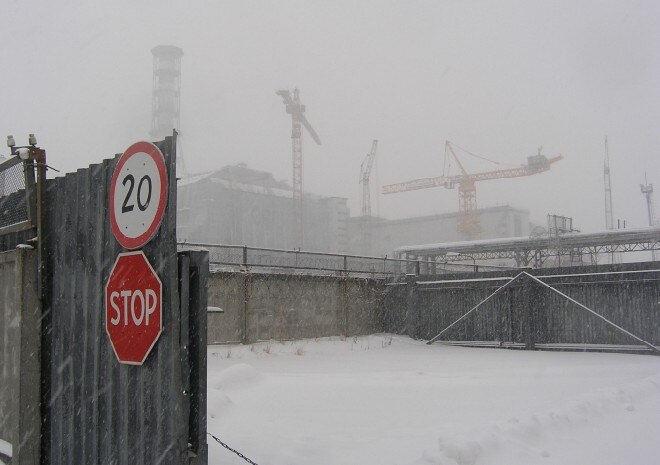
Construction work on the new shelter for Chornobyl's No. 4 reactor in March (RFE/RL)
In the meantime, the existing structure will be reinforced, according to Stern.
"Over the past several years and in the coming years, we have been and will be implementing structural upgrades at the existing shelter to help prevent any possibility or any significant possibility of collapse, that at the same time, as we are building the new shelter," he said.
Full Extent Of Disaster Still Unknown
U. S. Representative Christopher Smith (Republican, New Jersey), the co-chairman of the commission, and Ambassador Shamshur emphasized that the full extent of the damage caused by the Chornobyl accident will only be revealed in the future.
"While numerous studies have furthered our knowledge of Chornobyl`s consequences, there is still much we don't know including its long-term impact on human health and on the environment," Smith said. "There is a need for further study and action."
But Shamshur said that full knowledge of the damage caused by Chornobyl will not come for another 70 years.
"I'd like also to stress the fact that is sometimes neglected and we should be aware that the period of the so-called half-life of radioactive strontium, for example, released in [the] atmosphere in 1986 is 90 years," he said. "Therefore, however scary it might sound, the full story has not been told yet. The gravest implications of the catastrophe might be still ahead for Ukraine and other nations."
Chornobyl 20 Years After
 A sign in a store window in the abandoned town of Prypyat, Ukraine (RFE/RL)
A CONTINUING CATASTROPHE: Twenty years ago in the early hours of April 26, a chain of events began in Soviet Ukraine that was to unleash a catastrophe of unprecedented scale. At 1:23 a.m., a massive surge of power in Reactor No. 4 at the Chornobyl nuclear power station caused an explosion that lifted the 1,000-ton lid off the reactor's core. Within hours, a column of radioactive material some 1 kilometer high was drifting northwest across Europe that would leave traces across the Northern Hemisphere.
In Belarus and Ukraine, the accident left huge swathes of land deserted and radioactive. An area of 30 kilometers around Chornobyl was evacuated and is still abandoned. Hundreds of thousands of people, many of them volunteers, fought courageously to contain the damage.
Twenty years later, what lessons have been learned from the disaster, and what is being done to address the damage it did to the region? In a series of articles, RFE/RL looks at these and other issues on the 20th anniversary of the Chornobyl nuclear disaster.
Read The Stories:
What Lessons Have Been Learned?
Liquidators Recall Disaster, Speak Of Life After
Photographers Aim To Keep Memory Of Disaster Alive
A Nuclear Nightmare Becomes A Political Disaster
Greenpeace, Others Challenge IAEA Report On Disaster Consequences
The Catastrophe's Political Fallout
LOCAL COVERAGE: Click here to see RFE/RL's coverage of Chornobyl in Russian, Ukrainian, or Belarusian.
 Click on the icon to view the slideshow