


Glass Half-Full
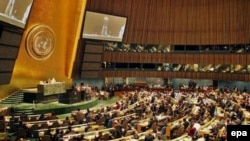
The 47 countries winning seats on the newly formed UN Human Rights Council include six nations the New York-based Human Rights Watch lists among the world's worst abusers of human rights: Russia, Azerbaijan, China, Pakistan, Saudi Arabia, and Cuba.
But the new council is free of the most notorious members of the now defunct Commission on Human Rights that it replaces. Those countries, such as Libya and Sudan, often voted as a bloc to defeat critical resolutions, turning the UN human rights body into an international embarrassment.
After the vote, many of the new members pledged to work hard to make the new Human Rights Council a success.
"This council and the member states who have been elected today will do their utmost to make this council effective because that was one of the ideas why we voted in favor of this council," Germany's ambassador to the UN, Gunter Pleuger, said. "The alternative of not having this council would have been no forum for human rights at all."
The threshold for winning seats was high. Candidates had to receive a minimum of 96 votes, an absolute majority of the General Assembly's 191 members. Iran, Iraq, and Kyrgyzstan applied for membership but failed to get elected.
The contention for seats was most heated among the Eastern European group of candidates, where it took three rounds of balloting to select the six members: Azerbaijan, the Czech Republic, Poland, Romania, Russia, and Ukraine.
U.S. Withdraws
The council will begin its work with one notable absence on its roster: the United States, which did not seek election to the new body. Washington has been skeptical of the new body, saying that its procedures do not adequately prevent human rights abusers from winning seats.
John Bolton, the U.S. ambassador to the UN, said that for the time being Washington will restrict its role to that of an observer. "We can actually have more influence being on the outside and the reason for that is that obviously any decision by the United States to participate in the new council depends on whether it is materially better than the commission that it replaced," he said.
Washington objects, among other things, to what it says are too lax rules governing when and how a member of the new council can be suspended from the body for failing to uphold rights standards.
With Membership Comes Scrutiny
But top UN officials said this week that such issues will now be addressed after the new council begins work.
"The precise procedures for that will probably be worked out in the context of the next couple of months as the new council establishes the details of its procedures," Craig Mokhiber, the deputy director of the Office of the High Commissioner for Human Rights, said.
"But there's another sort of guarantee which is written in there, which is that members of the council will be the first countries that will have their human rights record publicly reviewed under the universal review mechanism," he added. "So if you are a candidate for the council you know that you are going to be among the first that are put under the public scrutiny for your human rights record."
The first meeting of the new Human Rights Council is scheduled for June 19. The council is to hold no fewer than three sessions per year, for a total period of no less than 10 weeks.
The membership of the council will rotate regularly, with one-third of the seats coming up for election each year. To start the process, those states that won seats on May 9 were awarded one-, two-, or three-year terms by lottery.
Press Under Assault
(AFP)
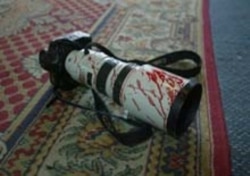
BREAKING THE NEWS: Press freedom is under assault in virtually all of the countries of the former Soviet Union. Independent media confront enormous challenges in providing citizens with the independent information that can help advance democratic reforms. On May 2, RFE/RL's Washington office hosted a roundtable briefing that gave an overview of media developments in the CIS and discussed the connections between press freedom and future democratization. The briefing featured Freedom House Director of Studies CHRISTOPHER WALKER, American University Associate Research Professor ROBERT ORTTUNG, and RFE/RL Central Asia analyst DANIEL KIMMAGE.
LISTEN
Listen to the entire briefing (about 90 minutes):
Real Audio Windows Media
RFE/RL's Press Freedom Day stories:
Iraq: Covering The Most Dangerous Beat On Earth
Afghanistan: Women In Journalism Battle Restrictions, Threats
Iran: State Maintains Tight Control Over Information
CIS: Press Freedom In Former Soviet Union Under Assault
Central Asia: Bureaucratic Obstacles Hinder Journalists
Central Asia: Governments Wary Of Independent Media
Central Asia: Journalists Still Face Harassment, Threats
THE COMPLETE STORY: To view an archive of RFE/RL's coverage of media-related stories, click here.