




Today's talks were the second time that Robert Kocharian and Ilham Aliyev had met on the sidelines of the Black Sea Summit in the Romanian capital, Bucharest.
The talks were also attended by the French, Russian, and U.S. co-chairs of the OSCE Minsk Group, which has overseen the peace negotiations since 1992.
U.S. co-chair Steven Mann told RFE/RL that today's meeting took place in a "very good atmosphere" but gave few details about the nature of the talks.
"The co-chairs still believe that 2006 is the window to reach an agreement regarding Karabakh, and I don't want to characterize exactly where we might be in that process," Mann said.
This is the second occasion that Kocharian and Aliyev have met this year. The previous talks, held near Paris in February, failed to yield any agreement.
Predominantly ethnic-Armenian Nagorno-Karabakh seceded from Soviet Azerbaijan in 1988, triggering a six-year war that ended with a truce. Officially, the two countries are still at war.
ARCHIVE: To view an archive of all of RFE/RL's coverage of Nagorno-Karabakh, click here.
The Nagorno-Karabakh Conflict
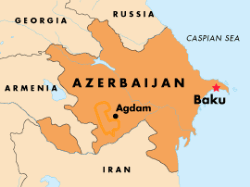 Click on the image to view an enlarged map of the Nagorno-Karabakh conflict zone
In February 1988, the local assembly in Stepanakert, the local capital of the Azerbaijani region of NAGORNO-KARABAKH, passed a resolution calling for unification of the predominantly ethnic-Armenian region with Armenia. There were reports of violence against local Azeris, followed by attacks against Armenians in the Azerbaijani city of Sumgait. In 1991-92, Azerbaijani forces launched an offensive against separatist forces in Nagorno-Karabakh, but the Armenians counterattacked and by 1993-94 had seized almost all of the region, as well as vast areas around it. About 600,000 Azeris were displaced and as many as 25,000 people were killed before a Russian-brokered cease-fire was imposed in May 1994.
CHRONOLOGY: For an annotated timeline of the fighting around Nagorno-Karabakh in 1988-94 and the long search for a permanent settlement to the conflict, click here.
 Click on the icon to view images of the Nagorno-Karabakh conflict (Flash required)
To view an archive of all of RFE/RL's coverage of Nagorno-Karabakh, click here.