


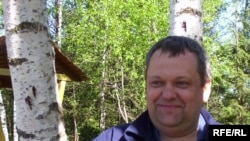
Levaneuski, a political activist, spent two years in prison on charges of defaming President Alyaksandr Lukashenka in a 2004 May Day leaflet. The leaflet charged that the president had misused public funds to pay for a skiing holiday in Austria.
He was sentenced and jailed in September 2004. In Hrodno prison, in western Belarus, Levaneuski staged a series of hunger strikes and spent long periods of time in solitary confinement.
Life In Hrodno Prison
"The Hrodno jail is the place where even the walls and ceilings are depressing," he said. "It was built a long time ago and, as they say, many prisoners have died there, in those cells."
He was released on May 15 and says conditions from the beginning of his sentence were tough.
"There is a special [train] carriage to transport prisoners," Levaneuski said. "It has bars on the windows. This compartment houses some 18 prisoners. They are like herrings in a box. It has three tiers of beds. Practically, it is impossible to breathe. People are not allowed to go to the toilet. It is very difficult when you are being transported, when you travel for several hours or for several days."
Solitary Confinement
Levaneuski says the most challenging time he faced was when he was put in solitary confinement for staging a hunger strike.
"I was put in a solitary-confinement cell where the sewage system was not functioning," he said. "Excrement and urine was flooding the floor. Nobody was cleaning it, as there was no water there."
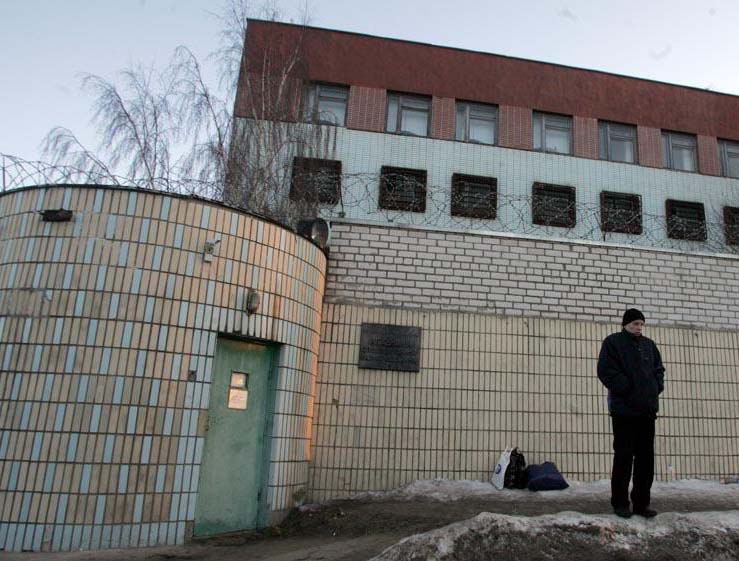
The Akrestsina Prison on the outskirts of Minsk (RFE/RL)
"Everything starts with a daily routine," Levaneuski said. "It is impossible to wash yourself. It is impossible to wash clothes. It is impossible to go [out from the cell] and walk. You are allowed to have only a one-hour walk in a small yard. It is impossible to do any physical exercise. There is no library. There is no information [from outside]. Correspondence is practically forbidden as the censorship is such that it is a problem to communicate with relatives as many letters do not reach them."
A National Problem
Belarusian human rights activists paint a similar picture. They say there are some 41,000 prisoners in the country. Worldwide, that's high. According to the International Center for Prison Studies at King's College London, only the United States and Russia have a higher number of prisoners per 100,000 citizens.
Capital punishment has not been abolished in Belarus, and at least three prisoners were executed last year.

Relatives of prisoners waiting to hand over parcels of food and supplies at Akrestsina Prison near Minsk (RFE/RL file photo)
"We are concerned about the state of health care," Protska said. "There are very many sick people there -- people sick with tuberculosis, HIV. People, who are in jail, are not always getting sufficient medical help."
However, Protska says the real problem lies in the courts, not jails.
She says Belarusian courts give prison sentences even for minor offenses. For example, joyriding is punished with five to seven years.
Protko also says that most imprisoned opponents of the regime are in jail for criminal offences, rather than on political charges.
Uladzimir Labkovich, a Minsk-based lawyer and human rights activist, says that the Belarusian penal system is only concerned with punishing prisoners, rather than rehabilitating them.
No one from the Belarusian Interior Ministry was available for comment about the situation in the country's prisons.
The Media In Belarus
CPJ Europe and Central Asia Program Coordinator ALEX LUPIS, who had just returned from a trip to Belarus, told an RFE/RL briefing on 15 February that he found conditions that make it almost impossible for journalists to report independently on the campaign leading to the country's 19 March presidential election.
Lupis said the Belarusian government is "criminalizing" independent journalism, and forcing journalists to leave the country, change professions or join the state-controlled media. There is a "Cold War atmosphere" in Belarus, Lupis said, adding that President Alyaksandr Lukashenka makes up the rules of the game. The Internet, he said, is the "last free outlet" where independent journalists can publish, but Russia and Belarus are updating their media laws in order to restrict Internet usage. Numerous journalists with whom Lupis spoke said that they miss the support they used to receive from nongovernmental organizations such as IREX and Internews, which were once active in Belarus.
Lupis believes that the government in Belarus bans independent journalism because it fundamentally "mistrusts its own people."
Listen to the complete panel discussion (about 60 minutes):
Real Audio Windows Media
See these RFE/RL stories on the media in Belarus:
Independent Newspaper Struggles Against State Interference
EU-Funded Media Broadcasts To Start Before March Elections
Authorities 'Cleanse' Media Ahead Of 2006 Vote
Click on the image to view a dedicated page with news, analysis, and background information about the Belarusian presidential ballot.

Click on the image to view RFE/RL's coverage of the election campaign in Belarusian and to listen to RFE/RL's Belarusian Service.