



UN special envoy Martti Ahtisaari emerged saying that "Belgrade was willing to give everything but independence, and Pristina wanted nothing but independence."
Contentious Agenda
Today's talks mark the first time since the UN-led mediation process began in February that the Kosovo Albanian population's demand for full independence has been placed formally on the agenda.
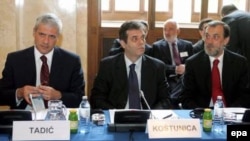
Participants in the one-day talks included Serbia's President Boris Tadic and Prime Minister Vojislav Kostunica, and Kosovo's President Fatmir Sejdiu and Prime Minister Agim Ceku.
The presidents and prime ministers of entered the meeting room in a Vienna palace separately and did not shake hands.
An estimated 90 percent of the Serbian province's 2 million people are ethnic Albanian. The population includes 100,000 Serbs.
Serbia says it will only agree to autonomy.
The United Nations has administered the province since 1999, when a NATO bombing campaign drove out Serbian forces.
(Reuters, AP)
Spotlight On Kosovo

THE WORLD'S NEWEST NATION? The region of Kosovo has a population of more than 2 million, some 90 percent of whom are ethnic Albanians. It was one of the poorest regions in the former Yugoslavia, but has considerable mineral wealth and an enterprising population, many of whom work abroad but keep close contact with Kosovo. All ethnic Albanian political parties seek independence on the principles of self-determination and majority rule. They feel that Serbia lost its historically based claim to what was its autonomous province under the 1974 constitution by revoking that autonomy in the late 1980s and then conducting a crackdown in 1999 that forced some 850,000 people to flee their homes.
Since NATO's intervention that year to stop the expulsions, Kosovo has been under a UN administration (UNMIK). The UN has begun to gradually transfer functions to elected Kosovar institutions. The primary Serbian concerns are physical safety for the local Serbian minority, a secure return for the tens of thousands of Serbian displaced persons, and protection for historic Serbian religious buildings. The main problems affecting all Kosovars, however, are economic. Until Kosovo's final status is clarified and new legislation passed and enforced, it will not be able to attract the investment it needs to provide jobs for its population, which is one of the youngest and fastest growing in Europe. Prosperity is widely seen as the key to political stability and interethnic coexistence in Kosovo, as is the case in much of Southeastern Europe.
For an archive of RFE/RL's coverage of developments in the disputed region of KOSOVO, click here.