

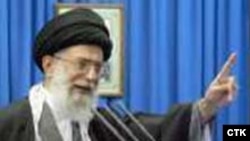
As quoted by state television, Khamenei said the Islamic Republic "has made its decision" and will continue on its course "powerfully."
Khamenei stopped short of saying that Iran has rejected international demands for an end to uraniuam enrichment, a technology which can be adapted to military purposes.
But reports say his remarks suggest that the Iranian government will do so in its formal reply to the international proposal, due to be issued in Tehran on August 22.
The five permanent members of the UN Security Council and Germany have offered Iran various incentives if it renounces its uranium-enrichment program.
Meanwhile, Iran's Atomic Energy Organization (AEO) said today it would start operating a heavy-water production plant in the near future.
In comments to Iran's Fars news agency, AEO deputy chief Mohammad Saidi described the plant at Arak, southwest of Tehran, as one of the country's "greatest and most unique achievements."
The plant aims to supply heavy water to a research nuclear reactor under construction which the United States fears could eventually produce plutonium.
(Reuters, AP, Fars)
What Would Sanctions Mean?
 Economic sanctions could further undermine Iran's already shaky economy (Fars)
MOVING TOWARD SANCTIONS: If the United Nations Security Council imposes sanctions on Iran, domestic support for Iranian President Mahmud Ahmadinejad will wane, according to ALEX VATANKA, Eurasia editor for Jane's Information Group.
Vatanka told a February 24 RFE/RL briefing that "economic sanctions will hurt the average Iranian" and, consequently, many "will blame the ruling clerics" for making life difficult and "impairing the country's long term development."
Vatanka said sanctions would be a serious challenge to the Iranian government. If harsh economic sanctions were imposed, Iran's poorest population will be hurt the hardest -- and might react "as they did in the 1970s and protest in the streets." Sanctions on travel, Vatanka said, would hurt a many Iranians because "Iran is a nation of small traders" who depend on the ability to travel to earn an income. According to Vatanka, unemployment in Iran is estimated at 30 percent, "so small trading is essential to survival." Although current U.S. sanctions "haven't worked," he said, "Iranians fear an oil embargo." He stressed that "oil revenues are a major part of the economy, so it is critical to look at this sector."
Should negotiations with the European Union and the UN fail, Vatanka believes that Iran would follow a "North Korea model," since Ahmadinejad's base of support among the "Islamist militias" has been "urging withdrawal from the NPT [Nuclear Non-Proliferation Treaty]." The Iranian government's "tactic" so far, Vatanka said, is governed by the belief that "by shouting the loudest, you'll get concessions [from the West]."
LISTEN
Listen to the complete panel discussion (about 60 minutes):Real Audio Windows Media

THE COMPLETE STORY: RFE/RL's coverage of the controversy surrounding Iran's nuclear program.