

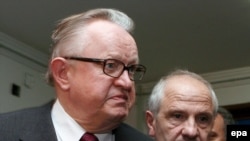
Ahtisaari's move is the latest in a series of diplomatic events that began to take shape in the summer of 2005 in response to the ethnically motivated unrest in Kosovo in the spring of 2004. In mid-2005, UN Secretary-General Kofi Annan, at the recommendation of Norwegian diplomat Kai Eide, recognized that failure to resolve the question of Kosovo's status would most likely lead to even more violence. The two men realized that time had come to end the province's political limbo and proceed toward a settlement. This position was strongly supported by Washington, in particular. Following the latest developments at the UN, Ahtisaari is now expected to have his proposal ready by late October or early November.
An Imposed Solution
In view of the demand by the 90 percent ethnic-Albanian majority for independence, which they have expressed through all their political parties, the most likely outcome appears to be independence, albeit with strong international guarantees for the Serbs and other ethnic minorities. Serbia has long been put on notice by the international community that it will not be allowed to veto any settlement.
Ahtisaari, moreover, has followed the lead of Denmark's Soren Jessen-Petersen, who recently left Kosovo as head of the UN civilian administration (UNMIK), in criticizing Belgrade politicians for barring Kosovo's Serbian minority from taking part in the province's elected institutions, and hence from a assuming a direct role in determining their own future. At the UN on September 20, the six-member Contact Group dealing with Kosovo -- the United States, the United Kingdom, France, Germany, Italy, and Russia -- also slammed what it called Belgrade's "obstruction." The six noted that they "reaffirmed their commitment that all possible efforts be made to achieve a negotiated settlement in the course of 2006." Off the record, some Western diplomats said they fear a "meltdown" in Kosovo next spring unless the status question is resolved by the end of this year.
Belgrade Dragging Its Heels
The Belgrade politicians, who have expected to face early elections for well over a year, have been speaking in increasingly desperate tones about Kosovo and its role in the Balkan political balance. Those leaders are reluctant to say or do anything that voters might interpret as showing "weakness" regarding Kosovo. They thus waste time and energy over Kosovo, which some of them privately admit is "lost" anyway, that could be put to use in dealing with Serbia's real problems -- crime, poverty, corruption, and a democracy deficit. Some observers go one step further and suggest that the politicians deliberately talk tough and draw voters' attention to the Kosovo issue in order to distract them from Belgrade's poor track record in improving the daily lot of ordinary Serbs.
In any event, it is clear that there will be no more serious proposals from Belgrade before Serbia goes to the polls than President Boris Tadic's vague calls for a "creative solution" in dealing with Kosovo. It was probably this realization that was instrumental in Ahtisaari's decision to go to the UN for authorization to act.
The Russia Factor
For their parts, Serbian Prime Minister Vojislav Kostunica and Foreign Minister Vuk Draskovic -- both of whom fare poorly in Serbian public opinion polls -- have stressed in public statements that Russia will use its Security Council veto to block any settlement that Moscow finds unacceptable.
Russia's role and its definition of what is acceptable are, however, unclear. Under the tsars and the communists alike, its foreign policy in the Balkans was always dictated by its own interests rooted in realpolitik, not by any abstract loyalties to any peoples or states in the region. For a century and a half, it alternated its support as it wished between rivals Serbia and Bulgaria -- both of whom are Slavic and Orthodox -- in regard to Macedonia and ultimately in regard to their respective claims to be the dominant power in the region.
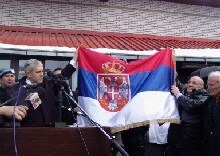
Serbian President Boris Tadic (left) visiting Kosovo in February 2005 (AFP)
This view leaves out one very important fact -- namely, that under the 1974 Yugoslav and Serbian constitutions, Kosovo had rights almost equivalent to those of the six federal Yugoslav republics, all of which are now independent. The same cannot be said of Transdniester.
What is clear, however, is that Moscow will use the Kosovo issue as a bargaining chip for promoting its own interests. These lie very close to its own borders, Russia's growing business interests in Serbia notwithstanding. Despite Kostunica's fulsome praise for the support of Russia and Putin over Kosovo, this reality is probably not lost on him or his colleagues in Belgrade.
The Kremlin Looks At Kosovo...And Beyond
 Russian President Vladimir Putin (right) greets Serbian President Boris Tadic in the Kremlin in November 2005 (TASS)
WILL THE KREMLIN BACK INDEPENDENCE? As the drive for independence grows in the Serbian province of Kosovo, the international community is speculating on how Russia, a veto-wielding member of the UN Security Council, will act. On September 22, Nicholas Whyte, director of the International Crisis Group's Europe Program, gave a briefing on the subject at RFE/RL's Washington, D.C., office. He speculated on what the Kremlin's "price" might be for agreeing to Kosovo's separation from Serbia.
LISTEN
Listen to the entire briefing (about 45 minutes):Real Audio Windows Media
RELATED ARTICLES
Referendums Seen As Kremlin's Master Plan
Independence Votes Popular In The Kremlin
Putin Warns Against Montenegro Model
How Does Moscow View Frozen CIS Conflicts?
Putin Calls For 'Universal Principles' To Settle Frozen Conflicts
ARCHIVE
RFE/RL's coverage of Kosovo and Russia.
