

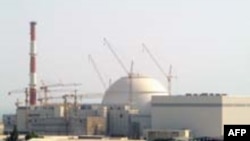
The head of Atomstroieksport, the state company building the plant, said Russia is to start supplying Iran with nuclear fuel in March next year.
Completion of the $800 million plant at Bushehr has been put off several times.
Russian Security Council Secretary Igor Ivanov, meeting with Iranian Vice President Gholamreza Aqazadeh-Khoi, today reiterated Russia's stance that the standoff over Iran's nuclear program should be resolved diplomatically.
"A concrete plan has been drawn up for the completion of the Bushehr plant and we will strictly observe our obligations," Ivanov said. "We are actively participating in negotiations on Iran's nuclear [program]. All issues can and should be resolved within the framework of negotiations, at the negotiation table."
Washington fears Iran is seeking to produce weapons under cover of its nuclear energy program.
(compiled from agency reports)
What Would Sanctions Mean?
 Economic sanctions could further undermine Iran's already shaky economy (Fars)
MOVING TOWARD SANCTIONS: If the United Nations Security Council imposes sanctions on Iran, domestic support for Iranian President Mahmud Ahmadinejad will wane, according to ALEX VATANKA, Eurasia editor for Jane's Information Group.
Vatanka told a February 24 RFE/RL briefing that "economic sanctions will hurt the average Iranian" and, consequently, many "will blame the ruling clerics" for making life difficult and "impairing the country's long term development."
Vatanka said sanctions would be a serious challenge to the Iranian government. If harsh economic sanctions were imposed, Iran's poorest population will be hurt the hardest -- and might react "as they did in the 1970s and protest in the streets." Sanctions on travel, Vatanka said, would hurt a many Iranians because "Iran is a nation of small traders" who depend on the ability to travel to earn an income. According to Vatanka, unemployment in Iran is estimated at 30 percent, "so small trading is essential to survival." Although current U.S. sanctions "haven't worked," he said, "Iranians fear an oil embargo." He stressed that "oil revenues are a major part of the economy, so it is critical to look at this sector."
Should negotiations with the European Union and the UN fail, Vatanka believes that Iran would follow a "North Korea model," since Ahmadinejad's base of support among the "Islamist militias" has been "urging withdrawal from the NPT [Nuclear Non-Proliferation Treaty]." The Iranian government's "tactic" so far, Vatanka said, is governed by the belief that "by shouting the loudest, you'll get concessions [from the West]."
LISTEN
Listen to the complete panel discussion (about 60 minutes):Real Audio Windows Media

THE COMPLETE STORY: RFE/RL's coverage of the controversy surrounding Iran's nuclear program.