



The package of United Nations sanctions agreed to last week reflects this duality of hi-tech and low-tech problems. It concentrates on stopping the flow of technology and materials which Pyongyang could use to develop its nuclear capacity.
Not Enough Food
But it avoids broader punitive measures which could worsen the plight of the North Korean people.
The situation for ordinary people looks grim enough. The regional public officer for the UN's World Food Program, Michael Huggins, briefed journalists in Beijing today.
"We are at a very critical junction right now," he said. "The World Food Program is trying to feed 2 million people in the country. We have only reached 1 million. We only have 10 percent of the funds that we need. Winter is approaching. It is going to be a tough winter by all accounts."
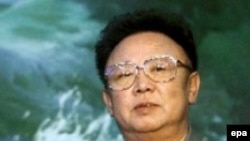
Huggins estimates that 37 percent of North Korean children under the age of six are malnourished. And this at a time when North Korean leader Kim Jong-il reportedly maintains a fine wine cellar of some 10,000 bottles and has his fish cooked over wood exclusively from the sacred mountain Paektu.
Additional Sanctions
Although the UN sanctions aim to avoid hitting the ordinary people, the ongoing row has already had its impact. South Korea, a key aid donor, stopped aid after the North test-fired a series of missiles in July. And supplies from China are running at one-third of last year's levels, for unexplained reasons, but probably also as a way of placing extra pressure on Pyongyang.
Several countries have already said they will go beyond the UN sanctions. Japan is preparing extra measures which will halt the import of North Korean goods, and Australia will bar North Korean ships from its harbors.
But China, long a supporter of Marxist North Korea, so far appears unwilling to go along with the plan to search all imports into that country to ensure there are no bomb or missile-related items. And the sanctions as passed by the UN Security Council do not authorize the use of force in cargo inspections.
And military expert Jason Alderwick, from the International Institute for Strategic Studies in London, points out that without UN authority for instance for full interdiction the sanctions cannot be fully effective.
China's Adherence Is Key
"There is still an ongoing battle between those that want the U.S.-led approach, which seeks more direct sanctions, and more of a carrot and stick approach which is what China and Russia are going for, so while the rhetoric has been quite hard, the sanctions don't go fullly towards satisfying the U.S. requirement," he said.
And if China declines to search all imports going across its land border with North Korea, the sanctions begin to look like a "paper tiger," Alderwick says.
And then there is the question of Iran. UN Security Council members, particularly the United States, have been hoping that Iran has absorbed the lesson that it, too, could soon become the subject of UN action over suspicions that it is trying to develop nuclear weapons. UN Secretary-General Kofi Annan addresses that point.
"I'm sure the Iranians are also paying attention to what is happening on the Korean Peninsula and what is happening here in New York in the [Security] Council, and I can also assure you that the council members are also very conscious of this," Annan said. "So, hopefully, in [dealing] with this situation, they will bear in mind the broader implication of any actions that they take."
Iran Rejects Sanctions
But on the contrary, Iranian President Mahmud Ahmadinejad has rejected the UN sanctions imposed on North Korea. In comments on state-run television, he also rejected as "illegal" a Security Council demand that Tehran suspend its uranium-enrichment activities.
Intelligence reports point to links between the missile development programs of Iran and North Korea, and both are believed to have benefited from the nuclear information clandestinely circulated by former leading Pakistan atomic scientist A.Q. Khan.
It's therefore believed that Tehran is unlikely to pay anything more than lip service to international sanctions against North Korea. And unless China agrees to a full-search regime, the sanctions now being put in place could prove less than fully effective.