

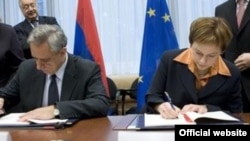
The agreements offer aid, improved trade, and more political cooperation in exchange for political and economic reforms.
But EU External Relations Commissioner Benita Ferrero-Waldner told RFE/RL, they don't even mean what the EU would call a "membership perspective."
"The neighborhood policy is not for membership. I have to say that very clearly. But at the same time, this is the policy of today. Therefore, the future is clearly not prejudged," Ferrero-Waldner said. "But these countries have to use this momentum now to do everything to get the experience that we have, the knowledge, the possibilities of cooperation. We want to help them, because best practices are there already. And the easiest thing is to look at what others have done in order to become successful."
'Ring Of Friends'
Brussels wants a "ring of friends," which eventually could include countries such as Israel, Jordan, Moldova, Morocco, and Ukraine.
Those countries would get access to the EU's vast internal market. In return, Brussels would get the promise of reforms -- and, ideally, the regional security that successful reforms would ensure.
Under the agreements, the EU offers economic help and help in reforming the justice, energy, education, health and other sectors.
'Frozen Conflicts'
Brussels has also said that the accords should help defuse separatist disputes in the three South Caucasus countries.
In Georgia, Abkhazia and South Ossetia are trying to secede, while Azerbaijan has a dispute with Armenia over the Nagorno-Karabakh region.
The foreign ministers of Armenia and Azerbaijan are meeting today to discuss Nagorno-Karabakh.
Azerbaijani Foreign Minister Elmar Mammadyarov says the Nagorno-Karabakh peace process is moving in the right direction:
Strategic Region
In recent years, the South Caucasus has gained greater strategic significance for the EU and the West.
Since its 2003 Rose Revolution, Georgia has pursued a more pro-Western course. It has made good headway with political and economic reforms -- although the problem of implementing legislation on the ground still remains. And in September, Georgia was offered an "intensified dialogue" with NATO.
Speaking today at the European Parliament in Strasbourg, Georgian President Mikheil Saakashvili praised closer ties with Brussels. He called for deeper EU involvement in Georgian political and strategic issues.

Javier Solana (file photo)
While Armenia has made some successful economic changes, its political reforms remain sluggish at best.
Azerbaijan is the region's exception. With huge oil and gas deposits, the country's economy is growing rapidly -- and expected to continue apace.
But questions remain about Azerbaijan's rampant corruption, dubious electoral practices, and rights abuses. Drunk on oil and gas, its detractors say, Azerbaijan can act with virtual impunity.
Standards For Energy?
And with the EU always ready to diversify its energy supply to avoid dependence on Russia, critics have said the union is prepared to compromise its own standards in exchange for access to Azerbaijan's vast energy reserves.
In an interview today with RFE/RL, EU foreign policy chief Javier Solana denied the charge: "Most of [the EU's] energy doesn't come from Azerbaijan. For us Azerbaijan is not a source of energy as other countries are. We would like Azerbaijan to develop because it's an important country and we would like Armenia to develop because it's [also] an important country."
The EU has defended its stance, saying that the countries in the South Caucasus are coming from different starting points -- and must be judged accordingly.
The EU's special representative to the South Caucasus, Peter Semneby, said it's better to embrace these countries than to leave them out in the cold.
"The problems would be larger if the two countries were left outside completely. That would mean that developments would be totally unpredictable; there would be immense dangers. The two countries are now included in a cooperative framework with the European Union which also includes a perspective for the future," Semneby said. "It would be much easier to control the risks in the short term, and in the longer term to find a solution based on mutual benefits in a new reformed neighborhood that will look very different from the one we have today."
(Interviews conducted in Brussels by RFE/RL Armenian Service director Harry Tamrazian and RFE/RL Azerbaijani Service acting Director Kenan Aliyev.)
EU Expands Eastward

To view RFE/RL's archive of coverage related to EU expansion, click here .