

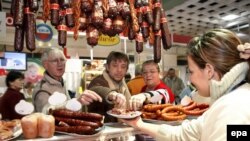
Russia had threatened to ban imports from the trade bloc as of January 1, citing concerns over animal health in Bulgaria and Romania, the new EU members.
Markos Kyprianou, the European Union's health and consumer protection commissioner, managed to avert the ban by agreeing to exclude Bulgarian and Romanian meat from EU exports to Russia.
The ban would have affected some $2.2 billion in annual trade.
Polish Ban
The agreement, however, failed to resolve another sticky issue: Russia's ban on Polish meat imports, put in place a year ago over hygiene concerns.
European Commission representatives, together with experts from Poland, have said they will urge Russia to lift the embargo at the talks in Berlin.
Kyprianou on January 15 said a recent EU fact-finding mission determined that the country has fixed past shortcomings and is now in line with EU food safety rules.
Political Allegations
Warsaw claims the embargo is political and has retaliated by vetoing the start of planned negotiations on a new EU-Russia partnership pact.
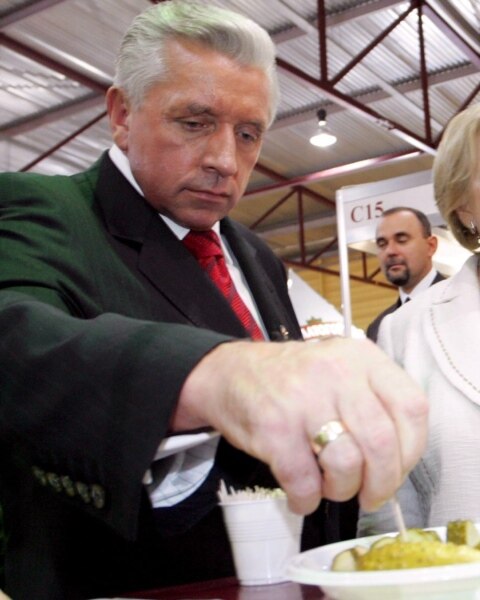
Polish Agriculture Minister Andrzej Lepper (epa)
Yevgeny Yasin, a former Russian economy minister who currently heads the Higher School of Economics in Moscow, also considers the ban retaliation for what Moscow perceives as Warsaw's anti-Russian policies.
He tells RFE/RL, however, that he believes the deadlock will be broken in the near future.
"This [ban] should be viewed, to a certain extent, as a political move connected to Poland's position towards Russia on other issues. Will measures be taken to restore normal relations? I think so," Yasin says. "The current Russian leadership's method is to make decisions without really discussing them with anyone, and then, when negotiations begin, to make concessions and play the role of reasonable partner."
'Solution Unlikely'
But both Kyprianou and Russia's EU ambassador, Vladimir Chizhov, have warned that negotiators are unlikely to broker a solution this week.
"We have to be realistic," Kyprianou told reporters on January 15 following a meeting with Polish Agriculture Minister Andrzej Lepper. "It's a complex issue and there is a possibility that it cannot be resolved at just one meeting."
Should today's talks fail to yield a breakthrough, a deal may be on the cards later this month, when German Chancellor Angela Merkel travels to Russia.
Merkel, whose country holds the six-month rotating EU presidency, is scheduled to meet Russian President Vladimir Putin in Sochi on January 21.