


Putin, meeting with the country's top business leaders on February 6, said Russia needs a more diversified economy with a stronger manufacturing sector.
But making Russia's market more flexible and dynamic means the Kremlin will need to give up something it has always craved -- control. Is Putin prepared to loosen the reins?
This week's meeting wasn't the first time the Russian president has gathered the country's leading moguls for a chat signaling change is on the way. (Coverage of the February 6 meeting in Russian from RFE/RL's Russian Service.)
At a meeting in February 2003, Putin warned Russia's tycoons to stay out of politics. Eight months later, Yukos boss Mikhail Khodorkovsky was in prison.
This time around, Putin was focused on the economy. Russia, he said, was far too dependent on its energy resources.
That same dependence contributed to the demise of the Soviet Union, when a precipitous drop in energy prices in the 1980s robbed the bloc of its hard-currency earnings and revealed the vulnerability of its rusty economic infrastructure.
"Qualitative Steps"
Putin might have been remembering those days when he said it was now time to diversify and transfer Russia's energy wealth into a more robust manufacturing sector.
Today, opportunities have been created for taking coordinated action in order to use the country's natural resources more efficiently and to reorient the economy toward an innovative way of development," Putin said following the meeting. "Frankly speaking, we need to take qualitative steps to move from the simple extraction of natural resources to their complete processing."
But analysts say turning Russia's energy economy into a manufacturing power will be a gargantuan task.
"This has never been a strong suit for the Russian economy or the Soviet economy, said Marshall Goldman, professor emeritus in Russian economics at Wellesley College in the U.S. state of Massachusetts. "So [Putin] keeps talking about doing this, but it is really pushing the stone up the hill. The reason for that is that Russia was never strong as a manufacturer, and it lacks the sense of working with the market."
Moreover, Goldman says, oil exports are driving up the value of the Russian ruble, making imports cheap and the country's own manufactured goods prohibitively expensive.
"This is a very serious problem," he said. "And to the extent that Russia is trying to break into manufacturing, it means that it has to compete with the Chinese and the Indians like everybody else in the world."
Power To The People
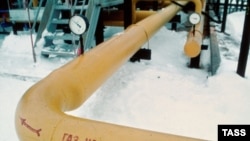
Economists point out that Russia's current manufacturing sector -- building pipelines, for example -- is highly dependent on the energy industry and would suffer if energy prices fell.

Putin meeting with business leaders in the Kremlin on February 6 (TASS)
Clifford Gaddy, a Russia specialist at the U.S. Brookings Institution in Washington, D.C., says the problem is not one that can be solved by Putin and the country's top tycoons.
"What is really needed is to let people figure things out themselves. Let entrepreneurial people figure out what makes most sense," Gaddy said. "As an economist, you tend to say the most important thing is to have a level playing field. Make it possible. Deregulation. Remove the obstacles to allowing people to reallocate the resources that do exist -- the human capital, the physical capital. Increase mobility of people as well as capital. And don't stand in the way. Let them try to figure this out. And that is fundamental."
Losing Control?
Gaddy says the tendency in Russia today, however, is in the opposite direction -- toward greater control and greater centralization.
"Ultimately, the dilemma that Mr. Putin and his team face is the epic one that has always been in Russian and Soviet history. And that is the trade-off and the conflict between the imperative for control and an imperative for greater efficiency," he said.
The Russian president, Gaddy says, himself embodies this contradiction.
"Putin personally and intellectually is well aware of the fact that a market economy is more efficient. He knows that the Soviet centrally planned economy failed in the competition between the two systems. So he is pro-market in that sense. He knows that the market economy works," he said.
"At the same time, perhaps even more fundamentally, I would say he is a person who needs control, who believes that that is the Russian way -- and, in particular, that this huge country has to be under central control."
And when it comes to choosing between control and efficiency, Gaddy and other analysts say Putin's instincts will lead him to the exact same place as his predecessors in the Kremlin. Even if it means sacrificing a more dynamic economy.
The Post-Soviet Petrostate
 The oil-export terminal at Primorsk, Russia (TASS)
WEALTH AND POWER. At an RFE/RL briefing in Washington on January 24, Freedom House Director of Studies Christopher Walker and RFE/RL regional analyst Daniel Kimmage argued that energy-sector wealth is preventing many former Soviet countries -- Azerbaijan, Kazakhstan, Russia, and Turkmenistan -- from developing strong democratic institutions.
LISTEN
Listen to the entire briefing (about 90 minutes):Real Audio Windows Media
RELATED ARTICLES
Russia's Gazprom Looks Ahead To A New Year
Azerbaijan: Coping With The Oil Windfall
Azerbaijan Boom Sparks Fears Of Dutch Disease
Kazakh President Tells West -- We Don't Need Your Advice
Could Turkmen President's Death Lead Instability?
