

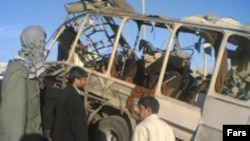
Nasrollah Shanbehzehi, the man convicted of the bomb attack that also injured some 30 people, was hanged today at the scene of the explosion. Iranian media report that he was executed in public to chants of "Death to America," "Death to Israel," and "Death to Rebels and Wahhabis."
Efforts To Improve Border Security
Additionally, Iran's Foreign Ministry on February 18 said it had summoned Pakistani Ambassador Shafkat Saeed following two bomb blasts in Zahedan, Sistan and Baluchistan's provincial capital.
Foreign Ministry spokesman Mohammad Ali Hosseini said after the meeting with Saeed that the two countries decided to form a committee to try to improve border security.
Shanbehzehi's execution came just five days after a car packed with explosives detonated in front of a bus carrying IRGC members. It follows another explosion on February 16 in a school in Zahedan that caused no casualties. Iranian media reported that police exchanged gunfire with "terrorists" who were fleeing the scene of the crime.
A Sunni militant group called Jundollah has reportedly claimed responsibility for the two bombings. The group has been blamed before for a series of kidnappings and attacks on police in Sistan and Baluchistan Province.
The province is home to many ethnic Baluchis, who are overwhelmingly Sunnis. Jundollah claims it defends the rights of the Baluchis but Iranian officials say the group is involved in drug smuggling and has ties to terrorist groups.
Concern Among Population
Mahmud Barahuyinejad, an independent journalist based in Zahedan, says the explosions last week have caused concern among the population in the province.
"Life had gone back to normal in Zahedan but there is a wave of concern and anxiety among the people in Zahedan and at night people go out of their houses less than they did before," he said.
Iranian officials have said that full security has been restored to the area. Officials said they arrested five people following the first Zahedan attack, including Shanbehzehi, whose televised "confession" was aired on local television. He said that he had joined Jundollah three months ago and underwent two months of training in Pakistan. Human rights activists have in the past questioned the authenticity of similar confessions.
Authorities say the "elements" of the bombing entered Iran via Pakistan some 48 hours before the explosion. Officials have also said that bombers were supported by Western powers, though they gave no further details.
Soltan Ali Mir, a senior local official, is quoted by Iran's ILNA news agency as saying that the weapons used by the "terrorists " were U.S. made. He also said that they received training on how to plant the bombs by people who spoke English.
Socioeconomic Problems To Blame
Iran has also blamed the United States and Britain in the past for stirring up ethnic tensions in an attempt to destabilize the country. Some observers, however, believe that poverty and socioeconomic deprivation is causing tension in the region.
Ali Keshtgar, a Paris-based political activist, spoke to Radio Farda about the situation.
"The Islamic Republic is clearly responsible for the incidents that have increased in Khuzestan and now also in Zahedan because in a rich country like Iran we still see that hundreds of thousands of our countrymen live there in the worst conditions and they cannot defend their rights, they have a very hopeless situation," he said. "It is natural that under hopelessness and suppression such reactions occur."
Officials had claimed that the United States and Britain were behind a series of bombings in the southwestern province of Khuzestan, which has a large ethnic Arab population. At least 10 ethnic Arabs have been hanged for their role in the bombings despite calls by human rights groups to halt the executions.
Blaming The West
Tensions have increased in recent months between the United States and Iran over Tehran's nuclear program and also over U.S. accusations that Iran is arming insurgents in Iraq. Iran has rejected the accusations.
Observers believe the latest Iranian accusations against Washington for its alleged role in the Zahedan's bombings are likely to increase tensions.
Last week the UN Security Council condemned the bus bombing in Zahedan -- following a request made by Iran and despite the dispute between Tehran and the UN over its nuclear program.
Agencies reported that acting U.S. Ambassador to the UN Alejandro Wolff said it was "a rich irony" that Tehran -- which has refused to implement a council resolution demanding suspension of its sensitive nuclear work -- asked the council to adopt the statement condemning the attack.
The UN Security Council is expected to receive a report from the International Atomic Energy Agency later this week on Iran's compliance thus far with the resolution demanding that it suspend uranium enrichment. Enriched uranium can be used as a fuel in civil nuclear reactors but it can also be used for producing a nuclear bomb.
Iran says its nuclear program is peaceful but the West suspects Iran is seeking to covertly produce nuclear weapons.