




According to an informal survey of citizens and activists in Iraq, Armenia, and Georgia -- three countries either bordering Iran or near by -- people are concerned about the prospect of war.
The most common scenario being discussed centers around the United States or Israel disabling Iran's nuclear facilities with a preemptive military strike.
Preemptive Strike
Most people questioned believe such a strike would lead to war.
"I expect that America will strike Iran, and if it does strike Iran, the situation will not be favorable to Iraq or to Iran's other neighbors," said one man in Irbil, the capital of Iraq's Kurdish autonomous region, which borders Iran. "This is because the war will be big, and there is the possibility that Iran would use a nuclear strike, resulting in major problems for America, Iraq, and Iran."
Another Irbil resident said the question of a strike on Iran's nuclear facilities is not a question of "if" but of "when" -- and that U.S. interests in Iraq and elsewhere will be targeted as a result.
In Georgia, Tbilisi resident Guram Janjgava expressed similar fears.
"Of course this will harm us," she said. "There's simply no question about it. We are close to Iran. The Americans are far away -- they are our friends; it's the only strong friend Georgia has. But we would still be harmed. America is far away; Iran is our neighbor."
Another Tbilisi resident foresaw dire economic consequences in the event of war and said that Russia's role in the region should not be discounted.
Refugee Fear
In Armenia, Iranian-Armenian Caroline Zaqaryan predicted that war would result in an influx of Iranians across her country's border.
"If there is a war, Iranians and Iranian-Armenians living in Iran will move to Armenia in greater numbers," Zaqaryan said. "I am for the Iranian-Armenians to come; it's our motherland. But it doesn't seem so good to me when I see that there is an increasing number of Iranians living and studying in Armenia. If 3 million out of the 27 million of Iran's population come to Armenia, Armenia will become Iran. I suppose in the case of a war, Armenia would suffer as well, since Armenia is a neighboring country. Armenia would definitely endure famine, illness, human and material losses, and other harsh consequences of war."
Hot Air?
But not everyone questioned considered war as a foregone conclusion. Some see the increasingly hostile rhetoric as part of an effort intended to bring about an end to Iran's nuclear program.
A young Syrian-Armenian man in Armenia, Saroh Sargisyan, said Europe's influence and Iran's strength would ultimately serve to deter an attack on Iran.
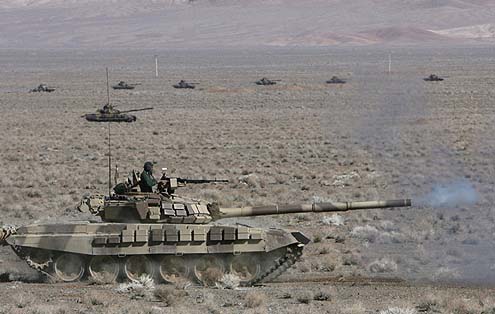
An Iranian military exercise last month (Fars)
Some opinions went to the other extreme. A Baghdad resident, Ilham Kamal, said some in Iraq believe that Iran "deserves such an attack." He said some of his countrymen believe it would serve to lessen Iran's influence in Iraq.
But most people questioned voiced caution.
"I suppose the situation in Iran is quite strained and there are many reasons for this, since the statements made by the Iranian government are rather aggressive, as much as the U.S. policy toward Iran. However, I think the issue should be settled diplomatically, through negotiations," Armenia's Armine Hyusyan said.
Haleem al-Qaddu, the head of the Minorities Council in Iraq, seconded that view.
"We hope that such an attack does not take place, since it is in nobody's interest, and it is in nobody's interest to have a new war in the region," he said. "The region is suffering from wars, and is suffering from the serious security situation; there are many security problems that threaten U.S. interests, that threaten the Iraqi people, in addition to the serious threats to the Iranian people and the Iranian government. As a result, we hope that sanity prevails, as I have already said, and that such military are abandoned in favor of peaceful options and to diplomatic dialog to solve the problems between the Iranian government and the United States."
Or, as Georgia's Bachuki Bachukishvili puts it: "Do we want war now? Do we want to become a military base? I know one thing -- you cannot fight evil with evil."
