



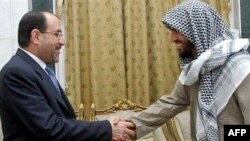
Sheikh Ahmad al-Shibani is a senior aide to al-Sadr, the leader of the Imam Al-Mahdi Army militia, which Washington recently called the greatest threat to security in Iraq.
The U.S. military confirmed al-Shibani's release.
Commentators say al-Shibani's release is likely to boost the standing of al-Maliki, a Shi'ite Islamist who relies on al-Sadr for political support. The Sadrist movement holds a quarter of parliamentary seats in the ruling Shi'ite-led alliance.
U.S. and Iraqi forces recently extended their Baghdad security crackdown into Al-Sadr City, a stronghold of the Al-Mahdi Army, but have met little resistance and U.S. commanders say senior militants appear to have left the capital.
Progress In Talks With Sunni Rebels
Meanwhile, a senior Iraqi official has said the Iraqi government has been holding talks with some insurgent groups and that some appeared close to agreeing to join forces against Al-Qaeda.
Speaking to the BBC early today, Sa'd Yusif al-Muttalibi, director of international affairs in Iraq's National Dialogue and Reconciliation Ministry, said the talks were designed to help drive Al-Qaeda out of the country.
No Iraqi officials were immediately available for comment on the report.
Insurgents draw support from Iraq's Sunni Arab minority, once dominant under Saddam Hussein.
Iraq's western Al-Anbar Governorate has been a hotbed for the insurgency. However, since September there has been a mounting power struggle in the area between Al-Qaeda, which has non-Iraqi Arabs as its leaders, and fellow Sunnis who oppose the group.
In the latest security operations in Baghdad, U.S. and Iraqi troops today conducted house-to-house searches in western Baghdad today, detaining 31 suspects and impounding containers of toxic chemicals, including chlorine. Insurgents have used chlorine in several attacks in Iraq this year.
Meanwhile, in the southern city of Basra, the British military said they used "minimum force" to quell rioting by detainees at a British-run prison. The inmates were protesting their detention without trial.
(Reuters, AFP)
Muqtada Al-Sadr
 Al-Sadr supporters demonstrating against the U.S. presence in Iraq in October 2006 (epa)
A RADICAL CLERIC. Shi'ite cleric Muqtada al-Sadr is a key figure in Iraq. He heads the Imam Al-Mahdi Army militia and a political bloc that is prominent in parliament and the government. His ties to Iran have also provoked concerns in some quarters.
RELATED ARTICLES
Cracking Down On Al-Sadr No Easy Task
Political Parties Consider Uniting Against Al-Sadr
Is Al-Sadr Stirring The Pot Or Promoting Peace?
Radical Shi'ite Cleric Calls For Shi'ite-Sunni Unity
Al-Sadr Reasserts Himself -- This Time Against Coreligionists
