


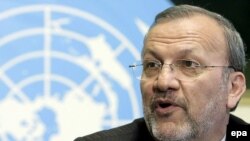
The council's March 26 vote was based on the recommendation by a five-nation panel that included Zimbabwe, which itself has been widely accused of human rights abuses.
The vote at the council's offices in Geneva was not unexpected, because most of the council's members oppose focusing attention on specific countries accused of human rights violations.
The United States also was not surprised, though State Department spokesman Tom Casey expressed disappointment. Washington has long called for reform of the UN, specifically within its human rights mechanisms.
At a briefing on March 27, Casey was asked about the council's vote. He expressed particular frustration that the Iran probe was ended.
"In the case of Iran, that decision is completely out of step with the views that the [UN] General Assembly expressed, which a couple months ago voted again to condemn the human rights practices in Iran," Casey said.
On March 6, the State Department issued its 2006 annual report on human rights practices around the world and accused the Iranian government of a variety of abuses, including suppressing political opposition, conducting unfair trials, and restricting the news media.
Uzbekistan, too, was criticized in the report, which accused it of political and judicial misconduct similar to Iran's. Relations between the United States and Uzbekistan have been cold since May 2005, when Uzbek security forces violently suppressed a demonstration in Andijon.
A 'Credible Body'?
Casey said the council's decision was "disappointing on several levels," but not just because it ended the investigations of the Iranian and Uzbek governments.
"I think, unfortunately, this is just another example of what we've seen of the Human Rights Council not behaving as a credible body, and as one that the international community more broadly can see as being able to actually carry out the function that it was intended to have," he said.
The United States has been so dubious of the council's ability to do its job that it didn't even try to get a seat on the panel, which has 47 members.
After today's briefing, Casey told Radio Farda the council appears to pay little attention to accusations of human rights abuses in virtually any country except Israel.
UN Human Rights Council
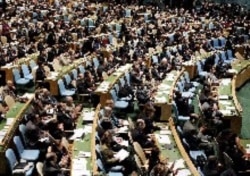
UN General Assembly delegates applaud the creation of the UN Human Rights Council on March 15, 2006 (epa)
A FRESH START ON HUMAN RIGHTS: The United Nations General Assembly on May 9 elected members to its new Human Rights Council, a step that reformers hope will help improve the United Nations' sullied record on defending human rights. The UN's old human rights watchdog -- the Commission on Human Rights -- had long been criticized for granting membership to countries with dismal human rights records, such as Cuba, Sudan and Zimbabwe.
Every member of the new body has to pledge to promote human rights. (more)
RELATED ARTICLES
General Assembly Votes To Create New Rights Council
Vote On Human Rights Council In Limbo Over U.S. Objections
At 60, UN Gripped By Debate on Human Rights Reform
