




But the court has made no rulings in over half a year, and now five out of 18 judges are refusing to consider the case, citing political pressure.
Professor Wojciech Sadurski, from the legal department at the European University Institute in Florence, Italy, says this development is a worrying one and suggests a certain fundamental crisis of the Constitutional Court.
Even if the five judges persist in their walkout, the Constitutional Court can still proceed with deliberations on the constitutional issues surrounding Yushchenko's decree. The court needs only 11 judges present in order to hold session. Of those, only a simple majority is needed for a ruling to be valid.
Even if a ruling is made, however, it's uncertain what the impact will be. Ukraine's Constitutional Court -- like its counterparts across the region -- does not have a long or illustrious history, and its influence remains weak.
European Model
After the collapse of communism, constitutional courts were set up in the 1990s to protect the rights of the individual against the power of the state.
The courts rule on whether laws or presidential decrees are in accordance with the constitution or constitutionally established rights and freedoms.
They also normally pass rulings on proposed constitutional changes and international treaties.
"[Constitutional courts] are really seen as a countervailing power, as a way of moderating the decisions of the parliament, which can be often contrary to the constitution, in particular to constitutional rights," Sadurski says.
There are two main models of constitutional courts. There is the U.S. model, where any federal court can invalidate any law that it finds unconstitutional, and the European model, with a single, specialized body, which decides whether laws are constitutional.
Most countries in the former Soviet Union have adopted the European model.
Minimizing Political Bias
In theory, constitutional courts are set up to avoid -- or at least minimize -- political bias.
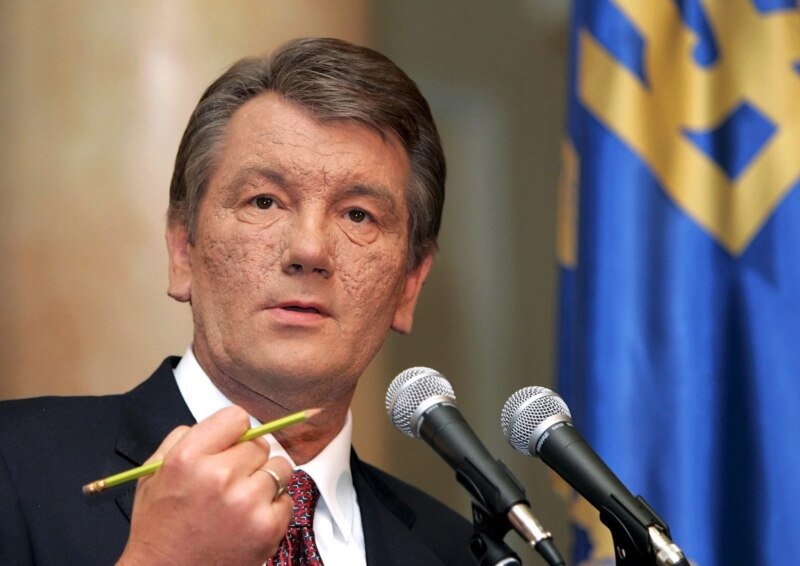
President Yushchenko has ordered the dissolution of parliament
In Ukraine, judges serve nine years and are allowed to serve only one term.
"This is a nine-year nonrenewable term, which gives them reasonable breathing space, reasonable independence, and which allows them not to think all the time about their political masters, if there are such," Sadurski says.
Other countries have different systems -- in some constitution courts, judges are exclusively appointed by parliament.
In Ukraine, Sadurski says the system creates a degree of dependency on the body that appointed the judges.
Paradox
That isn't unusual. In practice, constitutional courts have often mirrored -- and been a victim of -- their political systems.
In Ukraine, deadlock in the court reflects deadlock in parliament. In Belarus, the court has been sidelined by the executive and is dependent on the president's will.
Professor Sadurski says that, on the whole, constitutional courts in Central and Eastern Europe haven't been ineffectual, but they have had to deal with a number of challenges.
"First of all, to what extent is the appointment of judges is based on merit, as opposed to political considerations. Secondly, to what extent can the other political actors activate the decision of the constitutional court. One of the greatest weaknesses written into the very function of these constitutional courts is that they are not self-activating, that there must be an initiative coming from the other side," Sadurski says.
Perhaps the biggest paradox of all is the legitimacy of the constitutional courts: On the one hand, they are not accountable to electors, but on the other they have the power to frustrate the elected bodies of parliament.
RFE/RL Belarus, Ukraine, And Moldova Report

SUBSCRIBE For weekly news and analysis on Belarus, Ukraine, and Moldova by e-mail, subscribe to "RFE/RL Belarus, Ukraine, And Moldova Report."