



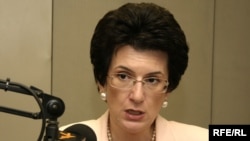
RFE/RL: So far, the political situation in Georgia is far more stable than in either of the other two "colored revolution" countries, Kyrgyzstan and Ukraine. How do you account for this?
Nino Burjanadze: I'd like to start with a correction. I don't know why these revolutions came to be known as "colored" ones. The Georgian revolution had nothing to do with color -- it was related to a flower, to the rose in particular. It was the "Rose Revolution," not a "pink revolution."
RFE/RL: People were probably just looking for a joint title.
Burjanadze: As for the reasons why Georgia has turned out to be more stable, I think it's because the team that came to power knew what the country needed, and what had to be done to achieve these aims.
That vision -- what had to be done, and in what order -- was clear, despite the fact that the reforms [following the Rose Revolution] were tough and painful, at times even unpopular. It's not easy to downsize the bureaucratic apparatus and leave thousands of people jobless. But these things have to be done, because otherwise you'll end up in a closed circle in which reforms won't be possible -- and the people who might end up unemployed couldn't be helped in any case.
Apart from this, I think one important factor behind Georgia's success was the fact that the unity of the revolutionary group has remained intact. Despite the differences that we had, despite the visions that at time diverged -- our main vision, on what our main task is, is certainly unified. We have had different positions regarding certain tactical issues, but we succeeded in keeping this unity. This, unfortunately, hasn't been the case in Ukraine, and this has caused serious problems.
RFE/RL: Some skeptics might say that Georgia's stability could be due in part to a weak political system. There is no functioning network of different political parties in Georgia like there is elsewhere in Europe.
Burjanadze: That's the case in Ukraine as well!
RFE/RL: But some might say that there, there are at least two forces in opposition to each other. Isn't that a sign of democracy?
Burjanadze: I can't agree with you on this. Democracy and anarchy are not the same thing. There's no democracy in that kind of conflict [that took place in Ukraine]. We all know very well how people were being moved from one faction to another in Ukraine. This has nothing to do with democracy. Ukrainian politicians themselves were citing incredibly high amounts of money that was offered to individuals in order to get them to change sides.
Nor is the party system any better developed in Ukraine. Let me remind you -- in Georgia, prior to the Rose Revolution, there was the National Movement, which was very strong and had a lot of supporters. But there was also a very strong team in the Burjanadze-Democrats, which also had many supporters.
RFE/RL: That situation has changed, however.
Burjanadze: Yes. These two parties, these two forces, have united. If it had been otherwise, I can assure you that we could also be having problems in Georgia. Perhaps not on the scale of Ukraine, but still.
RFE/RL: Georgian President Mikheil Saakashvili has been a very solid supporter of Ukrainian leader Viktor Yushchenko. But Saakashvili has been fairly quiet regarding the latest crisis in Ukraine. Is Georgia responsible for helping other countries in the region that share its democratic goals?
Burjanadze: You know, Georgia has no ambition to be someone's leader, to instruct someone on how to act. We have an ambition to be friendly toward our friends and supporting those individuals who fight for causes similar to ours. Ukraine and its president certainly have our full support.
When the conflict developed between the Ukrainian president and Yuliya Tymoshenko, however, I made a point of saying how sorry I was about it all, because I was friends with both of them. I knew the conflict was going to cause bigger political problems in Ukraine -- and that has proven the case.
We hope very much that it will be possible for Yushchenko and Tymoshenko to reunite, and that the democratic process will get stronger. Sometimes our statements of support may be louder -- at other times, less so. But our Ukrainian friends always have our support.
RFE/RL: Let's talk about the South Caucasus region. Does it have a political future as a regional bloc, or are the political attitudes between the three countries too different?
Burjanadze: It's of course very premature, and practically impossible, to speak about a unified South Caucasus policy. However, cooperation is going very well in a number of different aspects, and Georgia is lucky to have very kind and warm relations with both our Armenian and Azerbaijani neighbors. If we succeed in resolving the conflicts that exist in the South Caucasus, I can assure you that this will be an extremely successful, powerful, and attractive region, in every respect.
However, this is exactly what our northern neighbor does not want to see -- because, in this case, they won't be able to exercise political influence. I don't know why Russia refuses to understand that political influence can be maintained through positive actions – and that such influence is much kinder, better, and stronger.
RFE/RL: So you think it is Russia who precludes cooperation between these countries.
Burjanadze: Naturally, of course. Because if this becomes a united region, Russia's political influence will be minimized.
RFE/RL: Moscow cracked down very hard on Georgia last autumn after Tbilisi arrested five Russian army intelligence officers on spying charges. You're known as one of the most diplomatic and effective Georgian officials when it comes to dealing with Russia. Were you surprised by how strongly they reacted to the spy scandal?
Burjanadze: Of course I was. Personally, I was very surprised. I never would have thought that it was possible, in the 21st century, to keep children from going to school just because they were Georgian. That country, unfortunately, behaves in an uncivilized manner. And precisely because of these uncivilized ways and unpredictability, they of course represent a threat.
RFE/RL Exclusive Interviews
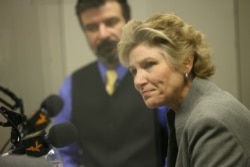 U.S. Undersecretary of State Karen Hughes being interviewed by RFE/RL in Prague on June 11 (RFE/RL)
AT THE MICROPHONE. RFE/RL frequently conducts in-depth interviews with leading newsmakers and analysts from throughout its broadcast region. Transcripts of many of these interviews have been gathered on a special archive page.
Recent Highlights:
Romanian President Traian Basescu | On EU aspirations
Georgian Integration Minister Giorgi Baramidze | On Georgia's relations with NATO, EU
U.S. Ambassador to the IAEA Gregory Schulte | On Iran's nuclear program
Kyrgyz Foreign Minister Alikbek Jekshenkulov | On relations with Uzbekistan
Former Ukrainian President Leonid Kuchma | On the return to power of Viktor Yanukovych
